
Mines Slot – Free Demo
Provider:
Coin Machine Gaming
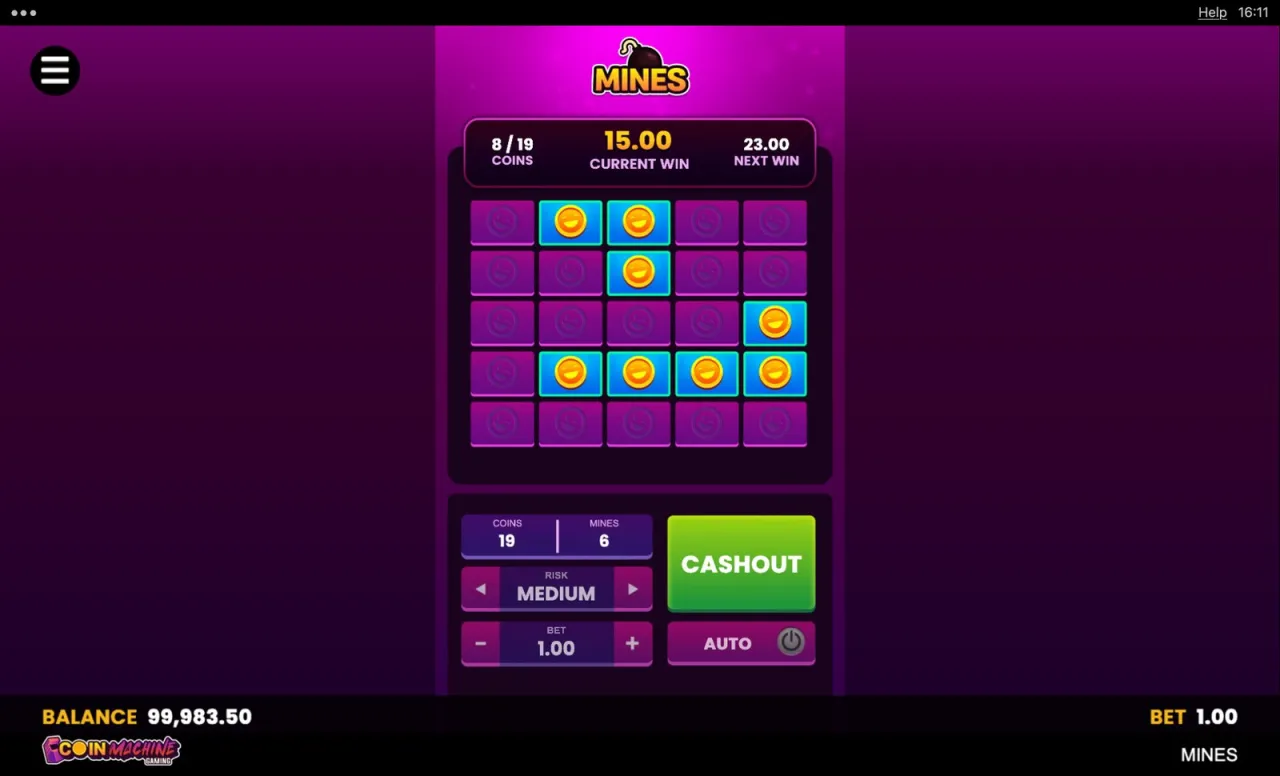
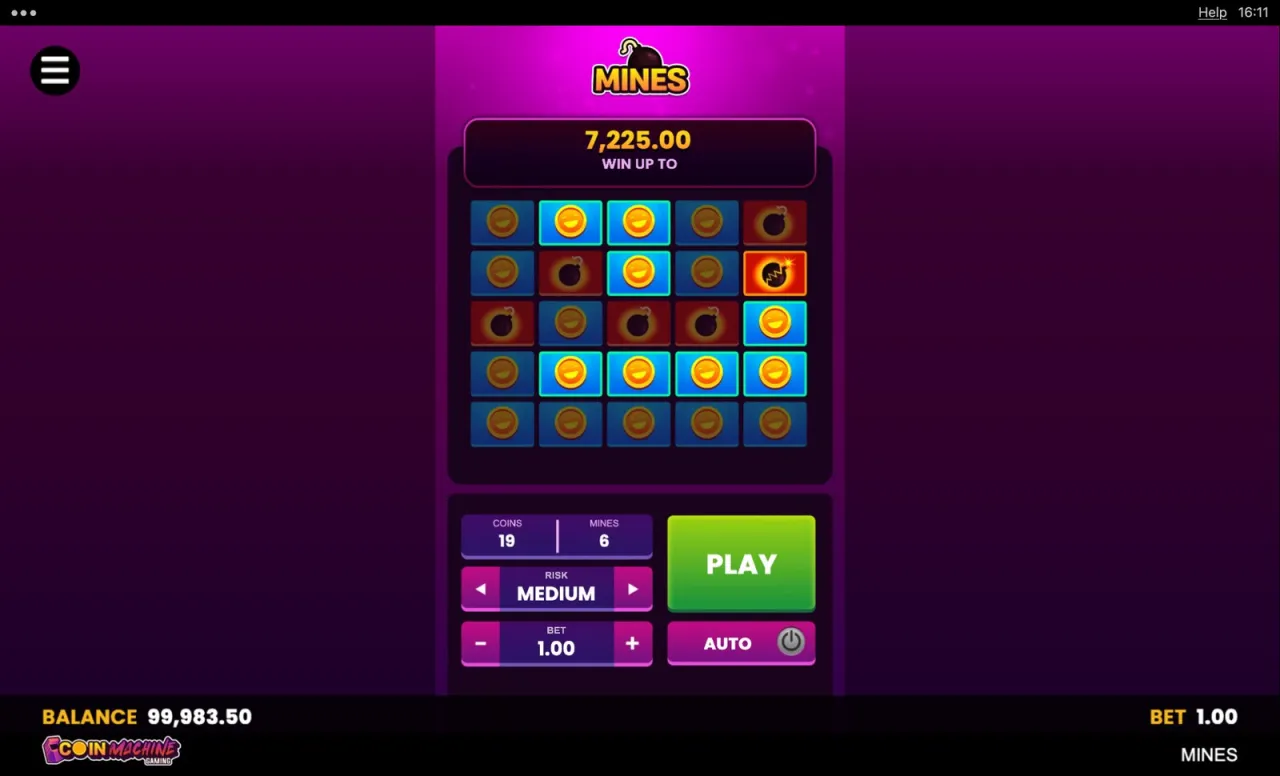
Every pick in Mines is priced before you make it: the board prints what cashing out pays now next to what the following tile would pay. Eight coins into a Medium round those two numbers read 15x and 23x, and the ninth tile was a mine.
Play Mines demo
No reels, only a 5x5 board
In Mines, Coin Machine Gaming takes the reels away completely in favour of a grid and a nerve test, and much like every other slot of its sort, it is founded on one choice repeated until it goes wrong. The round begins when you select a tile, and it carries on for as long as coins keep turning up. Not much is fresh. There is no bonus round, no buy-in and no free spin mechanic attached to the pick round. The interplay between the risk setting and the Cashout button has an intriguing twist, though the overall experience is a very bare one. We played it at 1.00 a round on Medium risk, by hand, for about six minutes. The action unfolds over a 5x5 board of 25 tiles. The panel never says how likely a coin is on any given pick. Current Win and Next Win sit side by side above the grid.
By picking bets of 0.10 to 20.00, players can play Mines across the whole of that band. Our session sat at 1.00 throughout and the stake was never changed. Déjà vu settles in when examining the math model. No volatility statement is made either, for the game or for the individual risk settings. No rating is available from Coin Machine Gaming for us to pass on, and the game's own info panel displays no RTP figure either, for any risk setting. Nor does it give the odds of a coin on a given pick, or say whether the split is redrawn between picks.
Cashing out after a coin and before a mine
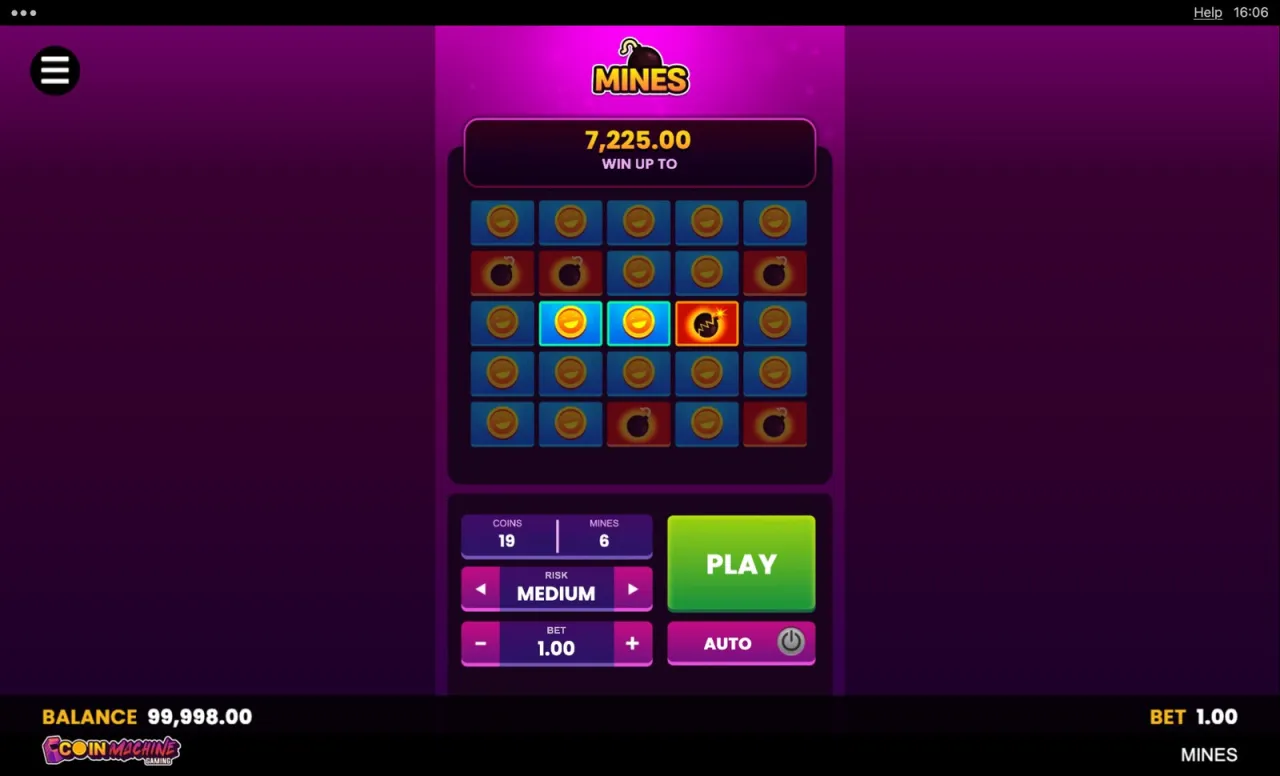
A tile flips over with each pick to reveal a coin or a mine, and a coin lifts the win and lets play carry on. On Medium, the setting we played, 19 of the 25 tiles hide coins. So does the next one, and the next, up to 22 of them when the board is at its most generous. The longest run we managed was eight coins, ended by a mine on the ninth pick. Winning demands cashing out after a coin and before a mine. The current win can be taken at any point in the round, from the first pick onwards. A mine finishes the round and takes the current win with it. That happened on the second pick in the first round of our session and again in the last. So multiple picks from a single round are the entire point of Mines. Most of our rounds ended between one and four coins, cashed at 1.30, 1.80, 2.40 or 3.20.
Since the division of the 25 tiles is the only lever there is, the three risk settings make a lot of sense. The split is fixed before the round and holds for the whole of it. Low grants 22 coins and 3 mines, Medium 19 coins and 6 mines, High 15 coins and 10 mines, and the paytable is in multiples of the stake, one column per risk. The Low and Medium splits are printed in the panel, while the High mine count is only implied by where its column stops. A single pick is worth 1.1x, 1.3x or 1.6x depending on which column you are in. Two picks move that to 1.3x, 1.8x or 2.7x. Five picks pay 2x on Low, 4.6x on Medium and 16.6x on High, and clearing every coin on the board finally caps the column out at 1750x, 7225x, or 12500x on High. Each column ends at the number of coins on the board for that risk, so the Medium ceiling asks for all 19 coins and the High one for all 15.
The risk selector and the pair of counters
Mines arrives with hardly any features. The pick round is the whole game, with no bonus round or buy-in behind it. Nothing is especially fresh, and extras amount to the risk setting, the Current Win and Next Win readout, and autoplay. We used none of it — every pick in the session was made by hand.
Before the round, the risk is fixed, and the choice locks how many of the 25 tiles are mines — 3, 6 or 10 — and which paytable column is in effect for the picks that follow. We left it on Medium for the whole run, so 19 coins and 6 mines every time.
Current Win and Next Win are displayed above the grid. Current Win is what cashing out at that moment would pay. The cost of carrying on is on screen at every pick, and on Medium, eight coins shows 15x with 23x waiting on the ninth. Six coins on that column reads 6.80 with 10.00 next, which is what our best round showed on the way through.
Eight coins, then the ninth tile
Mines is a mild disappointment, though there is nothing amiss with it as such and the grid delivers a solid bit of pick-and-cash gaming. Across six minutes at 1.00 on Medium risk, the balance never once rose above the figure it started on. It closed at 99,980.10 from an opening 100,000.00, a net loss of 19.90, with a low point of 99,977.50. Where it falls short is in the originality stakes: other slots have collection systems and modifiers happening which make them a must-see for fans, and Mines doesn't hold such an unmissable feel to it. Busts on the first or second pick came often enough that the balance never built a cushion. The likely standout here is the eight-coin round. It came at 16:11, with the balance standing at 99,983.50. It hit 15x with 23x showing on the next tile, and then struck a mine on the ninth pick. The balance read 99,983.50 on the frame before that pick and 99,983.50 on the frame after it.
The Minty Summary: Fifteen times the stake sat on the board with 23x printed beside it, and the ninth tile took all of it. That decision is what Mines sells, and there is nothing behind it — no bonus round, no buy-in, just the coin count and the two numbers above the grid.
A clip show with a Cashout button
What does not help rescue the game is the production values, and Mines is a grid of squares and a pair of numbers. The risk selector carries a Coins / Mines readout beside it. It makes no effort to be anything else. Selecting a tile is the only input a round takes. A minefield is a completely bare-bones world, and Coin Machine Gaming has recaptured the mood well.
Mines is like a TV clip show in some ways. It presents highlights from a bunch of earlier episodes, and that's not inevitably a poor thing. Clip shows can be quite amusing, and you get to see how the format has developed, adding richness to the present story. Yet they more often than not feel like padding. Partly owing to the three risk columns, Mines dodges this to a degree. Low stretches to 22 picks, Medium to 19 and High to 15. That plus the Next Win readout make Mines a decent enough game. Ours read 23.00 at the point where the eight-coin round ended. But it'd be nice to see something a bit bolder next time.