
Lightning Box Keno Slot – Free Demo
Provider:
Lightning Box Games
The keno part is over in a single draw: three to ten numbers picked, twenty pulled, hits paid off the table. What decides a session is how many of the drawn balls carry a lightning bolt, because six of them open the Lightning Respin and its four fixed jackpots.
Play Lightning Box Keno demo
Eighty squares, three to ten picks
Lightning Box Keno is an 80-number keno game where you pick 3 to 10 numbers and 20 are drawn at random. I played 370 rounds of it at a stake of 1.50, wagering 555.00 and winning back 924.75, with the balance moving from 1,000.00 to 1,369.75. It contains one feature - the Lightning Respin.
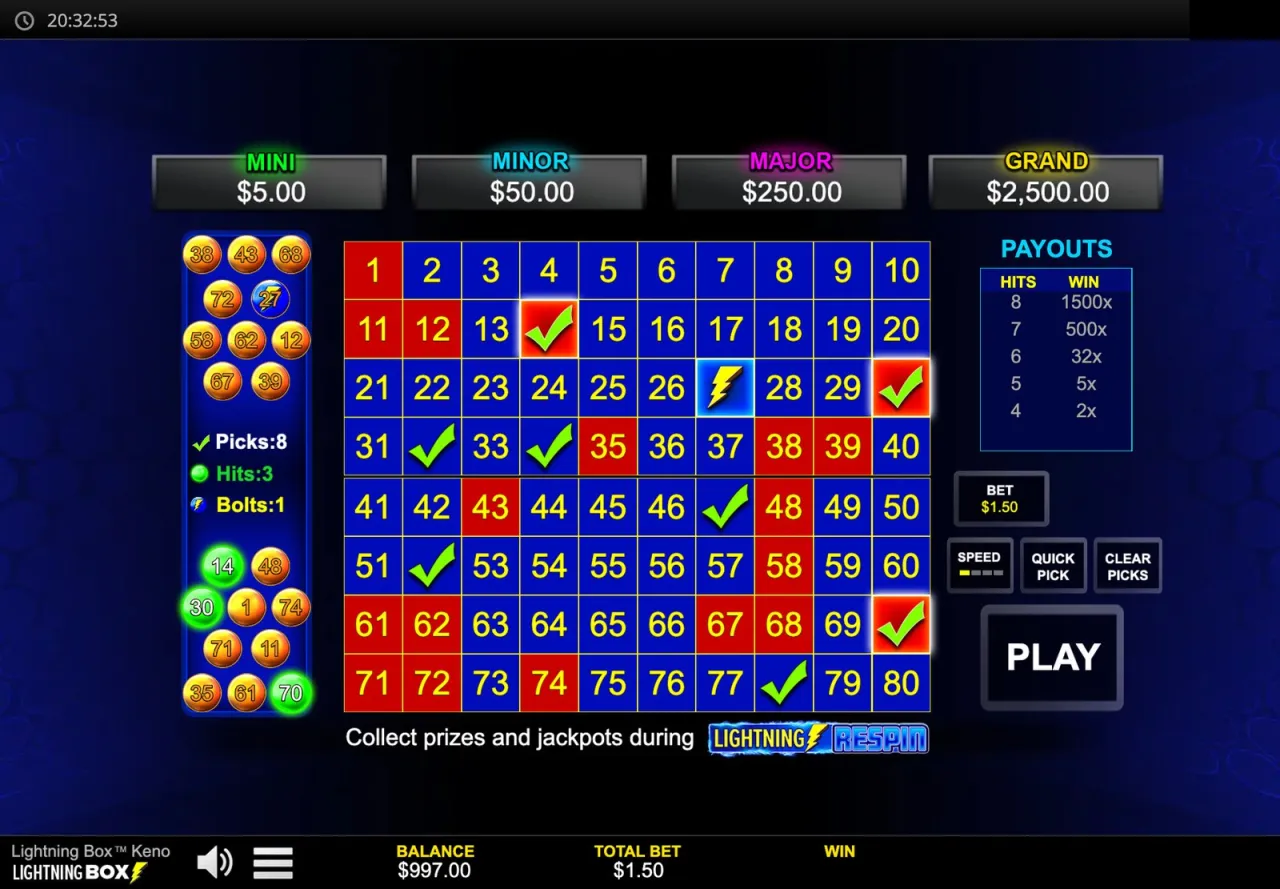
The prizes are paid on hits, meaning drawn numbers that fit a pick. The board keeps three counters, Picks, Hits and Bolt, the last of which tracks Lightning Balls drawn; one frame captured early in my session shows 8 picks, 3 hits and 1 bolt with the draw still running. They are multiplied by the total bet. At my 1.50 stake, six hits on a Pick 6 would therefore have been worth 750.00 credits. The highest keno prizes are 20x on Pick 3, 24x on Pick 4, 200x on Pick 5 and 500x on Pick 6, with the largest printed multiple being 1500x on Pick 8 for all eight hits, and there are also Lightning Ball and Lightning Bolt symbols. The Payouts column, with eight numbers picked, fills in the middle of that range at 32x for six hits and 500x for seven.
What the bolts collect
Drawing 6 to 12 Lightning Balls triggers the Lightning Respin, and the player is granted 3 respins. In 370 rounds I triggered it three times, the first on round 197, which paid 427.50 credits, or 285 times the stake. On each respin 5, 4, 3, 2 or 1 reels are active, and bolts count only if they land in an active reel. The Lightning Balls that triggered the round become prizes themselves and are collected before the first respin.
The respin count is restored back to 3 if the player manages to collect one or more Lightning Bolts, and the round therefore continues as long as bolts keep dropping. That happened once in my session, on round 255, where the round retriggered and paid 81.00 credits.
Inside the respin there are also Colossal Symbols. These are 2x2 and 3x3 Jackpot or Lightning Bolt symbols that break into several separate jackpots or prizes. A jackpot bolt counts whether it lands on the trigger itself or inside an active reel during the respin. The jackpots are Mini, Minor, Major and Grand. The four meters across the top of the board read Mini 5.00, Minor 50.00, Major 250.00 and Grand 2,500.00 at my 1.50 total bet. They are fixed rather than progressive, and they are not multiplied by the bet multiplier. A higher bet multiplier instead either improves the chance of a jackpot or raises the jackpot prizes themselves. Each can be won more than once per round. My second trigger, on round 224, paid 142.50, or 95 times the stake. The prizes and jackpots pay out when the respins expire, with prize values at min bet ranging from 25 to 4000 credits. Lightning Box Games hangs the same name on two of its 5-reel, 40-line titles, Lightning Leopard from 2019 and Lightning Gorilla from 2022, though what those two do with the storm is their own business.
The Minty Take: Three Lightning Respins in 370 rounds paid 651.00 credits between them, against 273.75 from every other round put together.
Three triggers in 370 rounds
Lightning Box Keno is a bit puzzling at first. Across my 370 rounds the session returned 166.6% of what I wagered. It takes some time to grasp what's going on with the feature. Of the 116 rounds that paid anything, 71 returned less than the 1.50 stake, and the longest run without a win at all was 17 rounds, ending on round 110. Instead players are reliant on the Lightning Respin in hope to obtain some prizes and jackpots. The first of the three arrived at my low point of 850.15, and the last carried the balance to its peak of 1,444.90 on round 255. Over 370 rounds it produced 651.00 credits of the 924.75 I won, or seven tenths of the return. That seems to be the only chance of having a respectable win.