

Lucky Leprechaun Clusters Slot – Free Demo
Provider:
Microgaming
Two bonus rounds landed inside four spins, and then Lucky Leprechaun Clusters went quiet for the next 259, until spin 287 came back with 1,222 times the stake. Getting there means collecting 125 winning symbols inside a single spin, which the Feature Meter counts up one cluster at a time.
Play Lucky Leprechaun Clusters demo
Five adjacent symbols on a 7×7 field
Lucky Leprechaun Clusters emerged out of Microgaming in February 2022, and the base game might not have been the most thrilling around. Every winning symbol on a spin is collected and counted, and that running count is what drives the meter. But it carried a feature meter that could go berserk. It filled to the top three times over my 410 spins at 2.50.
The theme is the one the game promises, and Lucky Leprechaun Clusters remains out on the green side of the rainbow, laden with shamrocks, pots o' gold and emeralds. The engine behind it is called Cluster Chase. The game zone housing it, for example, is a 7×7 grid with no paylines at all. Only the highest winning combination is awarded per cluster win. Identical symbols that land horizontally or vertically adjacent form a cluster, and 5 or more of them make a winner. Clusters can form anywhere on the grid.
Clovers, and the three wilds behind them
Players start from bets of 0.10 per spin, and the RTP is declared at 96.31%. I played 410 spins at a stake of 2.50, wagering 1,025.00 across the session. There is no bonus buy feature to lift it. Volatility is exceptionally high, as anticipated, graded 5 out of 5, and can lead to a whole lot of not much in the base game. Total wins came to 4,706.50. It is punctuated by abrupt eruptions of a bonus game where anything can occur. My lowest point of the session was a balance of 99,944.50.
The symbols divide the customary way, and there are low pays and high pays. The high group is the leprechaun, the fiddle, the stout and the pipe, with A, K, Q and J underneath them. A random low symbol is tagged with clovers on every spin, the tags enduring for that spin and its feature occurrences. The clover, the pot and the coin are the wilds. They stand in for other symbols, though they only appear during Lucky Coin, Pots o' Gold, Clovers and Rainbow Road, and a wild resting in more than one cluster counts as a separate symbol for each combination. A spin that triggers none of those features therefore runs on the plain symbol set alone.
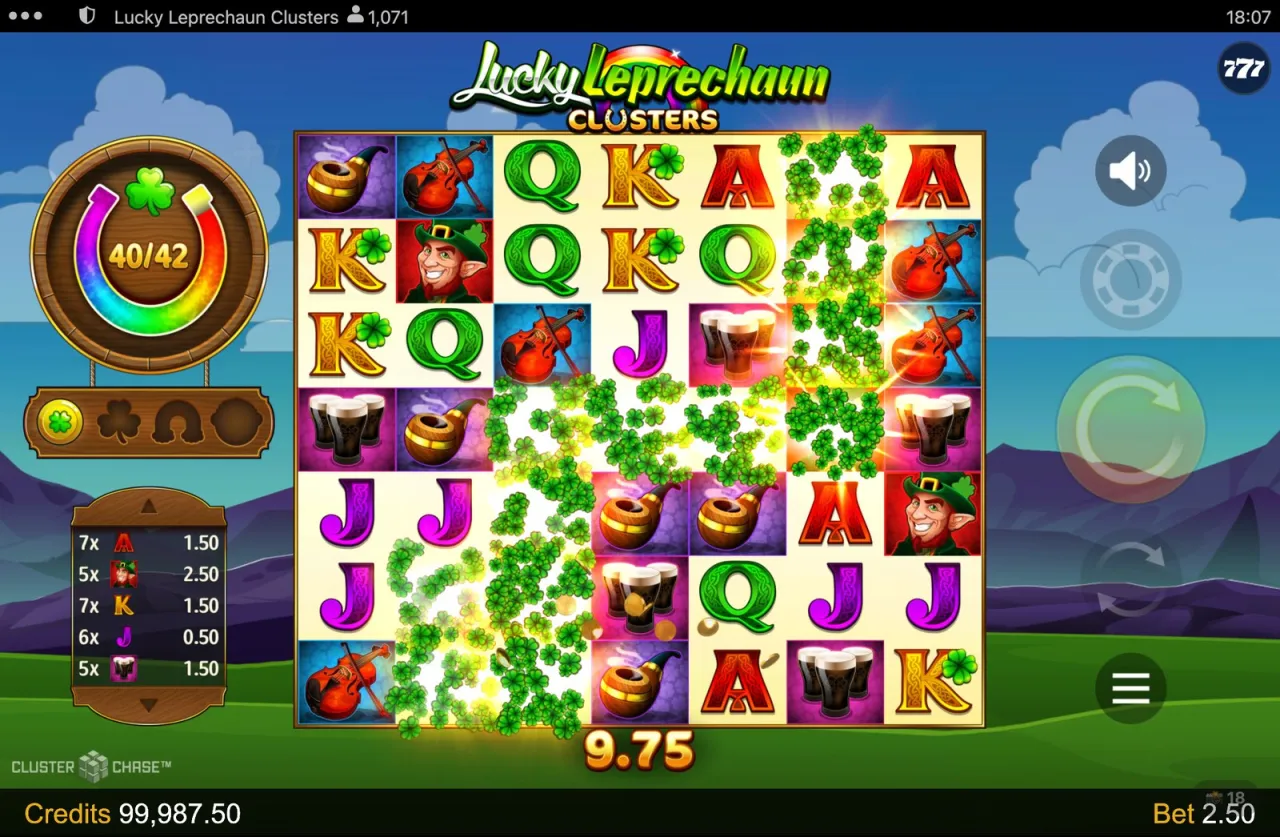
The meter counts every winning symbol
When it comes to features, the heart is the cluster grid, like the remainder of Lucky Leprechaun Clusters. It's just been heavily boosted, and players do get something in the base game that kills two birds with one stone. My largest win away from a bonus round was 340.00 on spin 83, or 136 times the stake. One, it lends a bit of a buzz to what would otherwise be a fairly dull experience; two, it draws the sting out of spins that don't get anywhere near the top of the meter.
It's named Rolling Reels. Each drop can produce another cluster, so the symbol count builds inside one spin. It triggers whenever a cluster pays, winning clusters are cleared and fresh symbols drop into place, so a single spin can grant several successive wins. Every winning symbol along the way is collected and counted, advancing the Feature Meter by one, and there is also Lucky Charms. It can trigger on any non-winning spin: one low symbol is chosen and every instance of it on the grid is copied into a random adjacent position.
Shamrock Shake, Lucky Coin, Pots o' Gold, Rainbow Road
The meter itself is the major one, and it holds five levels, at 21, 42, 63, 84 and 125 winning symbols. The four lower levels hand out Shamrock Shake, Lucky Coin, Pots o' Gold and Rainbow Road. Each level attained grants a feature once all the wins on the spin are finished. Each of those features is applied once per spin. The meter resets at the beginning of a new spin. A spin that stalls at 20 winning symbols therefore leaves nothing behind for the next one. Features fire sequentially, the arrangement of the first four shifts every time, and an assortment of features can land - all reshape the grid in some way. Some have extra powers, like so:
- Shamrock Shake – 4 symbol types are randomly chosen and cleared. Fresh symbols drop into place, and a 2x or 3x multiplier may be randomly granted.
- Lucky Coin – 10 to 15 random symbol positions are chosen and swapped with high or low symbols, or the wild coin.
- Pots o' Gold – 2 to 6 wilds are randomly positioned. Symbols to the left, right and above each new wild are cleared.
- Rainbow Road – a road appears across a random row and column, and symbols along it are cleared. A wild pot is positioned at the junction, and up to 4 extra wilds can surface on the road.
Don't fret, there won't be a test on this list of features later, and suffice to say that each one rearranges the grid. Fresh symbols fall in after every removal, which can set off another round of wins. One also has a modifier that multiplies the amount. That one is Shamrock Shake, and the rules only say the 2x or 3x may be awarded. When it is cleared, a winning clover cluster leaves a single gold wild clover behind, in a fresh twist.
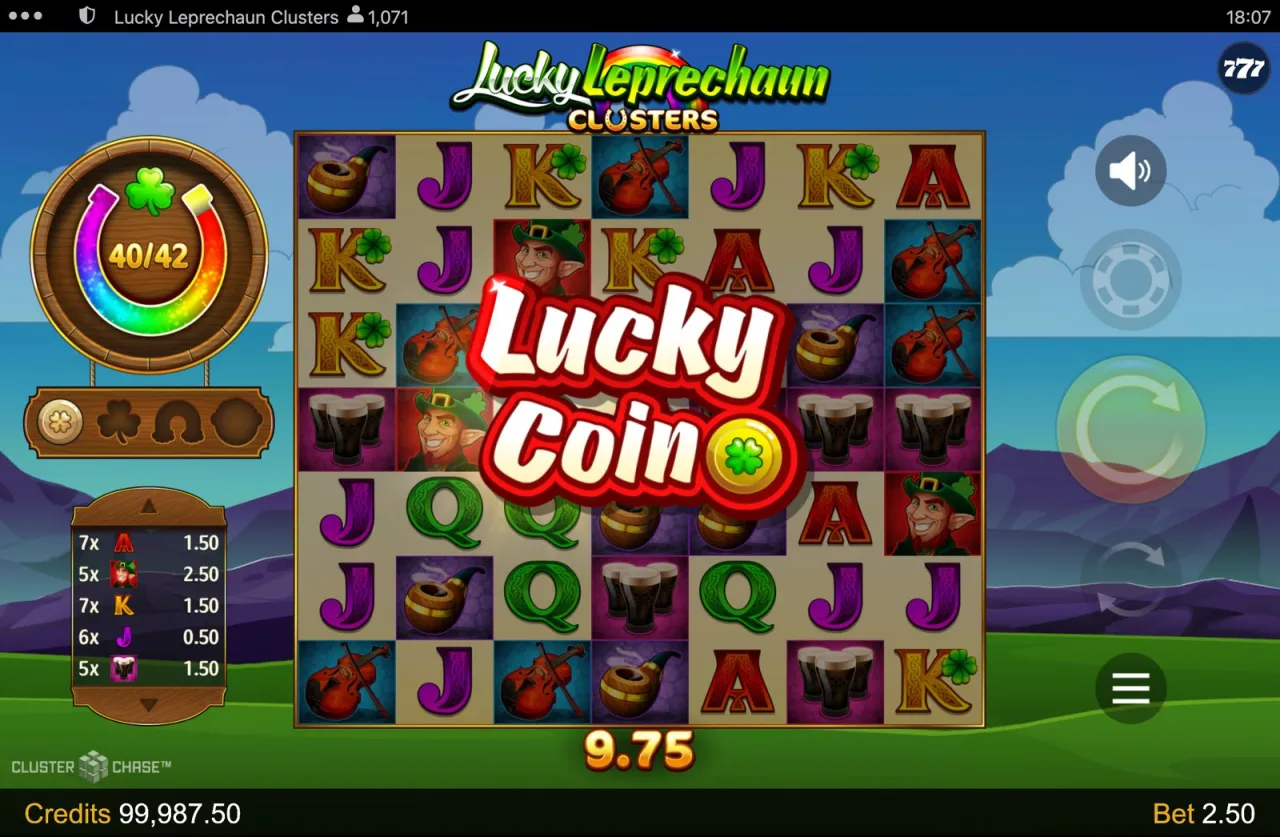
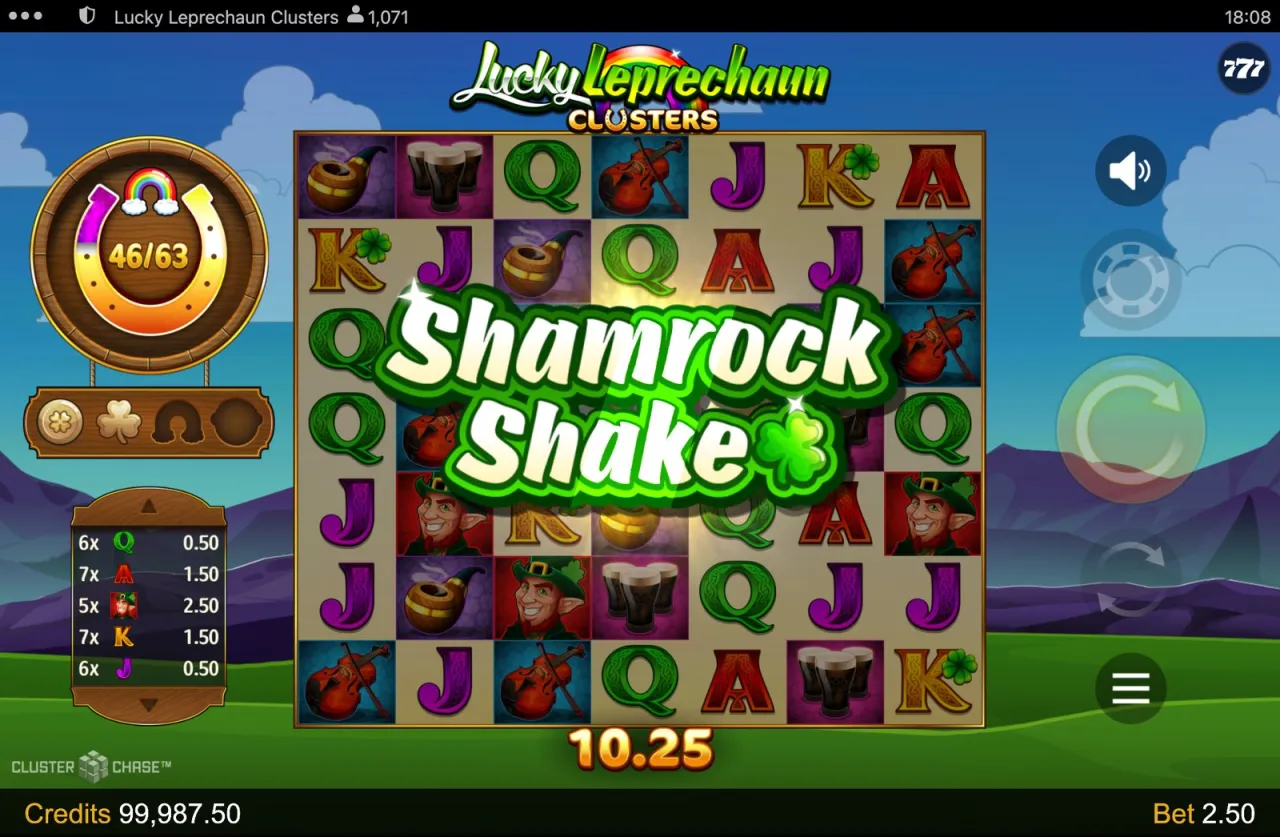
Level 5 is where the trail starts
Level 5 is the Trail o' Fortune Bonus. It is attained by collecting 125 or more winning symbols on a single spin. Wins from the cascades and from the four lower features all feed that count. Spin the wheel to travel along the trail, cross rainbow bridges to leap ahead, uncover emeralds for an extra spin, and the multiplier granted is multiplied by the total bet, up to a cap of 1500x. At my 2.50 stake, that cap works out at 3,750.00.
Minty’s Closing Thought: Three fills of the meter carried 3,680.00 of the 4,706.50 I won, and the other 407 spins split what was left. Microgaming shipped 9 Pots of Gold HyperSpins on the same day in February 2022, with the same pots and rainbows on five reels and twenty lines, and money that arrives in smaller pieces.
259 spins between the second bonus and the third
Cluster games are often the milder end of the shelf. Mine finished at 103,681.50 from a starting balance of 100,000.00. This one is next level, Rolling Reels does offset the effect to an extent, but patience may be needed. Twenty-seven of my paying spins came back under the 2.50 stake. Due to the meter, the base game is more engaging than the bare grid implies. The first level needs 21 winning symbols out of a single spin. And of course, you want a large cascading spin in this situation to ascend as far up the levels as possible. My peak balance arrived on spin 321, at 103,860.50.
It's still all about the elusive bonus game, despite Rolling Reels, and this is where a buy feature would be alluring indeed. Except there isn't one. Triggering the thing naturally is entirely down to the grid, and as an illustration, over my 410 spins, the first one came on spin 25 and the second three spins later. Those two paid 135 and 115 times the stake. Then the game went 259 spins without another. The drought broke on spin 287, with the balance at 100,689.25 going in. The notion of having to sit through a long drawn-out grind was more than a little intimidating after that swift and furious pair of bonus rounds. The middle of the session was base game and nothing else. The dry spells bit elsewhere too, with a streak of 22 spins without a win finishing on spin 141, and only 69 of the 410 spins paying anything at all. The best of the ordinary spins was 187.50 on spin 321, 75 times the stake.
What 410 spins gave back
The carrot end of the bargain are the prizes, and wins of up to 4,600 times your stake are possible on a single spin. The bonus round is capped a long way below that, so the rest of the distance has to be covered on the grid itself. The bonus rounds are where it occurs: they paid 3,680.00 between them, 78% of everything won. The largest of the three was worth 3,055.00 on its own, the other two adding 625.00 together. The one on spin 287 alone returned 1,222 times the stake and hauled the session to a 459.2% return. The balance stood at 103,741.75 once it was over.
All up, it has plenty of features and the potential has been wound right up. The session ended 3,681.50 in front. It's still a cluster game at heart despite the trappings, so devotees of the format will easily settle in, and saying it's a brutal beast is the only caveat.