Reactoonz Slot – Free Demo
Provider:
Play'n GO
Reactoonz is Play'n GO's 7×7 cluster slot from October 2017: aliens drop in, five or more matching symbols touching horizontally or vertically form a cluster, every cascade feeds a Quantum Leap meter, and at five charges the meter releases Gargantoon, a 3×3 wild that splits twice on its way through…
Play Reactoonz demo
Reactoonz at a glance: a 7×7 alien grid with a 4,570× cap
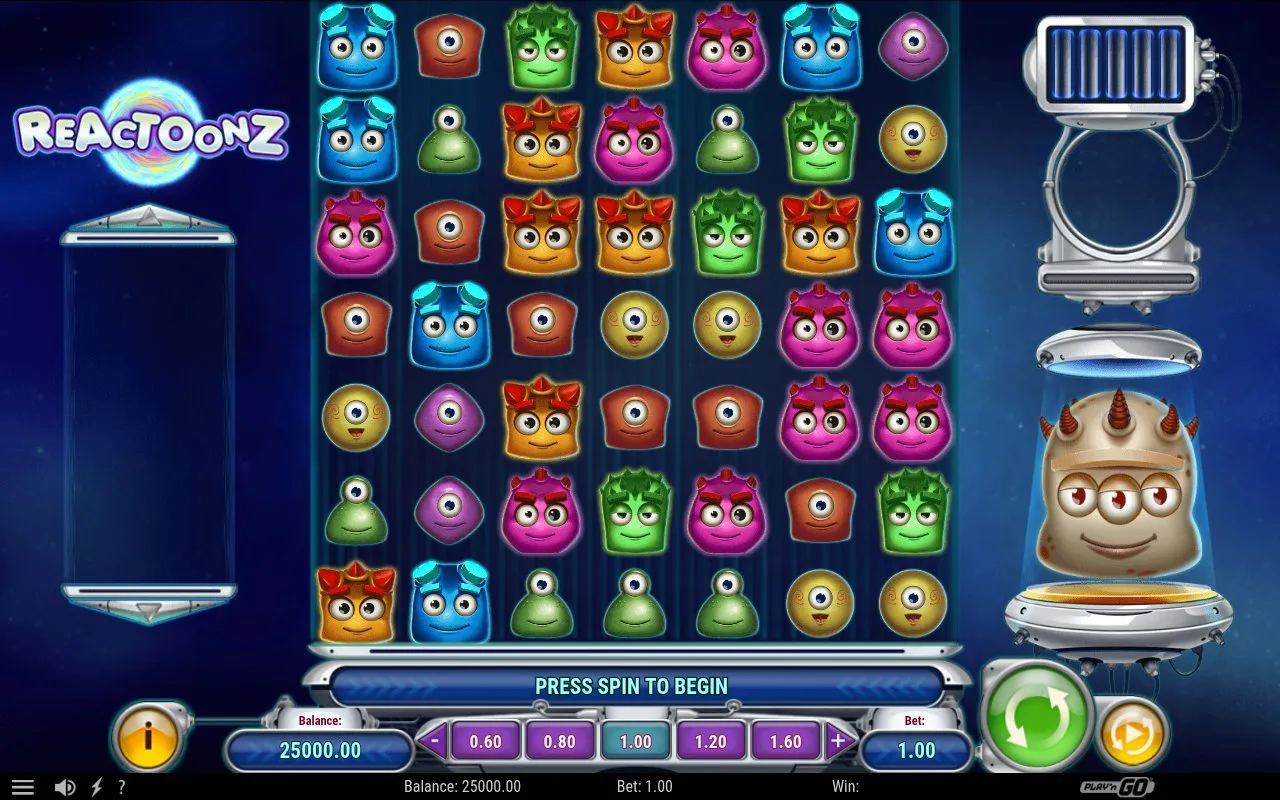
Reactoonz launched on October 24, 2017 and remains one of Play'n GO's most-deployed cluster slots. The board is 7×7, scoring runs on Cluster Pays (at least five matching aliens touching horizontally or vertically), cascades clear winning clusters and let fresh symbols drop in from above, and every removed symbol charges a Quantum Leap meter. Bet range is CAD 0.20 to 100.00, max win is 4,570× stake, and Play'n GO classifies variance as high.
The base game on its own is thin. The interest lives in four queued features the meter releases as it charges, two background mechanics that run on every spin (Fluctuation and Giantoonz), and a Gargantoon endgame at five charges. Before any of that mattered, the first thing I wanted to confirm was the active RTP, because Play'n GO ships Reactoonz in several certified builds and what an operator runs is not always the marketing headline.
The Minty Take: A high-variance grid slot with a tidy four-feature stack and a real top-end at 4,570× stake. One caveat sits on top: RTP varies by operator build, and the 96.51% headline isn't necessarily the math you're playing. Open the in-game info sheet on the real-money page and confirm the active value before you commit any bankroll.
The RTP question: which Reactoonz build is your operator running?
Play'n GO certifies Reactoonz at several theoretical RTP values. The marketing standard is 96.51%, with lower published variants in the 94 to 95% range and a low-end build close to 91%. The choice is made at integration time by the operator, not by the player. Slot-catalogue entries even flag "RTP range" as a configurable feature on this title, which is shorthand for exactly this practice.
For Ontario-regulated play through AGCO-registered operators, the active RTP has to appear in the game's information sheet. AGCO's Registrar's Standards for Internet Gaming make that disclosure mandatory, and iGaming Ontario's quarterly reports cover aggregate market handle and revenue (per-title RTP isn't reported there, and doesn't need to be when you can read it inside the game). On an AGCO-licensed site, confirming the headline takes under a minute. Offshore, the same disclosure depends entirely on operator policy, with no regulatory floor under it.
The demo client itself doesn't surface the active RTP to a player at the screen, which is one of the few times the demo is less useful than the real-money page for due diligence. Read the info sheet on the live game before you spin.
Cluster Pays on a 7×7: how the grid scores
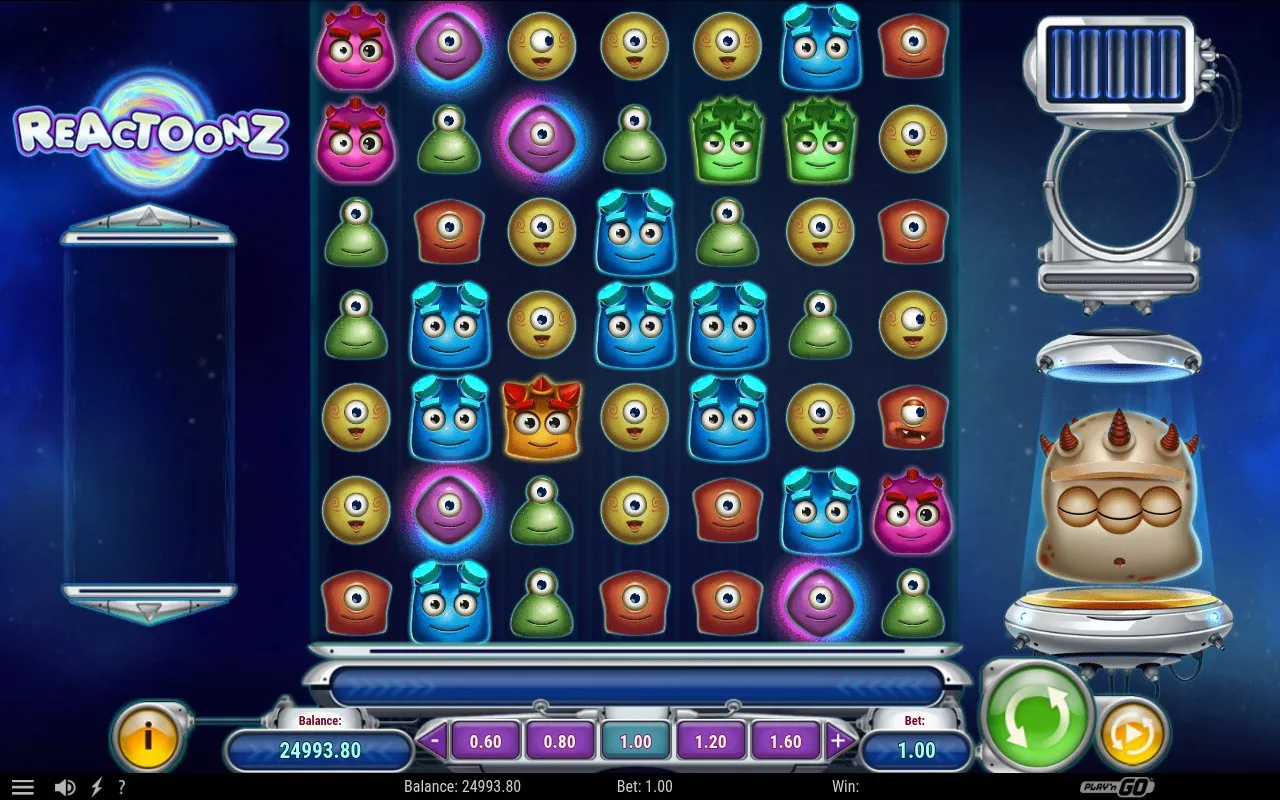
Five matching aliens touching horizontally or vertically form a cluster and pay. Diagonals do not count. That single rule changes the topology of the grid a lot compared with a payline slot: isolated pockets of one symbol type sit there harmlessly, while a long snaking chain of seven or eight matching aliens across the board can settle a sizeable payout on a single landing.
Cascades follow every win. The cluster's positions clear, new symbols drop into the gaps, and each cleared symbol charges the Quantum Leap meter. The meter is the slot's real economy: 25 symbols cleared inside one paid spin's cascade chain fills one segment, up to a maximum of five.
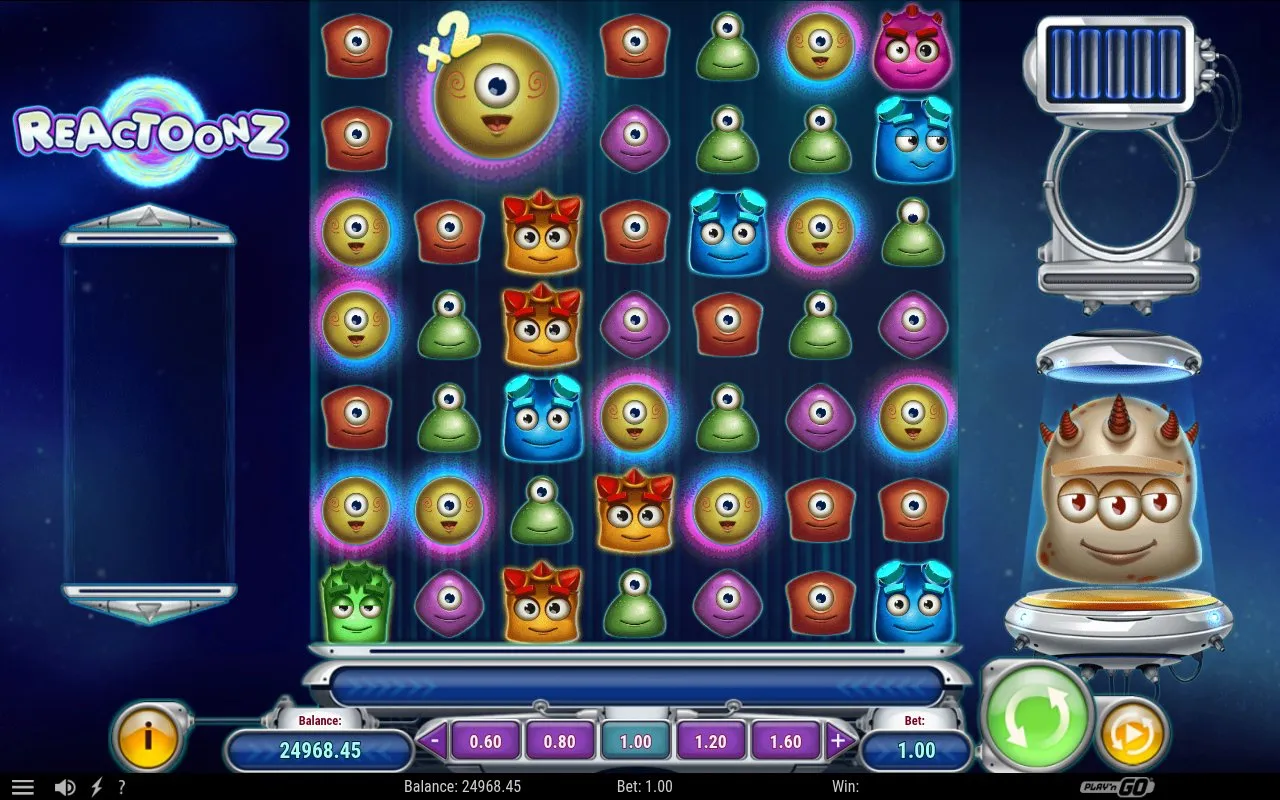
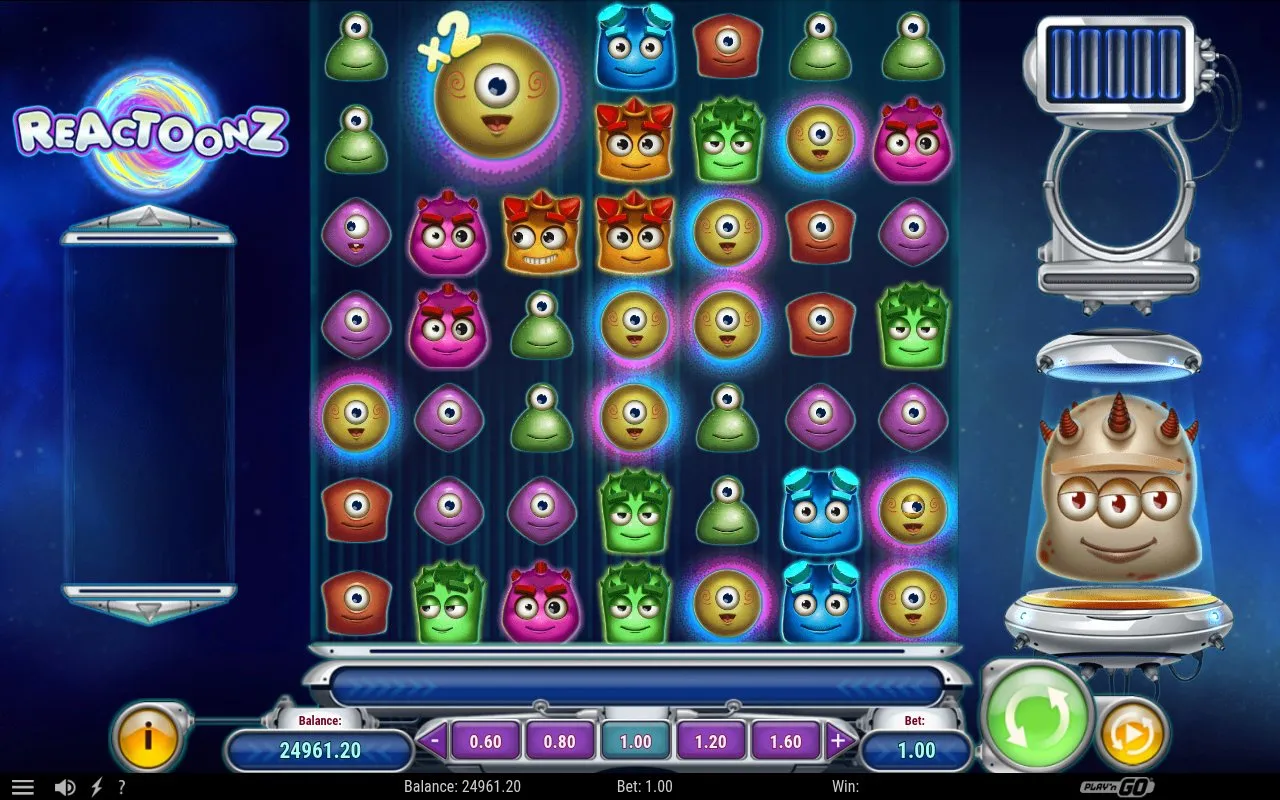
Two background mechanics run on every spin and matter more than they look. Fluctuation picks one of the lowest-paying one-eyed aliens; if that symbol is part of a winning cluster on the spin, the destroyed positions leave wilds behind. Giantoonz fuses any 2×2 square of identical symbols into a single large symbol that doubles any cluster it joins. Instability is the third and rarest: on a losing spin, Gargantoon may scatter four to eight wilds across the board. Of those three, only Fluctuation produced clearly visible cluster-wilds in my session.
The Quantum Leap meter and the four queued features
Each meter segment fills at 25 destroyed symbols inside one paid spin's cascade sequence. Each filled segment queues a feature: segments one through four queue one of the four Quantum features at random, and segment five queues Gargantoon. Queued features fire in order after the paid spin's natural cascades have stopped.
The four Quantum features
Alteration converts every instance of one chosen low-paying symbol into a higher-paying alien, which usually opens fresh cluster opportunities on the next cascade. Implosion drops three to six wilds onto the grid and destroys everything adjacent to them. Demolition removes every one-eyed (low-value) symbol from the grid in a single pass. Incision places a single wild at the centre of the grid and extends diagonal lines of one chosen symbol outward from it.
Because features fire on a tidied-up grid after the paid spin's cascades resolve, each one frequently starts a fresh cascade chain of its own, which can charge more meter segments for the next paid spin's start state. One heavy charge round can keep paying across two or three paid spins as the leftover features clear the deck.
Gargantoon and the path to 4,570×
At five charges, Gargantoon arrives as a 3×3 wild block, covering nine grid positions at once. Once any cluster wins resolve with that block in place, the 3×3 splits into two 2×2 wilds that drop into new positions. After those resolve, each 2×2 splits a second time into nine 1×1 wilds scattered across the grid. The full sequence is one feature with three distinct wild phases, each capable of seeding fresh clusters and fresh cascades.
The 4,570× cap is reachable, but the route requires Gargantoon plus aligned premium symbols plus active Giantoonz fusion inside the same paid-spin sequence. Maximum-win events on this slot are infrequent by design. The kind of long-tailed distribution that produces a 4,570× hit pays a handful of times across a very long sample. Treating it as a session target is the wrong framing for a slot this volatile.
What 203 spins looked like at the screen
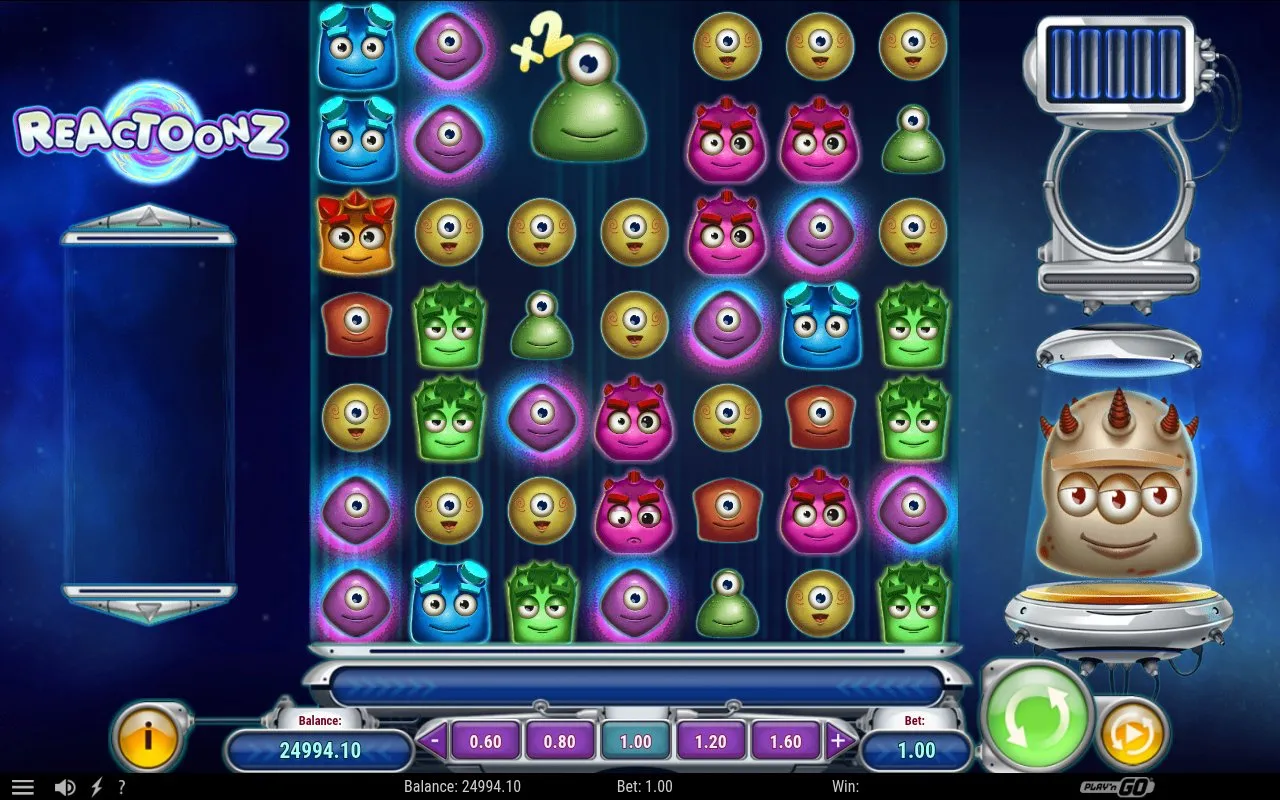
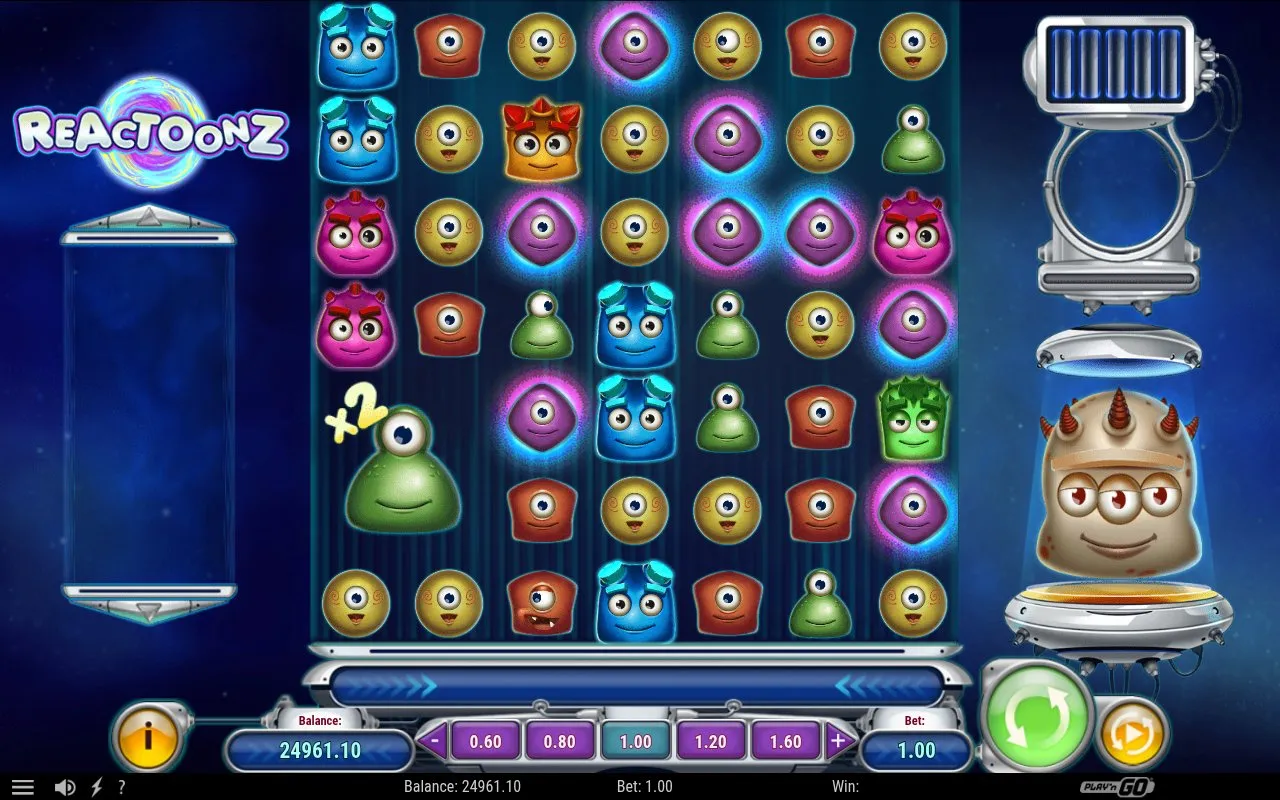
At $1.00 a spin across 203 spins on the demo, the net was -$43.85, the biggest single-spin win was $27.00 (27× stake), and two Quantum-feature pauses landed across the session. Peak drawdown from the $25,000 starting balance was $46 before a partial recovery.
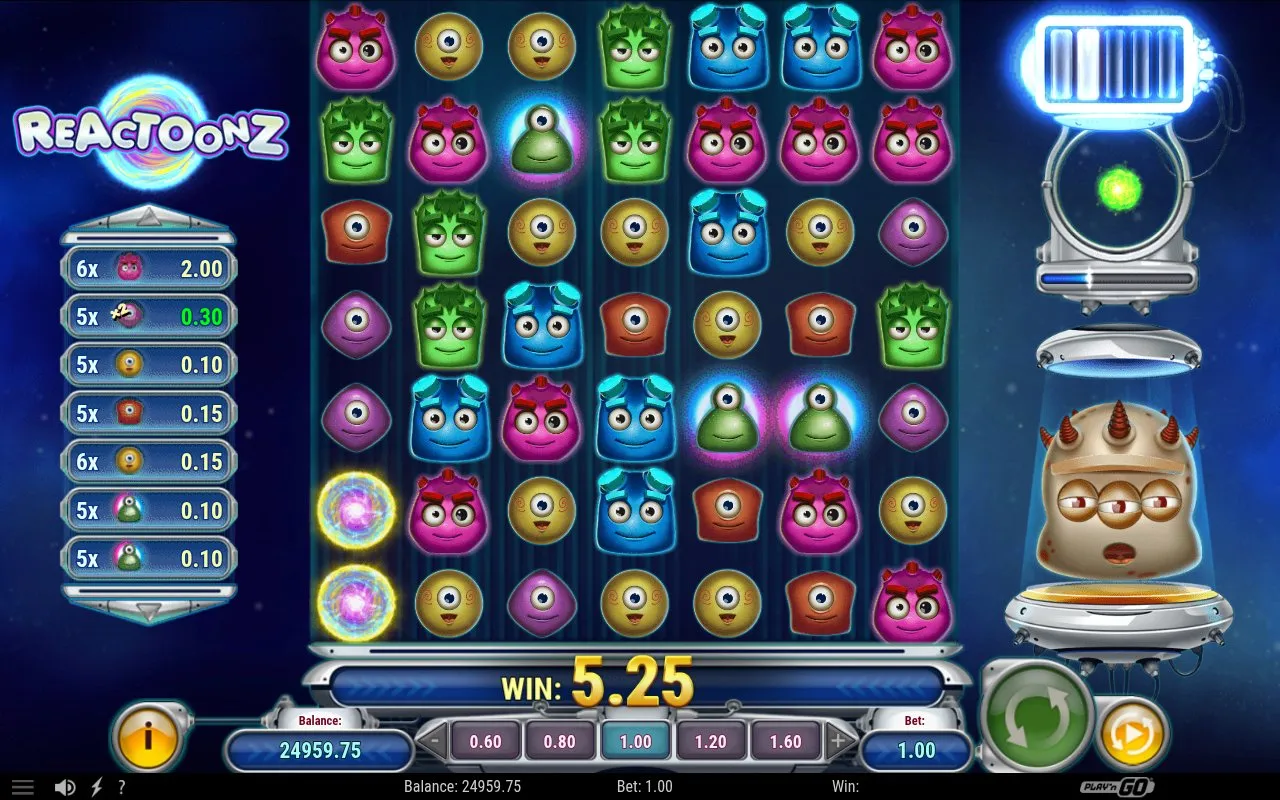
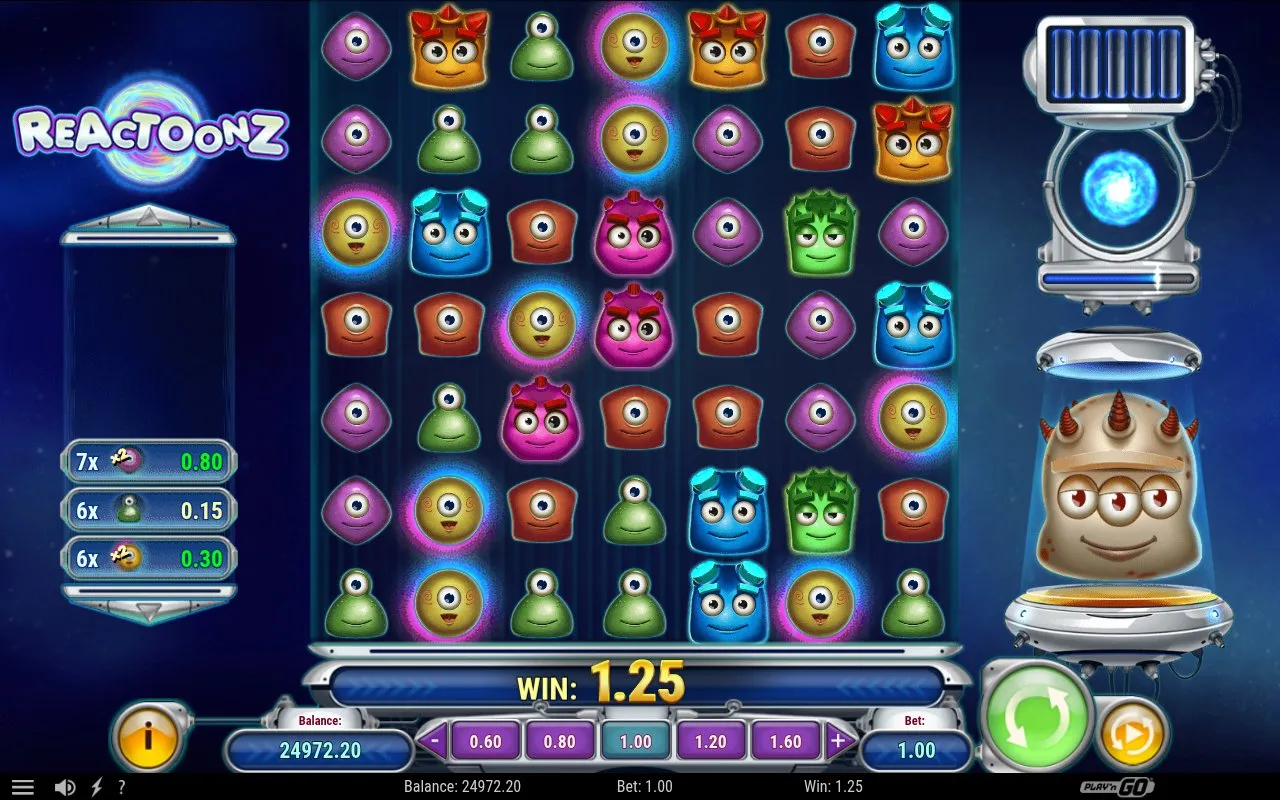
The shape of those numbers matters more than the bottom line on a sample this small. Cluster wins of one to a few times stake landed in clumps across the first 20 spins, including a $5.55 cluster on spin 18, with the rest of the early run mostly settling between 0.30 and 1.50. After that, about 18 consecutive losing spins, then a $1.25 cluster on spin 59 broke the dry stretch. The middle of the session ran similarly: short pockets of small wins, longer stretches of pure stake bleed. Both feature triggers landed inside higher-charge cascade chains, with no regular cadence between them.
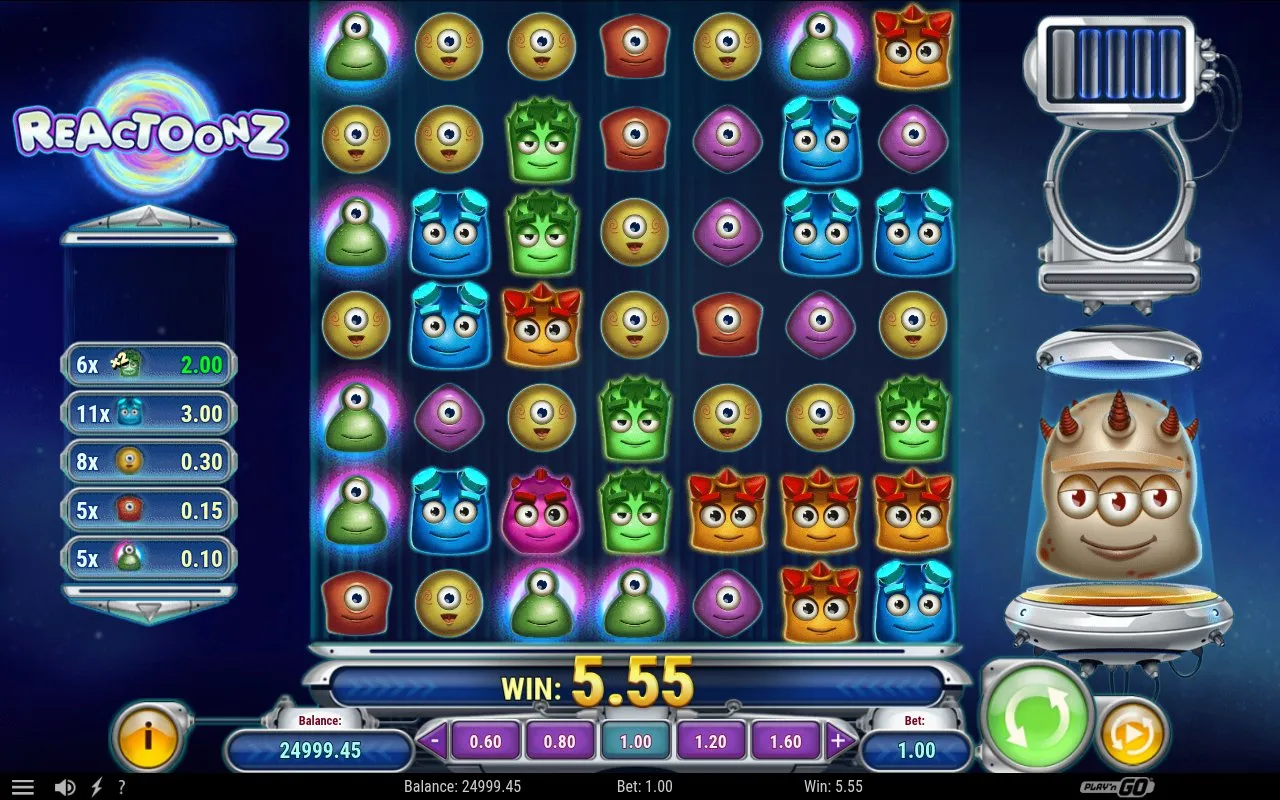
Twenty-seven times stake sits well below the 4,570× headline, which is what a sample this size is expected to look like. The cap is a long-run ceiling, and the distribution that yields one pays a handful of times across a very long sample. A single session of this length doesn't target it.
Ontario-regulated vs offshore: the RTP-disclosure gap
The Ontario-regulated version of Reactoonz at an AGCO-registered operator must disclose its active RTP inside the in-game information sheet. Lab certification on Play'n GO games comes from one of the major test houses (Gaming Laboratories International or eCOGRA, depending on the certification path). Public iGO quarterly reports cover aggregate market handle and revenue but not per-title RTP, which is the right division of labour: per-title detail belongs inside the game itself.
On offshore sites, RTP disclosure depends on operator policy. Reactoonz is a known multi-RTP title, so the spread between a marketing 96.51% and an actual 94.51% or 91.51% build is a real thing to watch for. A five-point RTP gap on a high-variance grid slot shifts the expected long-run return meaningfully, even if one session won't reveal it.
For Canadian players the procedure is short: open the in-game info sheet before any real-money spin, and check that the active RTP matches what the operator's slot library page claims. The two values should agree. If they don't, that is a problem to flag with the operator.
Demo, mobile, and the paytable that wouldn't open
The demo client runs cleanly in a desktop browser and on mobile in portrait orientation. Features behave identically on both, which lines up with Play'n GO's HTML5 build. The seven symbols I could catalogue from the active grid were the alien set (Zymo, Gatorian, Chimpy, and the spike-headed one-eyed alien) plus the Gold Coin, Red Cube, and Green Sparkle mid- and lower-value tiles.
Two flags worth knowing. The in-game paytable did not open from the standard rules button during my session, which made symbol-by-symbol pay validation impossible from inside the game. Reactoonz has a documented paytable and the math behaves normally; this is a UI quirk, but it is worth knowing if you want to read the pays before you spin. The second flag: on operator sites running a sub-96.51% Reactoonz build, the in-game info sheet is the only place the active RTP shows. Read it.
Demo play is the right starting point for anyone unfamiliar with cluster grids. A couple of short demo sessions teach the rhythm of cascades, meter charge, and feature trigger without putting real money against high variance. For a wider sample of Play'n GO's catalogue, the studio's library page lists the rest of the inventory.
Reactoonz FAQ
- Q: Why does the Reactoonz RTP listed at different casinos sometimes vary?
A: Play'n GO publishes Reactoonz in several certified configurations, with a top build at 96.51% and lower variants below that. Each operator chooses one at integration time. AGCO-registered Ontario operators must disclose the active RTP in the in-game rules sheet, so a quick read of that sheet before play tells you which version of the math you are playing against. - Q: How does the Gargantoon feature trigger in Reactoonz?
A: Gargantoon unlocks when all five segments of the Quantum Leap meter fill inside one paid spin's cascade chain. Each segment fills at 25 destroyed symbols, so charging the full meter requires an extended sequence of cluster wins and cascades on the same paid spin. There is no bonus-buy option and no traditional free-spins round. - Q: Is Reactoonz playable at low stakes, or really only for high rollers?
A: The minimum bet is CAD 0.20, which makes the slot accessible at low stakes. Variance is high, so a longer bankroll cushions the dry stretches typical of cluster grids of this profile; across 203 demo spins at $1.00 each, my run saw a $46 peak drawdown with two feature triggers in total, which is the kind of session shape worth budgeting for.