
Age of the Gods: Keno Slot – Free Demo
Provider:
Playtech
Seven hits on a ten-number ticket pay 42 times the total bet, and the row above it pays 500. Almost everything Age of the Gods: Keno holds is stacked past that step, out beyond where 350 rounds of drawing balls ever got.
Play Age of the Gods: Keno demo
A board of 80 and a ticket of 10
This is not a slot at all but a keno game, with a board of 80 numbers and no reels and no paylines. Picking is done by hand on the table, or with Quick Pick, which marks 10 numbers at random. That means you mark between 2 and 10 numbers of your own picking and then 20 balls are drawn per round, with no repetitions, every match counting as a hit, and before the draw the board sits there waiting for you to choose. Clear empties the table for a fresh set, and Play again replays the numbers you already have. The total bet is set from the Bet drop-down.
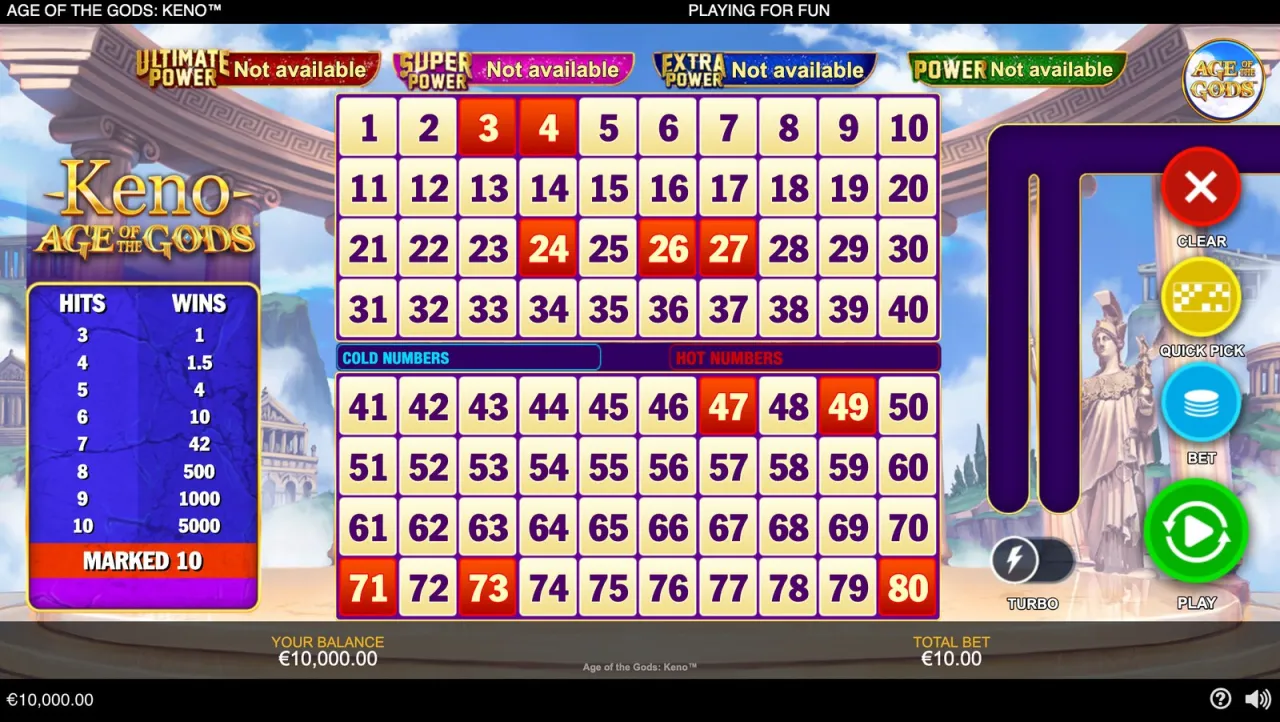
Although the help screens never clarify them, Age of the Gods: Keno arrives with the four Age of the Gods jackpot meters - Power, Extra Power, Super Power and Ultimate Power - bordering the board. The rules note only that progressive wins are left out of the RTP calculation. They are inaccessible in fun play.
What ten marked numbers pay
The game holds 80 numbers and no bonus round, and with a complete ticket of 10 numbers marked, 3 hits pays 1 times the total bet, 4 hits 1.5, 5 hits 4, 6 hits 10, 7 hits 42, 8 hits 500 and 9 hits 1000. Those figures are stated as multipliers of the total bet, so the 42 at seven hits is 42 times what you staked. Ten hits out of ten is the biggest result. It needs every one of the 10 marked numbers to turn up among the 20 balls. It produces a 5000 times the stake win. Nothing in the table sits between the 1000 at nine hits and that top line. Anything under 3 hits pays nothing. The entire table contracts with the ticket size. A five-number ticket shows five rows and the rest of the table stays empty.
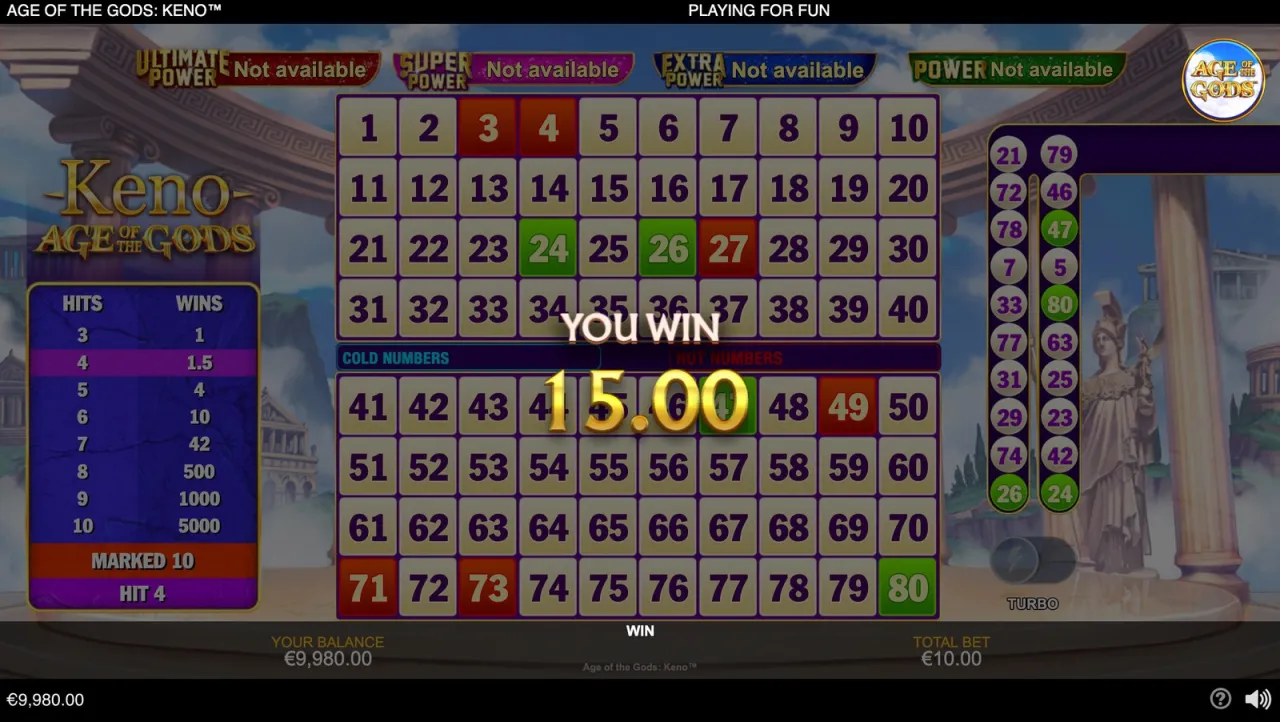
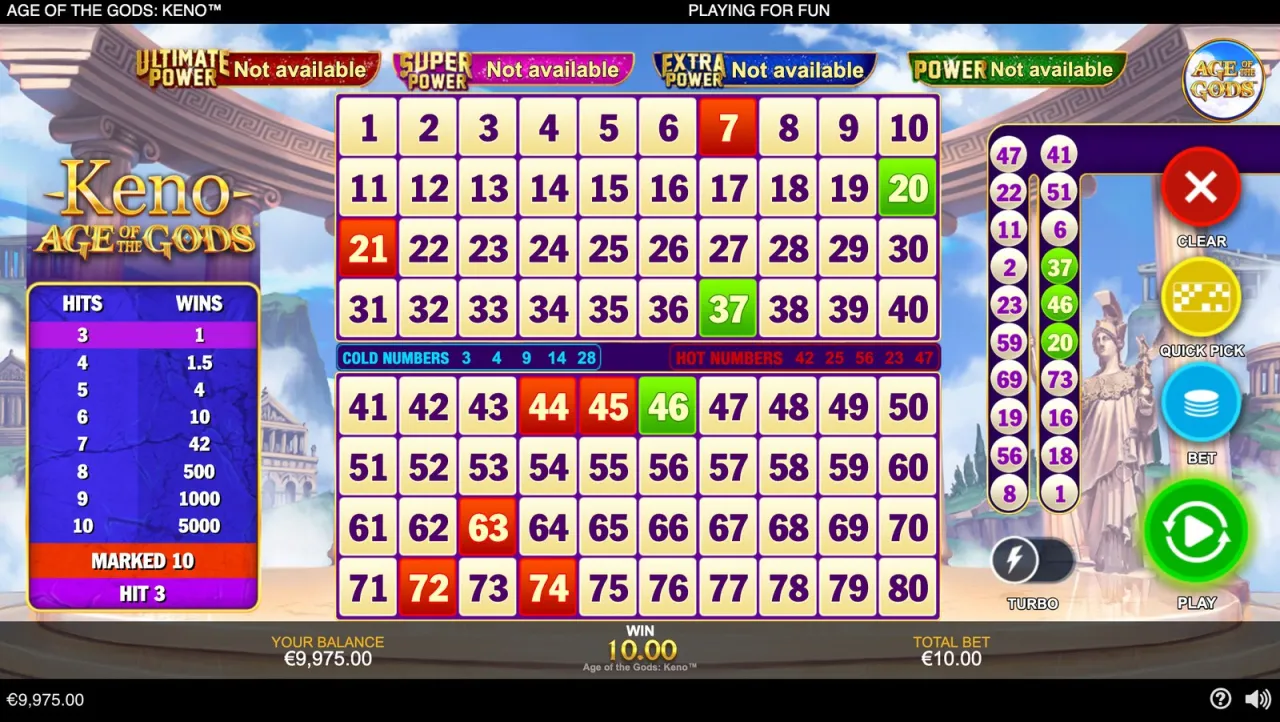
Hot and Cold numbers are display only. A number reads hot when it has been drawn more than three times in the last five rounds and cold when it has not appeared in those five, and nothing shows at all during the first five rounds. Turbo and Autoplay are controls rather than features, and there are no free spins to chase here, which brings me to the next part of this review.
Final Minty Score: The paytable steps from 42 times the total bet at seven hits straight to 500 at eight, and the whole distribution lives in that gap - 350 rounds produced one stretch of 21 without a win and nothing bigger than 30 times the stake.
350 rounds at a 10-credit ticket
I'm looking at a game that could very well turn out to be one of Playtech's odder releases, and the top line interests me, but there is nothing novel here beyond the jackpot meters. I played 350 rounds at a total bet of 10.00. Reading this review it might come across as complex and bewildering. Actually it is not. Sure, it's not the most recognizable format. But the pieces fall into place rather swiftly as you start drawing balls. The published return is a range rather than a single figure, a minimum of 94.93% and a maximum of 96.10%.
To summarize it, Age of the Gods: Keno has some of the things I want from a number game. That run wagered 3,500.00 and returned 1,720.00. Those are a max win worth 5000 times the stake and a paytable that prints every tier. The balance ran from 10,000.00 down to 8,220.00, which was also its lowest point. It is a high variance game, and that means you are likely to have many lengthy dry stretches before landing any real wins. Three of my rounds paid more than ten times the stake. My own 350-round run confirmed that: 78 rounds paid, 47 of them for less than the stake, and the longest drought lasted 21 rounds. That drought ended on round 30. The best single hit was 30 times the stake, the balance never once rose back above where it began, and it concluded at 49.1% of what I wagered. It came on round 115 and paid 300.00, and the next largest was 260.00 on round 319.