Thunderstruck Wild Lightning Slot – Free Demo
Added: Jan 30, 2026
Updated: Apr 7, 2026
Provider:
Stormcraft Studios
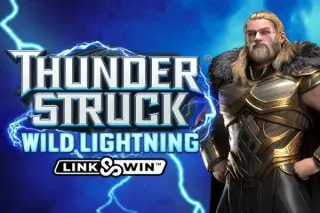
Thunderstruck Wild Lightning is Stormcraft Studios' Norse-themed answer to "what if we gave a payline slot two actual feature engines?" The 5-reel, 40-line base game is mostly a waiting room: real session math lives inside selectable free spins with climbing multiplier wilds, and a Link&Win respin…
Play Thunderstruck Wild Lightning demo
Thunderstruck Wild Lightning: Two Engines, One Bankroll
Thunderstruck Wild Lightning is a 5-reel, 40-payline Norse mythology slot from Stormcraft Studios that builds its session math around two distinct feature engines: a selectable free spins round where multiplier wilds do the heavy lifting, and a Link&Win-style respin where cash orbs unlock additional grid rows and feed fixed jackpot tiers. The base game supplies a steady stream of small line wins, but it is transparently secondary — its main job is keeping the bankroll alive while scatters and orb symbols accumulate toward the next feature entry point.
The volatility is high and unambiguous. Most spins resolve as routine payline coverage; the distribution spikes hard when free spins multipliers align with premium symbols, or when a Link&Win trigger catches an early orb that resets the counter and cascades into row unlocks. Between those moments, expect long stretches of steady attrition. The 15,000× published max win is real, conditional on a near-perfect respin run — board-filling, rows unlocked, mega jackpot orb included. For most sessions, the practical ceiling is a well-timed mid-tier jackpot plus a multiplier free spins hit, and that is still a meaningful number if the timing cooperates.
Norse Aesthetic Done Right
Stormcraft Studios leans into cinematic Norse mythology without drowning in clichés: stormy blues, rune carvings, and glowing elemental orbs on premium symbols that read sharper than a typical legacy myth slot. Animations are purposeful rather than decorative — lightning accents fire on scatter landings, multiplier wilds pulse clearly, and cash-orb arrivals are distinct enough that you can track the respin board without hunting for visual cues. Sound design stays in the same lane: steady cinematic percussion as a base layer, short stingers on feature triggers. It marks events without becoming a dopamine jukebox that masks dry sequences with noise.
Our Minty Verdict: Two feature engines sounds generous — and it genuinely is, when both fire properly. The selectable free spins tier choice gives you real agency over your risk curve, and a Link&Win respin that unlocks rows mid-collection is legitimately more interesting than most hold-and-spin clones. The mathematical villain here isn't the game being stingy overall — it's the Frost-Dead Respin: the Link&Win that triggers on three orbs, resets once, unlocks nothing, collects pocket change, and quietly evaporates three spins of bankroll. You'll survive a bad free spins run on numbers alone; a shallow respin leaves no scar, just a slow bleed. The thunder is real. So is the silence between strikes.
The 5×4 Grid and Why the Row Count Matters
The grid is 5 reels by 4 rows, paying on 40 fixed lines left to right. No line configuration needed — stake and spin. The 4-row height is load-bearing rather than cosmetic: the Link&Win respin uses the full grid as a collection board, and row-unlock behaviour during that feature directly affects the number of landing positions available and the maximum prize ceiling a single trigger can build toward. A respin that fires early and unlocks all rows is a different mathematical animal than one that stalls on two.
Wild, Scatter, and Orb: Symbol Roles in Thunderstruck Wild Lightning
Card rank royals handle low-value hit frequency; the premium tier leans on mythology and lightning-orb iconography. The wild substitutes for payline completions and becomes the primary multiplier vehicle inside free spins — it does nothing extraordinary in the base game but transforms into the session's most important symbol the moment bonus reels start. Scatter landings are never dead weight: beyond triggering free spins at three-or-more, they feed a separate progression layer that can push toward a dramatic wild transformation event within the bonus. Even scatters that don't immediately build a payline are working toward something.
How the Base Game Bleeds You Between Bonuses
The base game is a controlled bleed engine punctuated by setup spins. Ordinary rotations resolve into small-to-mid payline wins that cover a fraction of the stake; setup spins are the ones where scatters land without reaching three, or a cash-orb symbol appears without triggering the respin — creating anticipation without resolution. That rhythm is intentional: the game is designed to feel like it is perpetually approaching a trigger, which keeps attention levels up during the between-feature grind. It is effective pacing, but it is still pacing for a feature-dependent math model. The base game does not have meaningful standalone wins; it has hit frequency.
Free Spins Tier Selection: Spin Count vs. Multiplier Ceiling
Three or more scatters open the free spins tier selection. The tradeoff is explicit: more spins at lower wild multipliers versus fewer spins at higher multipliers. The 15-spin end of the spectrum provides more trigger attempts and more forgiving variance; the 6-spin end is the high-multiplier stress test where a single premium hit under the right wild can dwarf the output of a longer, quieter bonus. Neither choice is objectively correct — it depends entirely on your bankroll depth and appetite for all-or-nothing swings inside a feature you already had to grind to reach.
Retriggers are available, and there is a secondary progression layer inside free spins: scatter accumulation during the bonus can unlock a special high-impact spin built around a full-reel wild transformation. That inner escalation loop is the second chase layer — it means even a low-multiplier bonus can build toward a standout moment if scatter landings cooperate. When both the transformation spin and a premium wild multiplier align in the same bonus, you get the kind of free spins result that finances a long future session. When neither shows up, 15 spins of modest payline hits will feel like a long applause for a mediocre outcome.
Link&Win Respins: Row Unlocks and the Jackpot Ladder
The respin triggers when enough cash-orb symbols land simultaneously. On activation, the grid freezes into a collection board with a limited respin counter; each new orb that lands resets the counter and adds its value to the running total. The row-unlock behaviour is the differentiator: as orbs fill the board, additional rows open up, expanding the landing surface and raising the theoretical ceiling on total collection. A trigger that unlocks all rows early in its run is a compounding event — more space means more potential orbs, which means more resets, which means a longer sequence and a larger pile.
Fixed jackpot orbs — tiered as Mini, Minor, Major, and Mega — can land during the respin and award defined stake-scaled prizes. These are not progressive pools; they are predetermined values that step up with your bet size. The Mega tier is reserved for full-board-fill scenarios after complete row unlocks, which is rare. The lower tiers are meaningful swing contributors: a Minor or Major jackpot orb mid-collection can convert an average respin into a session-best result without needing a perfect board. If collection-based features with visible escalation are what keep you spinning, this respin is the engine the whole slot is built around.
Thunderstruck Wild Lightning Math: RTP, Variance, and the 15,000× Reality Check
Published top RTP is 96.10%, with reduced configurations reported in the 92%–94% range — a compression that hits hardest in the quiet stretches between features, where small line wins are doing all the heavy lifting. Volatility is high: the gap between routine base-game payline hits and feature-driven spikes is wide. Expect frequent small returns and periodic dry patches broken by bursts when a respin extends into row-unlock territory or when a free spins multiplier wild connects with the right premium symbol at the right moment. The 15,000× maximum win is the outer edge of a near-perfect Link&Win run: full row unlocks, dense orb coverage, and at least one high-tier jackpot outcome. Realistic high-water marks per session are a mid-tier jackpot respin or a transformed-wild free spins hit — both capable of producing several hundred times stake under the right conditions.
Stake Sizing for a High-Variance Session
The bet range runs from 0.20 to 16 per spin. Low stakes are the correct entry point: they let you observe the free spins tier tradeoffs firsthand and see how quickly a shallow Link&Win respin can end before you have sized your bankroll to handle the variance properly. Higher stakes are proportionally more emotional — fixed jackpot amounts and orb collection totals scale directly with your bet, so the same respin at 8.00 that felt mediocre at 0.20 becomes a meaningful hit. The practical sizing rule for a high-volatility, feature-dependent slot: stake low enough that you can absorb the drift between triggers without running out of runway. You need feature volume to see the math, and feature volume requires time at a comfortable bet.
Thunderstruck Wild Lightning on Mobile
The 5×4 layout is mobile-legible — symbols stay tall and clear, primary controls are thumb-accessible, and spin speed options let you pace the session without touching the math. The respin board is the most information-dense moment, with row unlocks and orb tracking running simultaneously, but the grid stays centred and state changes are clearly animated. No meaningful degradation from desktop to mobile.
Try the Demo Before You Size Up
The free spins tier decision is not intuitive until you have watched both extremes play out — a 15-spin run where the multiplier wild barely shows versus a 6-spin run where one hit defines the session. Demo play removes the tuition cost from that education. The Link&Win respin is equally worth a free-play stress test: a shallow trigger that ends after two resets is a learning event in demo, not a financial loss, and recognising what a strong trigger looks like versus a weak one is the most practical intel you can carry into real-money sessions. Try the demo via Stormcraft Studios slots online before committing a bankroll to the variance curve.
Thunderstruck Wild Lightning FAQ
-
Q: How high can Thunderstruck Wild Lightning actually pay?
A: The published maximum is 15,000× your bet, requiring a near-complete Link&Win board with full row unlocks and a high-tier jackpot orb outcome. Volatility is high — realistic session peaks are more commonly mid-tier jackpot respins or transformed-wild free spins hits in the low-to-mid hundreds of times stake. -
Q: What RTP does Thunderstruck Wild Lightning run at?
A: The top reported configuration is 96.10%. Reduced settings in the 92%–94% range have also been documented depending on the operator — check the game info panel at your casino to confirm which version is active before you spin. -
Q: What is the difference between the free spins tiers?
A: The selection trades spin count against multiplier ceiling. The 15-spin tier delivers more attempts at lower wild multipliers; the 6-spin tier allows multipliers to climb significantly higher, making individual hits more impactful but the overall bonus more all-or-nothing. Retriggers and a secondary wild transformation event are available across all tiers. -
Q: What triggers the Link&Win respin, and how do the fixed jackpots work?
A: A qualifying cluster of cash-orb symbols landing simultaneously activates the respin. Each subsequent orb resets the counter and builds the total; row unlocks expand the collection surface mid-feature. Fixed jackpot orbs — Mini, Minor, Major, Mega — award stake-scaled prizes that are not tied to a progressive pool. The Mega tier requires a rare full-board finish.