
Added: Feb 11, 2026
Updated: Apr 7, 2026
Provider:
Elk Studios
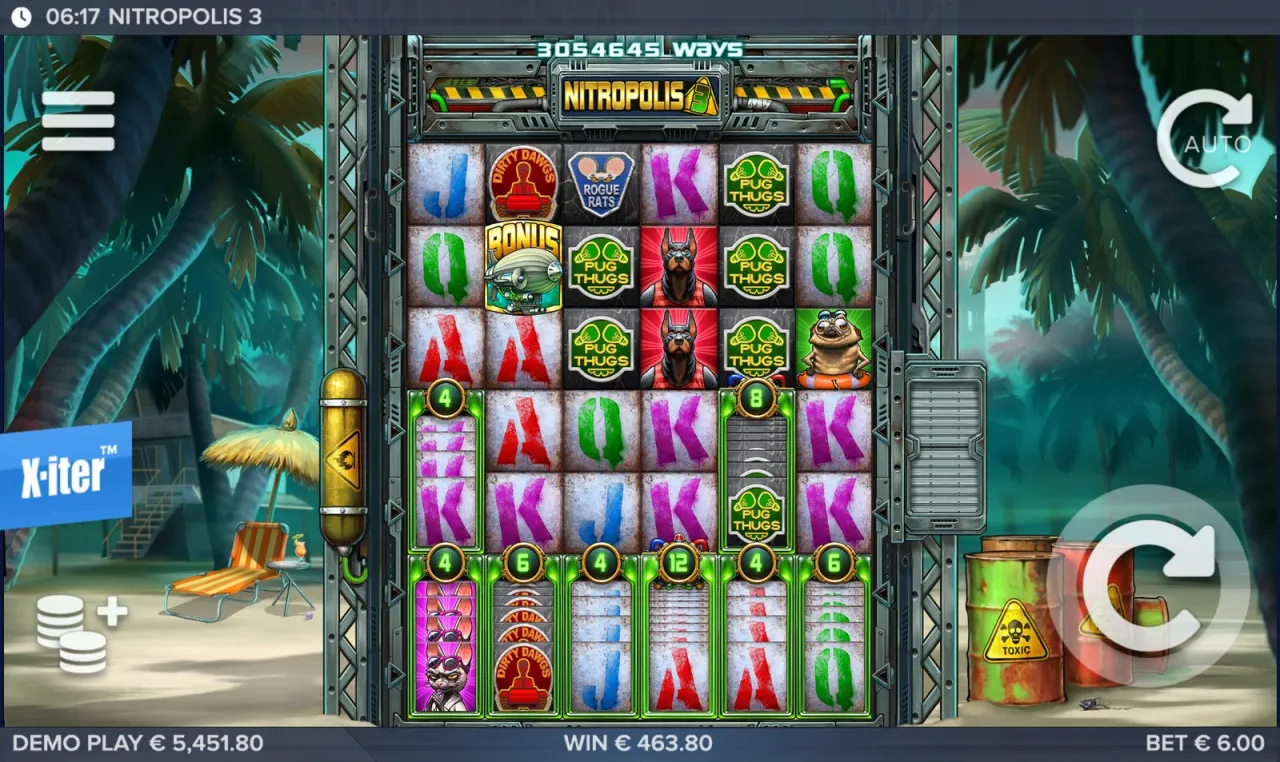
Nitropolis 3 is Elk Studios' most mechanically loaded entry in the Nitro Gangs series — a 6-reel avalanche slot where the grid doesn't just sit there at 4 rows but climbs toward 8 as tumble chains build momentum. Nitro Reels compress symbol density into key reel segments, oversized icons span…
Nitropolis 3 is built by Elk Studios on a 6-reel, ways-to-win engine where the grid starts at 4 rows and can expand up to 8 as avalanche chains sustain themselves. That expansion isn't decorative — each added row widens the combinatorial surface, meaning the valid win paths at the end of a hot spin are structurally different from the ones available at the start. Nitro Reels, oversized symbol clusters, and a situational Both Ways modifier all feed into that expansion loop, creating a board that can look genuinely different 5 tumbles into a single spin than it did on the first drop.
The numbers: RTP 95.00%, volatility 4/6 medium-high, max win 50,000× bet, bets from 0.20 to 50. None of that is unusual for the tier. What earns Nitropolis 3 its spot is the coherence — the individual modifiers aren't features bolted onto a standard grid, they're interdependent variables that compound when the chain runs long enough to stack them.
The Nitro Gangs setting plays post-apocalyptic grit against a cartoon-gang attitude — industrial surface, playful execution. Character symbols are visually distinct at any grid size, oversized icons land without cluttering the layout, and the row-addition animation is clear enough that you can track grid growth in real time rather than piecing it together after the chain resolves. In a slot this busy, legibility is a design feature, not an afterthought.
The soundtrack earns its keep. It escalates as feature conditions approach, shifts texture when the grid expands, and punctuates tumble continuations with audio cues that function as information rather than atmosphere. If you're the type who kills sound on every session, Nitropolis 3 is worth reconsidering — the audio layer actively signals when a spin is trending toward feature territory versus resolving back to baseline, which is useful data when the avalanche chain is mid-run.
Minty Breakdown: The grid expansion and avalanche loop aren't window dressing — they're the actual delivery mechanism for the slot's math, and Elk Studios built them to interlock rather than operate independently. That coherence is real. The problem is the toll: long base-game stretches on a compact 4-row grid with no Nitro Reels in sight feel like paying for a concert where the headliner hasn't shown up yet. Watch out for the Hollow Cascade — a tumble that adds a row, reshuffles the symbols, and ends without a single paid connection — because it's the slot's most recurring cruelty at 4/6 variance. The 50,000× ceiling is mathematically honest, not just a marketing number, but reaching it demands conditions that a single session budget rarely sustains. Fund accordingly or don't fund at all.
Base state: 6 reels × 4 rows = 4,096 ways. Full expansion: 6 reels × 8 rows = ways count that makes the starting grid look conservative. Wins evaluate as adjacency-based ways, so every row added by a continuing tumble is a structural increase in valid win paths — not a visual reward for a spin that's already paid, but a genuine widening of opportunity for the next drop in the chain.
The paytable ladder is standard — premium character icons at the top, card-rank filler below — but the symbol that does the real mathematical lifting isn't on the paytable. The Nitro Reel modifier changes how many icons are effectively present in a reel segment, raising density and with it the statistical chance of chain continuation. A Nitro Reel landing on a segment where expansion just added rows is the slot's best-case moment: higher surface area, higher density, longer chain — the conditions where 50,000× transitions from ceiling to plausible destination.
The avalanche loop removes winning symbols and drops replacements, allowing a single paid spin to run through multiple sequential evaluations before the chain exhausts. Every other modifier in the slot — grid expansion, Nitro Reels, Both Ways — depends on that chain staying alive long enough to activate them. The base game isn't where the money lives; it's the runway the slot uses to get to the modifiers.
Grid growth compounds with tumble momentum. Each continuation can push the playfield upward, and because the chain needs to stay alive to keep expanding, longer chains produce both more rows and more opportunity for Nitro Reels to appear in segments where that expansion has created maximum surface area. The volatility implication is blunt: cold stretches on a compact 4-row grid alternate with spins that activate the full expansion path and suddenly look like a different slot.
Both Ways adds a third variable when conditions are right. It converts near-miss patterns into paying connections by opening win directionality situationally, which can be the difference between a chain that terminates early and one that extends far enough to reach maximum grid height. It's not always on — treating it as a reliable base-game feature will produce the wrong expectation.
Free spins trigger via scatter landing; larger triggers award more spins. The structural distinction from the base game is persistence: Nitro Reels can lock in place across spins rather than resetting after each drop, so favorable board configurations carry forward. Instead of waiting for a Nitro Reel to appear from scratch on every individual spin, you're managing a board where the best modifiers hold their position.
Safety-level progression layers on top. Winning spins advance the safety level, improving the starting board condition for subsequent spins in the round. Early bonus wins raise the quality floor for everything that follows — which means the first few spins carry disproportionate weight. A retriggered session extends that compounding window; it's not just extra time, it's extra compounding cycles on a board that's already been conditioned.
The Super Bonus variant targets maximum grid height and applies Both Ways behavior persistently throughout the round, building the environment where the slot's top-end math is actually reachable. It's the mode that makes 50,000× a real number rather than a marketing figure — and hitting it via organic trigger is the scenario the entire base-game grind is theoretically building toward.
Direct feature purchase is available. It skips the base-game churn and delivers you into the sticky-modifier, safety-progression environment on demand — useful for evaluating bonus variance, stress-testing bankroll fit against the feature's actual distribution, or simply operating under session constraints that make organic triggering impractical.
The math doesn't change. You're paying a premium to access the same probabilistic outcome range that the base game would eventually reach — you're concentrating bankroll exposure into fewer, higher-stakes events, not improving the expected return. Treat the bonus buy as a volatility dial, not an edge. Browse related titles from Elk Studios if you want comparable feature structures at different variance profiles.
Bets run from 0.20 to 50 per spin. The spread accommodates casual calibration at the low end and high-roller sessions at the top, but neither end changes the slot's fundamental demand: a bankroll deep enough to absorb cold base-game stretches without forcing an exit before the modifiers stack. At 4/6 volatility, sessions that end mid-churn aren't bad luck — they're the expected experience for underfunded sessions.
Longer sessions at lower stakes let the board state evolve across sufficient tumble volume. Higher stakes with defined loss limits suit players targeting the feature environment directly. The key variable isn't the stake level — it's whether the session window is long enough for the slot's compounding conditions to actually appear.
RTP is 95.00%, volatility is 4/6 medium-high, and the maximum win is 50,000× bet. The 95.00% figure is feature-weighted — a disproportionate share of the theoretical return concentrates in expanded-grid, bonus-round scenarios rather than being distributed evenly across all spins. The base game pays, but in shorter bursts that service session continuity rather than session profitability.
The 50,000× ceiling requires the Super Bonus to reach maximum grid height, sustain sticky Nitro Reels across multiple evaluations, and land premium symbol coverage on a Both Ways-active board. That's a specific combination of conditions, not a loose probability range — which is why the headline number and the realistic session median occupy entirely different financial territory. At 4/6, you're funding the chance to hit that combination, not the expectation of it.
The slot translates cleanly to mobile. Symbol art is bold enough to stay readable when the grid sits at full 8-row expansion on a phone screen, row-addition animations are intentional rather than cluttered, and feature symbols are visually distinct from standard pay icons — relevant in a slot where misreading a modifier mid-tumble means losing track of what the board is actually doing.
Pacing is handled well for touch play. Spins resolve quickly when chains terminate early; the slot slows down only when it has cause — a continuing avalanche, an expanding row, a bonus entry. Mobile sessions don't feel sluggish, and the audio signaling that flags feature-approaching conditions carries effectively through a phone speaker.