
Pirots 2 Slot – Free Demo
Provider:
Elk Studios
Collect three bonus symbols and Pirots 2 grants five free drops, however far the grid has expanded and however high the amber symbols have been upgraded by then. The board only grows when a bird collects the red button, and each meteor strike adds a single row and column on the way to 8x8.
Play Pirots 2 demo
Four birds on a 6x6 board
Pirots 2 by Elk Studios unfolds in one of the most crowded grids around, and I am looking at a primeval board where four collecting birds roam about. Each one is matched with an amber symbol of its own shade. Feature symbols are open to all four of them, whatever the shade. The play happens on a 6x6 sized grid with falling symbols, extendable up to 8x8. Only a meteor strike makes it bigger. Winning combinations are created when a bird shifts and collects the paying symbols orthogonally next to it – amber symbols matching that bird, coins and wilds. A collected feature symbol sets off its own feature at once. Collecting birds are a familiar mechanic from Pirots and Pirots 3, as you are no doubt aware. Pirots 2's version of it isn't quite so ordinary, though: birds keep collecting until they can't collect more, so one bird can travel several times before a refill. The birds travel in descending order of symbol payout.
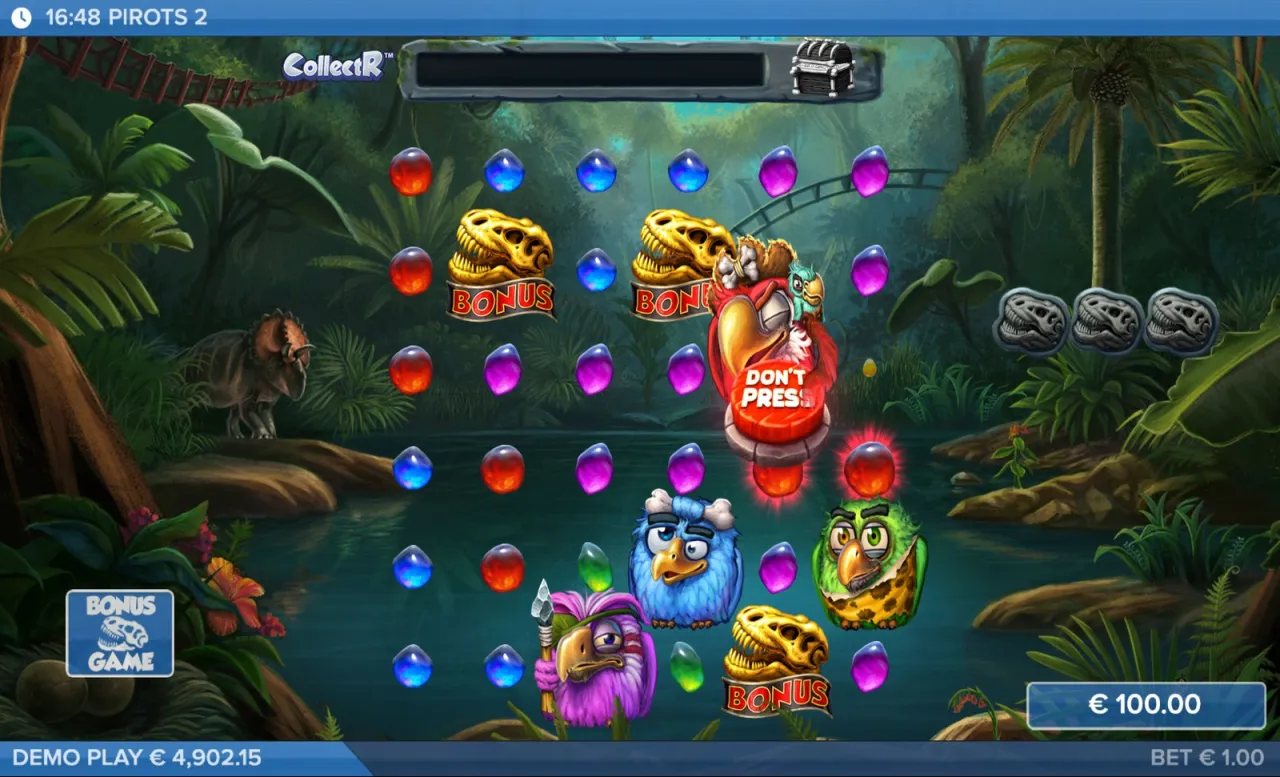
Elk Studios has fiddled with the math model as well as the visuals, and potential has received the largest alteration. The win cap is 10 000x the placed bet, and a round is ended the moment it is reached. Default RTP is 94.0%. Volatility rests at the top of the scale at 5 out of 5. It is playable on most devices, and stakes span from 20 p/c to $/€100 per spin, with each bet counting as 100 coins. At a 1.00 stake my balance never dropped below 4,991.10 in 350 spins.
The game fields amber symbols in four shades and eight varieties of feature symbol, and all drops in the base game begin with amber symbols on payout level 1. Grid size resets to 6x6 for every base game drop as well. They can be upgraded to greater payout levels, up to a maximum payout level of 7.
Likewise among the feature symbols is the wild, which as well as paying stands in for any amber symbol at its present payout level.
The meteor, the egg and the red button
The features in Pirots 2 all dangle off the same collecting loop, broadly. Nothing pays without a bird reaching it. When a bird collects, the respective symbols are cleared from the grid. The leftover symbols drop down to potentially produce new hits, and the mechanism carries on as long as there is something neighbouring left to collect.
Above the grid rests a symbol collection meter. It keeps counting through a round for as long as the birds are still collecting. It counts collected amber and wild symbols only, and when it is full, one pending feature symbol release is appended. Coins, eggs and the rest of the feature symbols do nothing for it. Up to three releases can be stacked and granted simultaneously, and each release turns 3 amber symbols in the grid into random feature symbols. A release is granted just before an egg hatches, before the meteor strikes, as part of the first free drop in the bonus game, or when the birds can't collect more.
Upgrade symbols lift the payout level by 1, 2 or 3 steps for all amber symbols of the collecting bird's shade. Since the birds move in descending order of payout, an upgraded shade moves earlier on the drops that follow. The upgrade all symbol does the same for every shade, and highest level is 7. Reaching that level takes several upgrades inside one round, because the next base game drop starts back at level 1.
Next are the leftover feature symbols. Each has its own altering capacity:
- Coin – pays its cash value times the present active bet level. The Max Win coin instantly pays the outstanding amount needed to reach the maximum win.
- Egg – hatches a dinosaur at the close of the round. The birds are frightened off the grid so they redrop in new spots.
- Transform – transforms a cluster of amber symbols next to the bird into the bird's shade. Each can instead transform into a feature symbol, though.
- Popcorn – sets popcorn in vacant grid spaces. The birds can traverse vacant spaces one time each to reach extra symbols.
- Red button – at the close of the round a meteor strike clears the birds and all non-feature symbols near it. It compels a redrop and enlarges the grid by 1 row and 1 column, to a maximum of 8x8. Two of them in the same round are what it takes to get from 6x6 to the full 8x8.
If both a collected egg and a collected red button are in sight, the egg acts first. Each is settled at the close of the round rather than the moment it is collected. The birds engage with each other too. The swap is called Switcheroo. Neighbouring birds may swap places when they can't collect more and only if new clusters can be unlocked. Three or more birds arrayed horizontally or vertically begin a fight over a random patch of the grid, automatically collecting bonus symbols, coins, eggs and red buttons along the fight cloud's route and clearing amber symbols. The birds are redropped once the fight is over and the empty places refill.
Keep a watch out for the bonus symbol: collecting three of them in the base game sets off the bonus game, and 5 free drops are granted. The bonus opens on a roller-coaster entry screen, and the counter beside the grid starts at 1 of 5. Collecting three more during bonus mode grants an extra 5 free drops. Of the three I hit, only the last one retriggered.
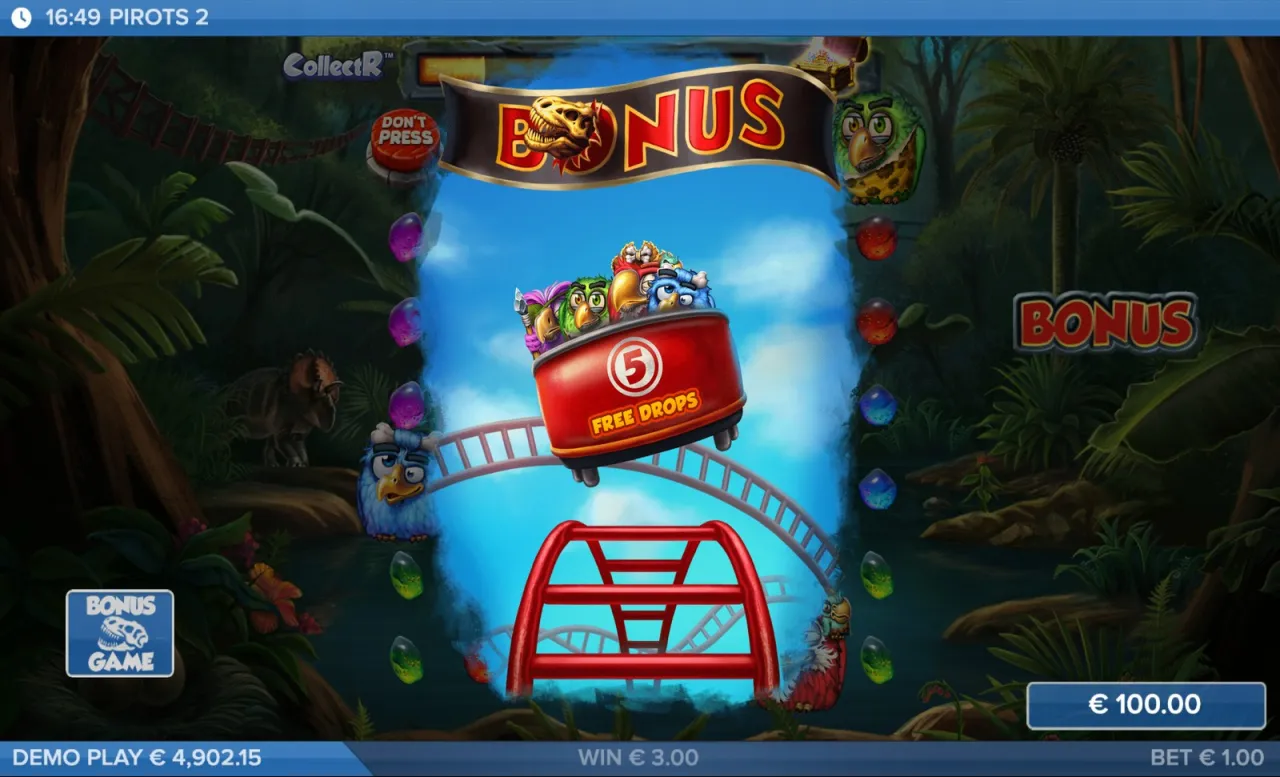
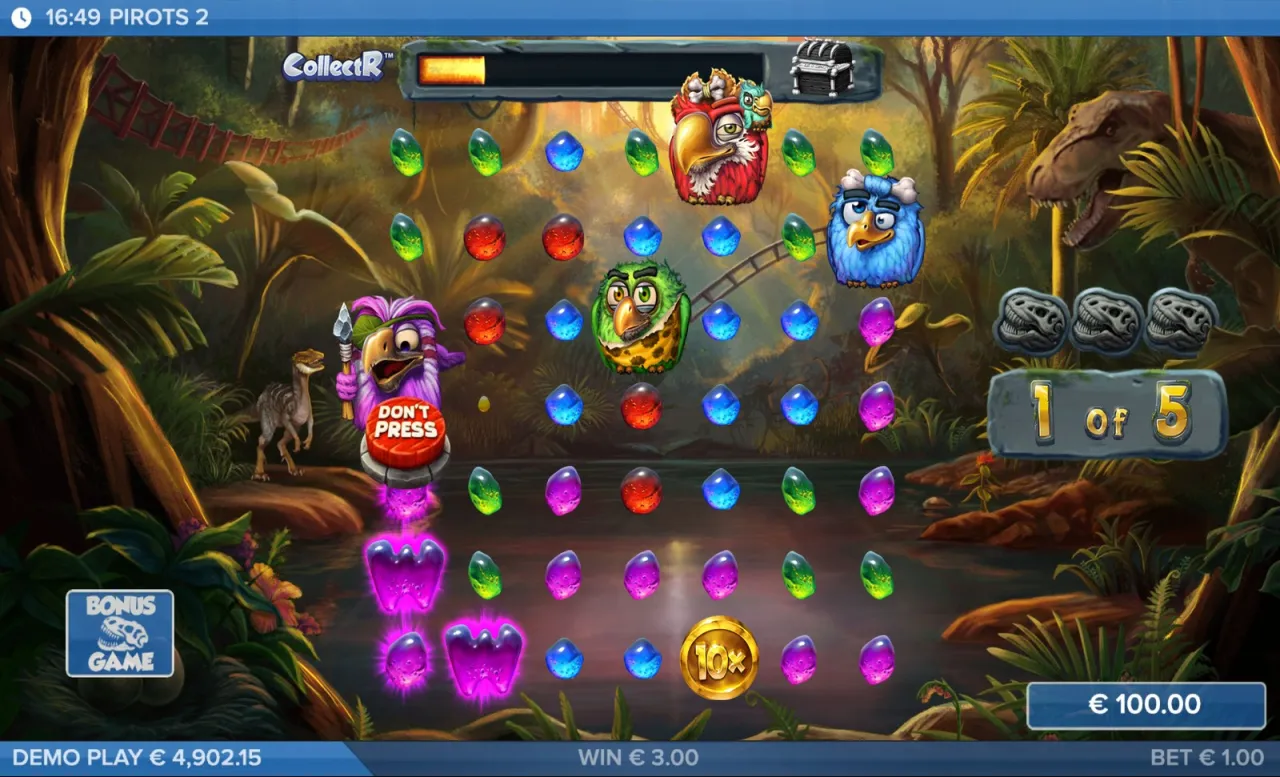
The bonus begins on the present active grid size. A round that has already taken a meteor or two carries the bigger board in with it. The grid size, meter progress and amber payout levels all endure through it, and pending feature symbol releases trigger as part of the first free drop. Bonus symbols collected during the round carry over as well. The bonus finishes when no free drops remain or when the win cap is hit. Winnings are paid out at the close. My three bonus rounds came to 423.00 between them. X-iter sells entries in the base game – Super Bonus at 500x the bet with all free drops at maximum grid size and every upgrade symbol upgrading every shade, Bonus at 100x for an assured entry, Maximum Grid Size at 25x for one drop at full size, Popcorn Fiesta at 10x for one drop with popcorn active from the outset, and Bonus Hunt at 3x for one drop with quadruple the odds to trigger the bonus – if waiting isn't your thing. At the 1.00 stake I played, that is 100.00 for the Bonus and 500.00 for the Super Bonus. Every mode operates at the same 94.0% RTP.
Minty Slots Verdict: Three bonus rounds turned up in 350 spins and they paid 79x, 82x and 262x the stake, which is 66% of everything the session won arriving in three rounds out of 350. Everything else about Pirots 2 – the meter, the upgrades, the growing board – is machinery for reaching those rounds, and the 94.0% return is the price of the wait.
Three bonus triggers in 350 spins
There is a lot occurring in Pirots 2. A single drop can chain collections, hatch a dinosaur, set off a meteor and grow the board before it settles. It turns outrageously frantic at times, increasingly so as the grid expands, and Pirots 2 is a harsh, volatile game because of it. My high point came on spin 167, at 5,359.80.
One of the major challenges is triggering the bonus game, and across 350 spins at a 1.00 stake it showed up three times – twice inside the first 36 spins and then not again for 131 spins. The first landed on spin 20 and the second on spin 36. Only 61 spins paid anything at all, half of those for less than the stake. That is 17% of the 350. One barren run lasted 24 spins. It ended on spin 159, shortly before the best round of the session.
Rule alterations like the meter requiring amber and wilds to fill make Pirots 2 tougher to get up to speed. A drop of nothing but coins and upgrades moves that meter not at all. The three bonuses paid 79x, 82x and 262x the stake, and between them they made up 66% of everything won in the session. The best base game spin without a bonus was 81x, on spin 316. The session ended at 5,289.70 from 5,000.00 – a return of 182.8%. Total winnings were 639.70 against 350.00 wagered.
Elk Studios has hoisted the risk/reward quotient right up for Pirots 2, and it is arguably fitted to a specific breed of player, one eager to take on a more demanding game to potentially collect greater rewards – should it shift out of second gear.