

Pyramid: Quest for Immortality Slot – Free Demo
Provider:
NetEnt
Every extra payout in Pyramid: Quest for Immortality comes from symbols falling into the positions just cleared, with the Avalanche Multiplier stepping up a level for every three winning drops and stopping at x10. My 260 spins at a 2.00 stake gave back 177.5%, though two of them carried it.
Play Pyramid: Quest for Immortality demo
Familiar ground, rebuilt as a pyramid
There is a moment and locale for innovation. You certainly cannot anticipate a pile of pyramid blocks to head the charge into uncharted territory, though, and as the name implies, Pyramid: Quest for Immortality is a journey down memory lane. I logged 260 spins on it at 2.00 a spin. This sturdily built game demonstrates that the Avalanche is a boon that can render any old game as absorbing as brand new themes. Those spins wagered 520.00 and returned 923.20, a session return of 177.5%.
Much of Pyramid: Quest for Immortality will be recognizable to you if you've tried NetEnt's latest releases. The balance moved from 1,000.00 to 1,403.20 across the run. Constructed around the pyramid reel set, this 5 reel Egypt-themed slot provides 720 bet ways and makes use of avalanching symbols, and the pyramid has never been confused for a noble champion. Only the longest matching combination per symbol is paid, so a shorter run of the same icon adds nothing on top. But it'll do all it can to assist you along the route, such as converting a symbol that lands on the top of reels 2, 3 or 4 in a winning combination into a Wild for the next Avalanche. Of those 260 spins, 84 paid something, a hit rate of 32%.
There's also a wild that stands in for all symbols. Of the 84 spins that paid, 46 came back with less than the 2.00 stake.
Three, four, five, four, three
Pyramid: Quest for Immortality is played utilizing Avalanche, and when you land a winning combination, it triggers a reaction. My longest run without a win at all was 13 spins, ending on spin 44. The winning symbols are removed as new ones fall in to replace them, and these reactions recur until no fresh winning combinations emerge. The highest my balance reached was 1,468.60, on spin 218. Furthermore, wins are counted as bet ways. The five best spins of the session paid 328.00, 220.00, 50.00, 48.00 and 28.00. These are matching symbols in any position on three or more adjacent reels, leftmost to rightmost, where only the longest matching combination per symbol pays. A combination has to start on the leftmost reel, so matching symbols on reels three, four and five alone pay nothing. That amounts to 720 ways to win. The positions run 3, 4, 5, 4 and 3 across the five reels, and multiplying them out gives that figure.
The multiplier will rise as the reactions keep arriving, just like the Avalanche itself. Spin 123 paid 328.00, 164.0 times the 2.00 stake, and it was the largest single win of the run. This is a base game feature called the Avalanche Multiplier. Mid-avalanche the reel set sits in its stepped pyramid frame with fresh symbols dropping into the cleared positions, the bet, level and coin value read out beneath it. Every 3 successive Avalanches carrying at least one bet way win add +1 to the multiplier, to a maximum of x10. Spin 136 was the next best at 220.00, or 110.0x, and it took the balance to 1,429.60.
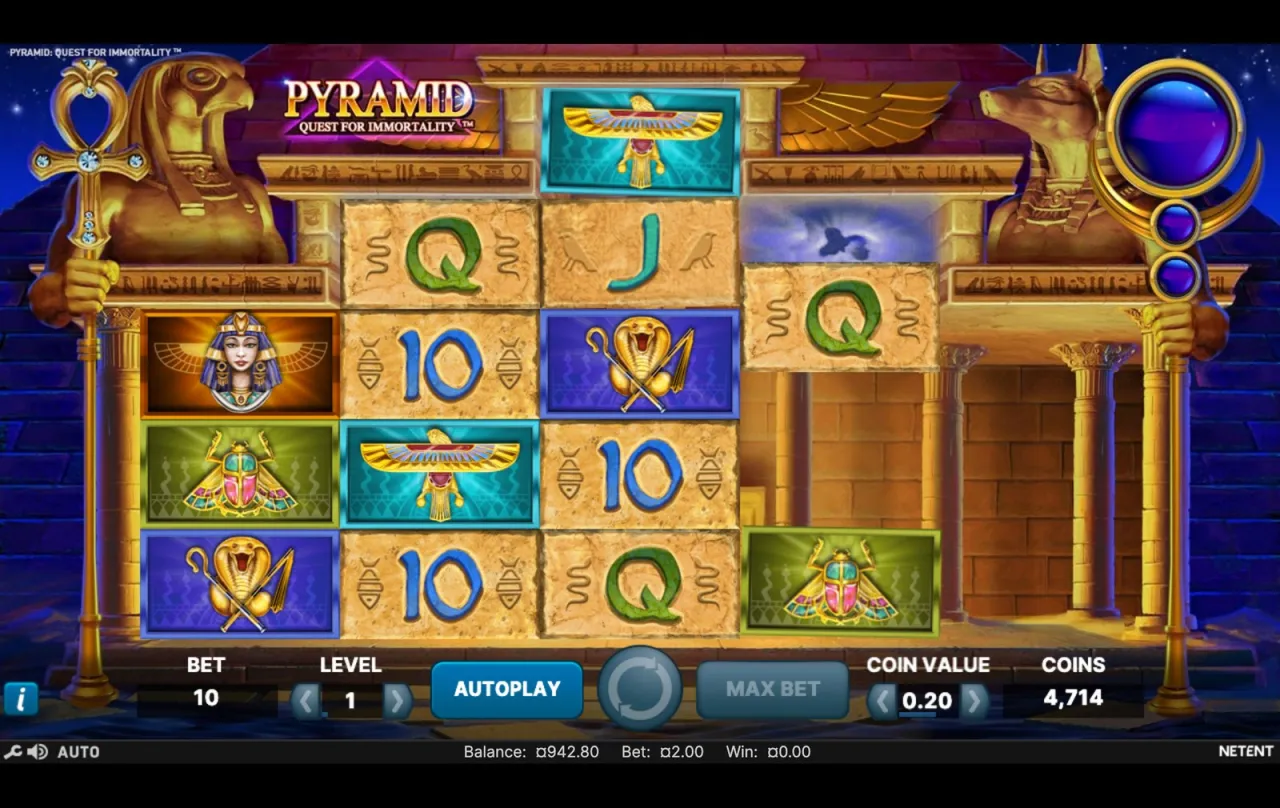
What shines here is the Wild Generation feature, appearing on the top of reels 2, 3 and 4 only, and any symbol that lands there in a winning combination turns into a Wild for the next Avalanche. A Wild made that way lasts for that one Avalanche.
The Minty Breakdown: Two spins out of 260 carried this run, 328.00 on spin 123 and 220.00 on spin 136 against a 2.00 stake, and take those two away and the session finishes below the 1,000.00 it started from.
What 260 spins gave back
It would be a reasonable point to raise, and the detractors are going to claim that NetEnt needs to devise something fresh and that they've quit being inventive, although I don't entirely concur. I played the whole session at Bet 10, Level 1 and a coin value of 0.20. NetEnt always seems to discover fresh intriguing twists, in my view at least. The Avalanche Multiplier is the only thing here that carries a bet past a single paid combination. They make every new Avalanche slot, Gonzo's Quest and Asgardian Stones among them, worth to investigate, and in combination with a potential of up to 3,600,000 coins, Pyramid: Quest for Immortality is a game that will be difficult to resist. My 260 spins produced two wins above 100x and nothing else above 25x.
Make no mistake about it: Pyramid: Quest for Immortality is a mid-volatility slot that yielded my 260-spin test a 177.5% return, with 84 paying spins and a top win of 328.00 from a 2.00 stake. The rest of the leaders were smaller: 50.00 on spin 212, 48.00 on spin 198 and 28.00 on spin 72. It will frequently grant you quite a lot of playtime. The low point of the session was 901.20. The Avalanche Multiplier alone completely makes it worthwhile, even if many components are akin to other NetEnt games.