
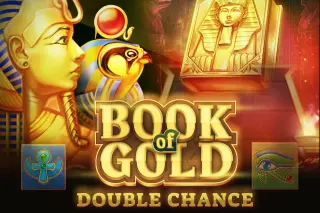
Book of Gold: Double Chance Slot – Free Demo
Added: Feb 17, 2026
Updated: Apr 7, 2026
Provider:
Playson
Book of Gold: Double Chance is Playson's attempt to justify yet another Egyptian book slot — and to its credit, it has one actual argument: two expanding symbols in the free spins instead of the genre-standard one. On a 5×3 grid with 10 fixed paylines, the Book handles wild and scatter duties,…
Play Book of Gold: Double Chance demo
What Book of Gold: Double Chance actually is
Book of Gold: Double Chance is Playson's entry into one of the most saturated slots sub-genres in existence: the Egyptian book format. Five reels, three rows, 10 fixed paylines, one multi-purpose Book symbol, and a free spins round that does all the heavy lifting. The RTP sits at 95.04% — below the 96% floor that experienced players typically use as a reference — and volatility is rated high. The maximum win is 2,000× your bet.
The single legitimate differentiator is the dual-expander setup inside free spins. Standard book slots pick one symbol to expand across reels before the bonus begins. This one picks two. That's not a reinvention, but it's a real structural change that affects how often full-reel expansion events occur during the 10-spin feature. Everything else — the base game, the symbol hierarchy, the pacing — follows the book-slot blueprint without deviation.
Our Minty Verdict: Playson solved the book-slot sameness problem by adding exactly one expander to the standard setup — call it incremental, but at least it's something real. The Gilded Time-Waster here is the base game itself: a high-volatility, sub-96% grind that pays just enough in small line wins to keep you seated while the actual math model waits inside the free spins. The dual-expander selection is genuinely better than single-expander book clones when the right symbols get picked — and genuinely forgettable when they don't. A 2,000× ceiling won't reshape your bankroll, but it's an honest number for what this slot is. Ancient Egypt has funded worse time investments. Not many, but some.
Book of Gold: Double Chance — how the base game plays
The 5×3 grid with 10 fixed paylines means nothing changes from spin to spin except the symbols landing on them. Wins pay left to right. There are no cascades, no reel modifiers, no cluster pays — just a straightforward line-hit model where bet size is the only variable you control. The betting range runs from 0.10 to 100 per spin, and autoplay is available for players running longer base-game samples to gauge Book frequency before settling on a stake.
In honest terms, the base game is a waiting room. Card-rank filler symbols generate small, frequent hits that barely offset spin cost. Premium icons produce larger line wins when they align, but the math model isn't built around base-game payouts — it's built around the free spins. What the base game actually does is burn through your stack at a controlled rate until three Book symbols decide to land simultaneously.
The Book symbol: one icon, two jobs, one purpose
The Book functions as a wild — substituting for any other symbol to complete line wins — and as the scatter that triggers free spins when three or more land in a single spin. That dual role gives it a small amount of base-game utility beyond the trigger function: a Book dropping into a useful reel position can occasionally rescue a near-miss line outcome. It's a minor quality-of-life detail, but it does reduce how often the base game feels completely inert.
The honest read: every spin in the base game has one primary question attached to it. Did enough Books land? If no, the card-rank hits are consolation prizes. If yes, the slot switches modes and the math finally starts performing.
💡 Minty Tips
- ✅ Size the bet for endurance, not optimism. A 95.04% RTP concentrated inside free spins means the base game runs at a structural deficit. Budget for 60–100 dry spins between bonuses to avoid chasing with inflated bets.
- ✅ Two expanders beat one — but random selection limits the upside. If both selected symbols are card-rank fillers, the expansion events during free spins will underdeliver. There is no way to influence selection. Factor the variance into expectations.
- ✅ Retriggers are where the ceiling becomes reachable. Expanding symbols are only live during free spins. A retriggered bonus extends that window significantly — a clean 10-spin run that ends immediately rarely approaches the 2,000× cap. Retriggers do.
The dual-expander free spins: where the math model lives
Three Book symbols anywhere on the reels launches 10 free spins. Before the bonus starts, two symbols are randomly selected from the paytable. When either of those symbols lands on a reel during free spins, it expands to fill the entire reel vertically. A grid where multiple reels simultaneously show a full column of the same high-value symbol creates the payout density that defines the slot's upside — and the "Double Chance" label refers directly to having two symbols capable of doing this instead of one.
The practical difference over a single-expander setup: statistically, at least one expansion event per spin is more likely when two symbols can trigger it. That tends to reduce the number of completely blank free spins and increase the frequency of visually active, potentially rewarding outcomes. Whether it translates to a materially better bonus session depends on which two symbols the game selects and how they interact with the reel layout during those 10 spins. A high-value premium pair selected as expanders and a lucky reel set can push toward the ceiling. Two card-rank selections will not.
Retriggers are possible by landing additional Book symbols during free spins. Each retrigger extends the bonus and — critically — keeps both expanding symbols live. Multiple retriggers compounding high-value expansion runs represent the realistic path to the 2,000× maximum win.
Book of Gold: Double Chance math model — RTP, volatility, max win
The 95.04% RTP is feature-concentrated. Most of the long-run return is generated inside free spins, which means the base game is operating at a higher effective house edge than the headline number implies. That's not unusual for high-volatility book slots, but it's worth being explicit about: every base-game spin you play between bonuses is contributing less return per unit than the stated RTP suggests at the session level.
High volatility plays out exactly as expected. Extended cold stretches between triggers, negligible base-game wins, then a bonus round that can either recover the deficit sharply or end without making a dent. The expansion outcomes during free spins have a wide range — the slot can deliver sharply positive runs when expansions stack across multiple reels, or it can return a single-digit multiple on a bonus that took 80 base spins to reach.
The 2,000× cap is attainable, not mythological. It positions this as a "strong session win" target rather than a transformative outlier. Players chasing extreme variance games with 5,000–10,000× ceilings will find this ceiling modest. For players who prefer a more reachable high end with a genuine dual-expander backing it up, the ceiling is honest about what it's offering.
No bonus buy, no jackpot — what's missing and what that means
Book of Gold: Double Chance offers no bonus buy option, no progressive jackpot, and no secondary base-game features. The path to the free spins is entirely organic: spin, wait for three Books, enter the feature. Players who rely on bonus buy to skip base-game variance and buy direct access to the expanding-symbol round will need to look elsewhere. The absence also means there is no shortcut to evaluating the bonus quality in real-money play — demo sessions are the only practical way to observe the dual-expander behavior without extended base-game exposure.
Where to play and what to try next from Playson
Book of Gold: Double Chance is available at online casinos stocking Playson titles. Demo play is the practical starting point — it lets you measure base-game Book landing frequency and observe how often the dual-expander setup produces meaningful expansion events during free spins at no cost to your balance.
If the format clicks, other Playson slots vary the structure meaningfully — some prioritize feature frequency over peak payout, others push toward higher ceilings with more complex bonus triggers. This title sits at the simpler, cleaner end of their catalogue, which makes it a reasonable reference point for calibrating what the developer's math models feel like before moving to more complex entries.
Book of Gold: Double Chance — FAQ
-
Q: What is the RTP of Book of Gold: Double Chance and where does that return come from?
A: The stated RTP is 95.04% — below the 96% reference point most experienced players apply. The majority of that return is generated inside the free spins bonus, meaning base-game play operates at a structurally higher house edge than the headline figure implies. -
Q: How does the two-expander setup differ from a standard book slot?
A: Standard book slots select one expanding symbol before free spins begin. Book of Gold: Double Chance selects two, increasing the statistical likelihood that at least one full-reel expansion event occurs per free spin. The selection is random — there is no player input over which symbols are chosen. -
Q: How are free spins triggered and can they be retriggered?
A: Three or more Book symbols landing simultaneously triggers 10 free spins. Retriggers are possible by landing additional Books during the bonus — each retrigger extends the feature and keeps both expanding symbols active, which is the most direct path to outcomes near the 2,000× maximum win. -
Q: Is there a bonus buy feature in Book of Gold: Double Chance?
A: No bonus buy option exists. Access to the free spins feature requires the Book scatter to trigger organically during base-game play. Players who use bonus buy to bypass base-game variance will need to consider a different title. -
Q: What betting range does Book of Gold: Double Chance support?
A: Bets run from 0.10 to 100 per spin in the selected currency. The 10 paylines are fixed — there is no option to adjust line count, so stake sizing is the only meaningful bankroll control the game offers.