

Buffalo Blitz Slot – Free Demo
Provider:
Playtech
On Playtech's Buffalo Blitz the Free Games scatter never landed three deep across 192 spins, which is the entire story of a two-hour sit at the €0.40 floor stake. The Golden Buffalo wild stacked into full reel columns at a satisfying rhythm. Spin 54 hit reels 1, 3 and 5 with the wild. Spin 152…
Play Buffalo Blitz demo
Stacks on reels one and five, blanks on reel three
The Golden Buffalo started doing the right thing right away. The first spin off the menu landed a stacked Buffalo column on the right side of the 6×4 grid and paid €0.40 back across the line, which is the stake-returned outcome the wild is built to produce. From that point on, the buffalo kept stacking. The trouble was where.
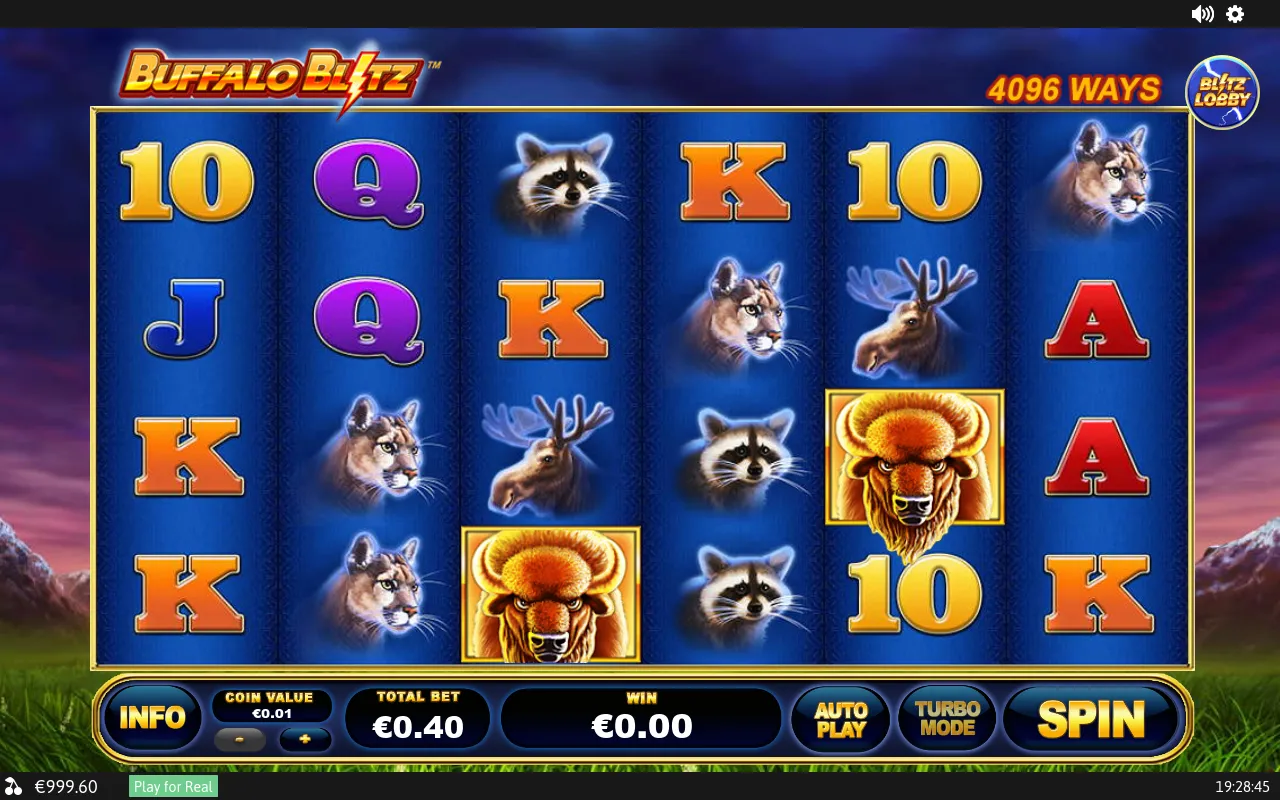
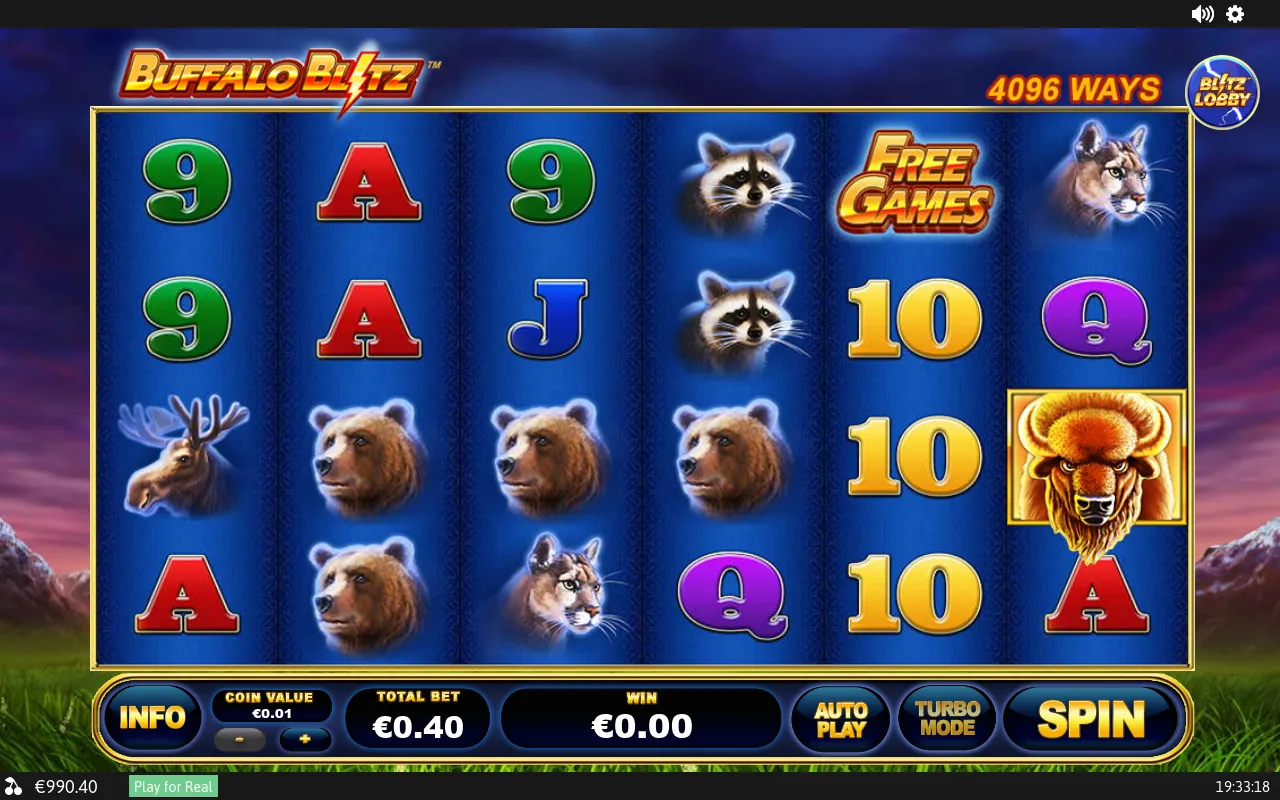
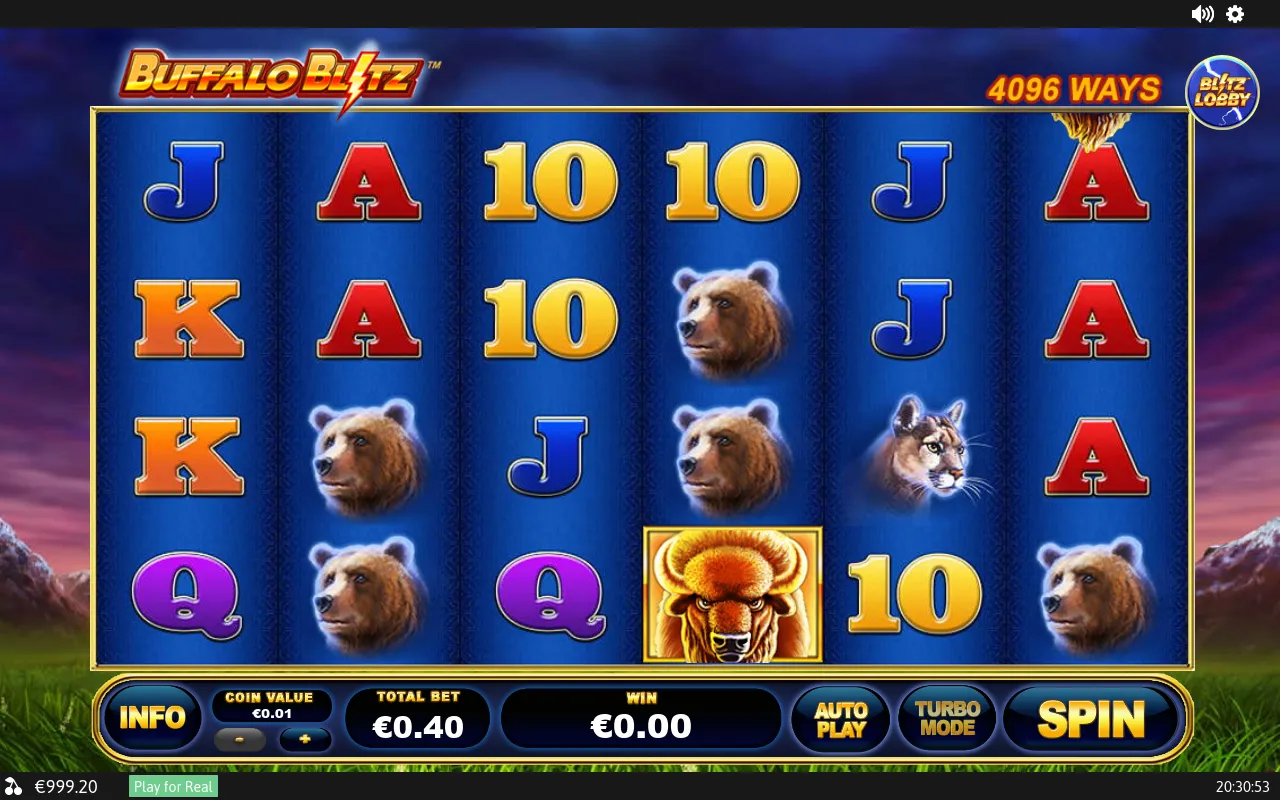
Across the next 192 spins at the €0.40 floor stake the wild appeared in tall single-reel stacks repeatedly, but rarely on three connected reels at once. Spin 54 lit reels 1, 3 and 5 with stacked Buffalo and a blank reel 2 between the first two. Spin 152 stacked reels 3, 5 and 6 with the bottom row half-empty. Spin 161 stacked reels 1 and 3 and put a single Diamond on reel 6 with nothing in between. The 4,096-ways engine wants adjacent matches reading left to right, and the herd kept landing one reel short of giving them to me. Balance opened around €997 and closed at €1,005, ducking as low as €987 at the bottom and touching €1,008 on the back of the better small wins. A net €8 across the better part of two hours, a flat result that says nothing useful about the slot's real ceiling when the Free Games scatter never landed three deep.
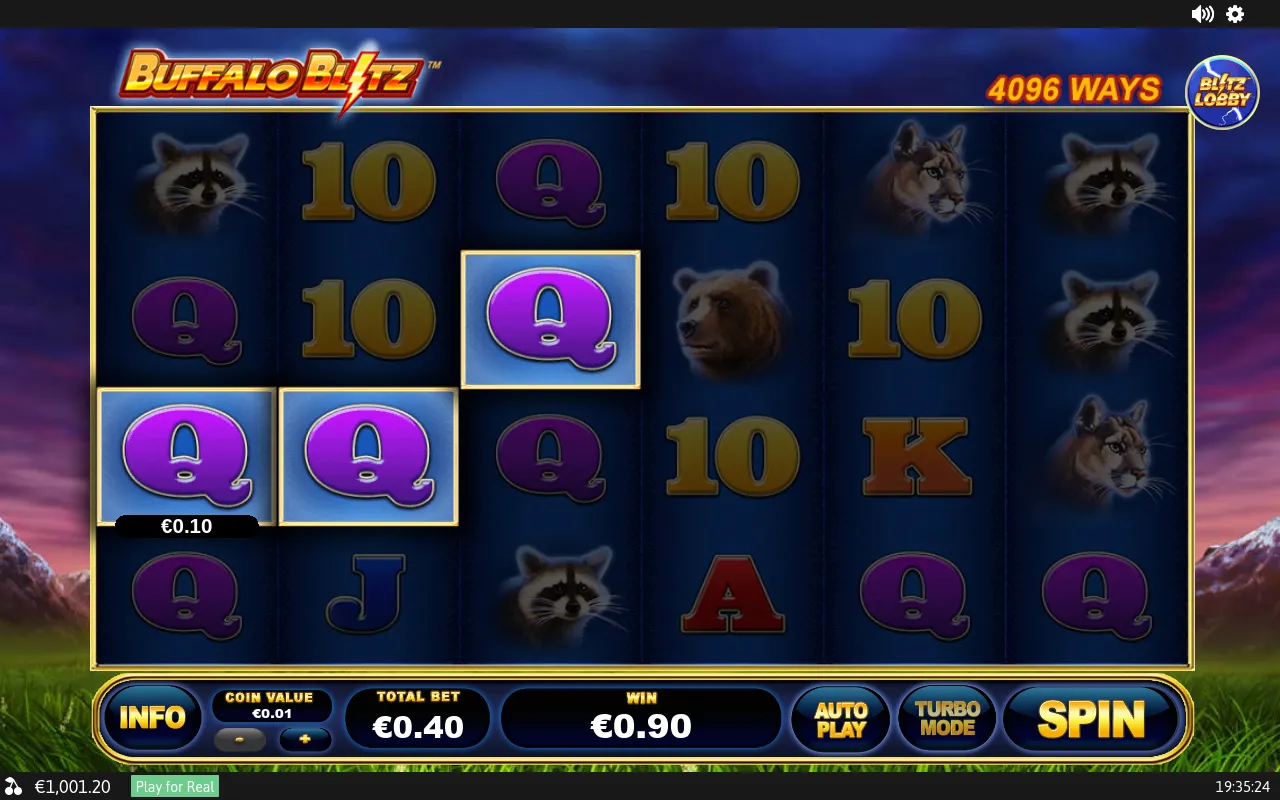
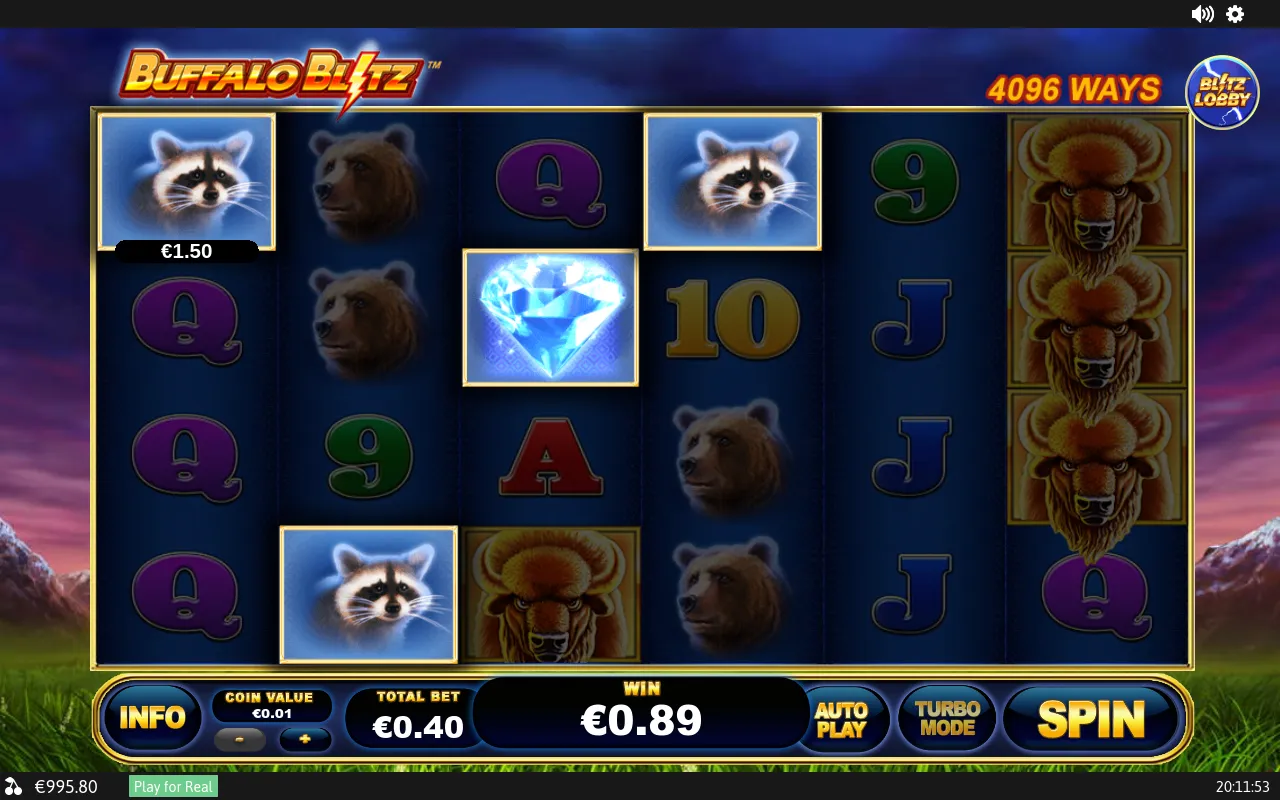
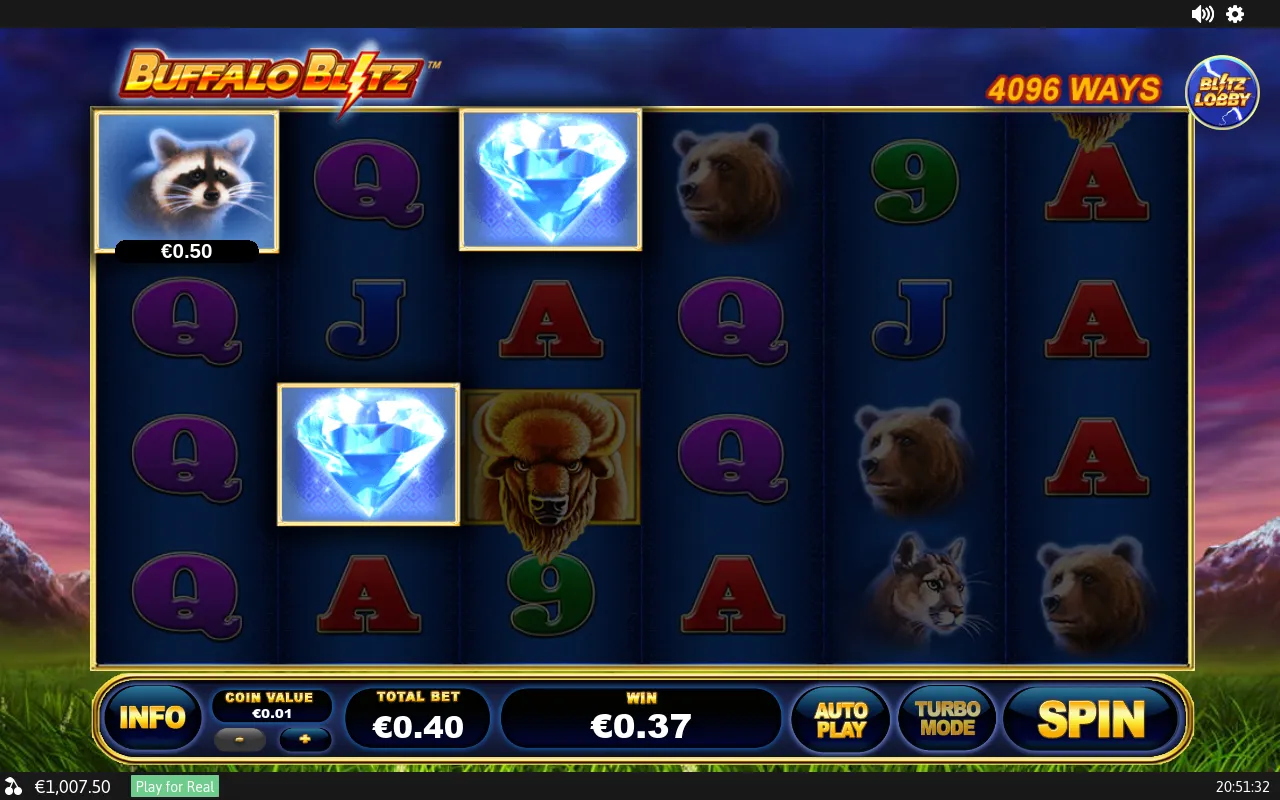
The Minty Take: 192 spins at €0.40 a pop over the better part of two hours. The balance crawled from €997 to €1,005, with €987 as the low and €1,008 as the high. The opening spin paid €0.40 on a Buffalo line. The session high came at spin 28: €0.90 on a spread of Queens. Spin 102 paid €0.89 on a raccoon line backed by a Buffalo column on the right reel, and spin 150 brought €0.37 on twin Diamonds. The Golden Buffalo wild stacked tall on single reels at a steady rhythm but only rarely on three adjacent reels at once, which is what a 4,096-ways engine actually needs. The Free Games scatter showed on the board most spins but never three deep, so the free spins round that carries the slot's multiplier track stayed closed. Both the standard 95.96% RTP build and the reduced 94.01% variant ship at different operators on this title; the one you are actually playing is written into the rules page that loads inside the game.
What 4,096 ways looks like when half of them line up
The 6×4 grid scores all-ways from left to right. Anything matching on adjacent reels counts as a paying combination, regardless of which row each instance sits in, and the math multiplies out to 4,096 separate paths for a winning read across the full six reels. On paper that is a lot of paths. In practice the engine needs symbols on connected columns, and the Buffalo's habit of stacking with a gap on the reel beside it kills the geometry.
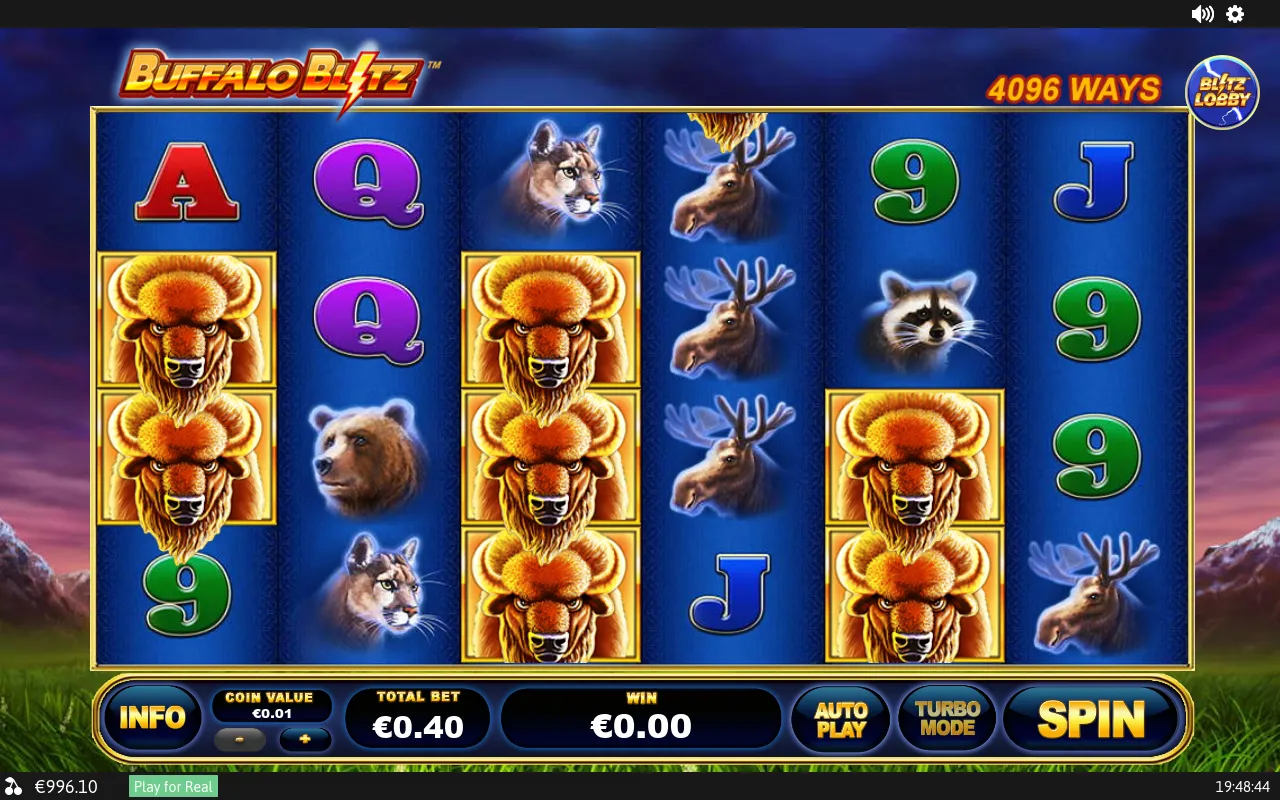
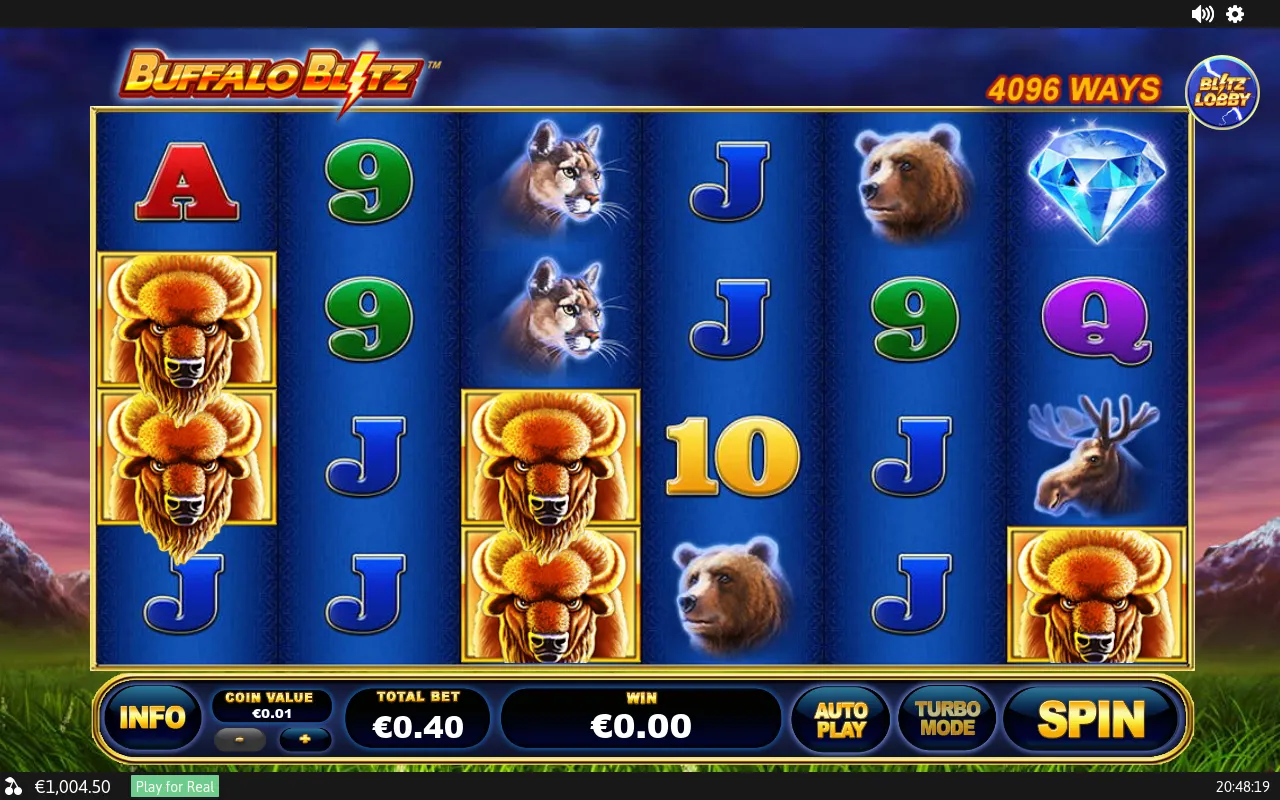
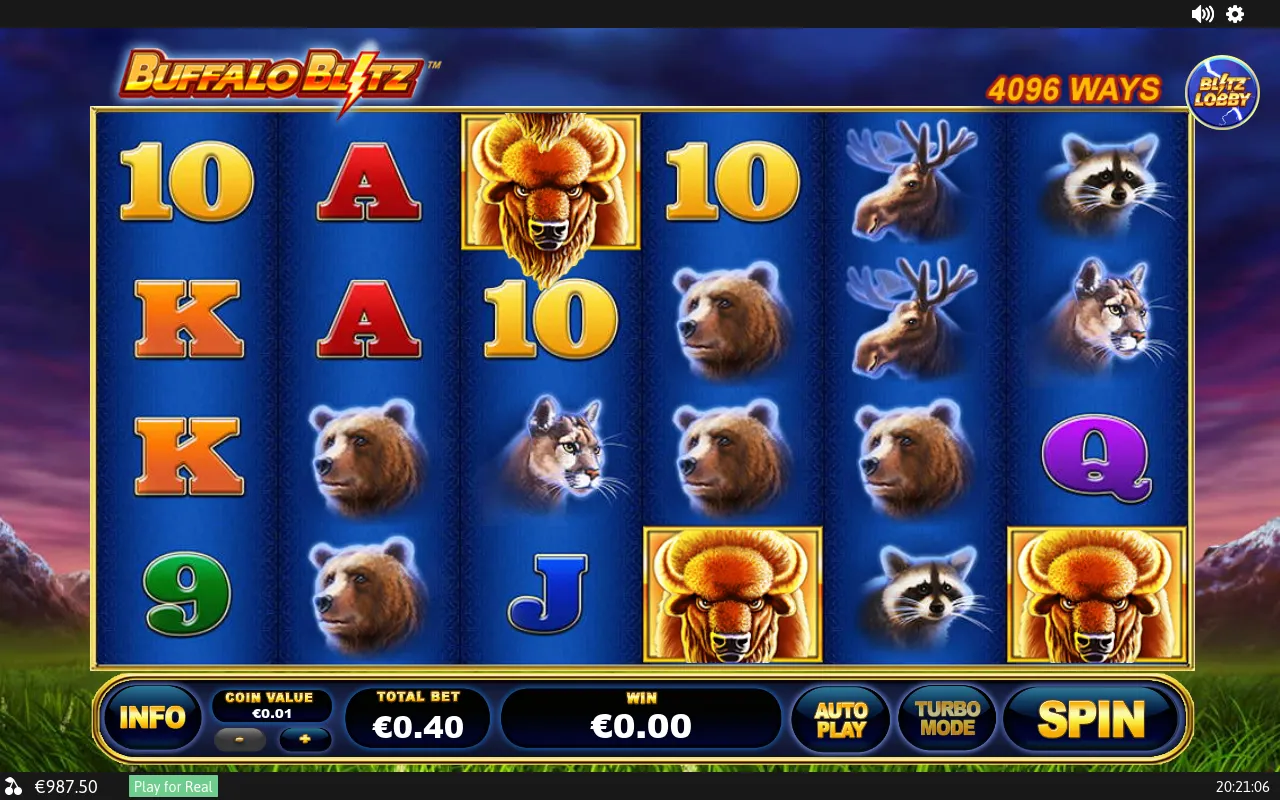
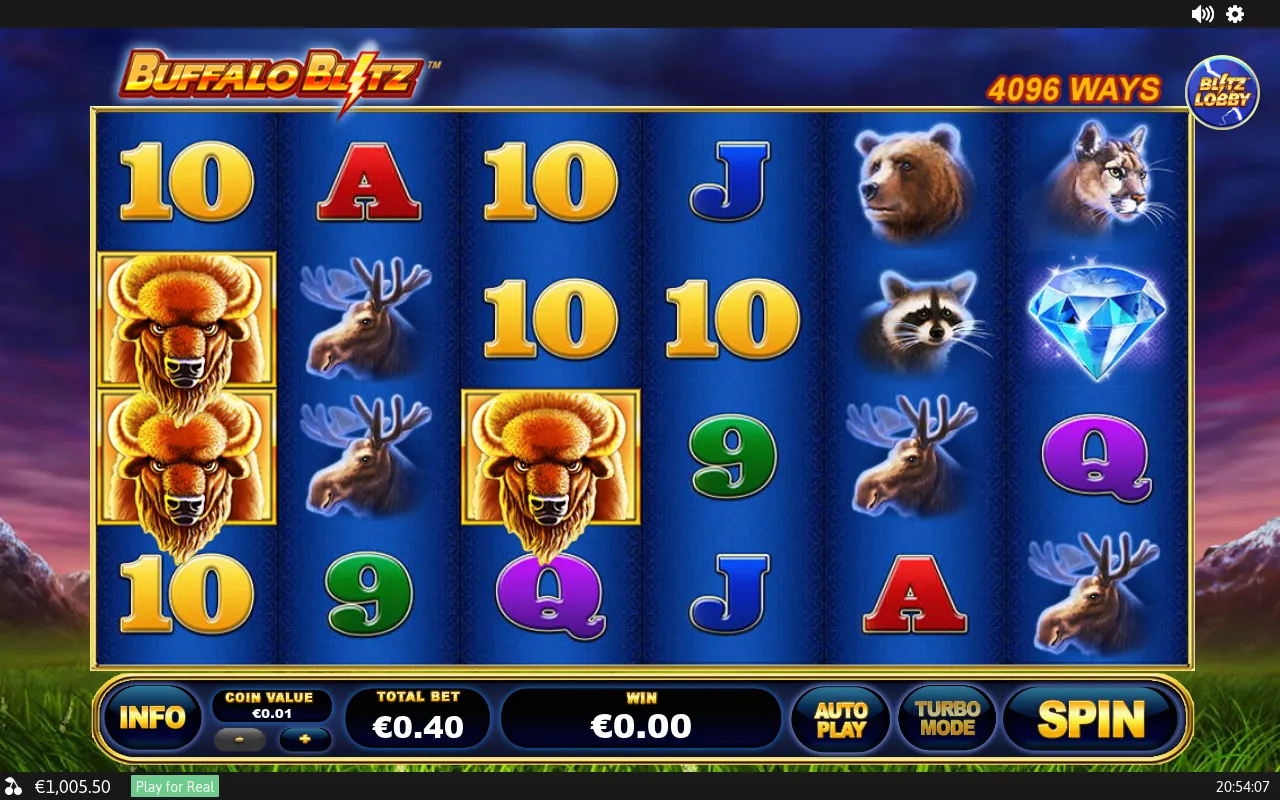
Four of the more dramatic near-stacks sit above. Two-reel-apart stacks generate plenty of small wins on whatever low and mid symbols happen to sit between them, but the 4,096-way count only earns its reputation when premiums or wilds connect across three or more reels in sequence. The wild substituting for everything is what makes the rare three-reel-stack spin pay meaningfully, and across the run I caught none reading across cleanly. The closest was that spin 152 board, where reels 3, 5 and 6 stacked and the lower rows on reels 1 and 2 carried enough mid-tier animals to pay a flat €0.32 line. Useful. A long way from what a properly connected stack would have settled.
€0.90 on Queens and €0.89 on raccoons with a Buffalo column behind them
The session's best win came at spin 28 on a spread of purple Queens, low-paying card royals that happen to populate the grid more densely than the premiums and therefore connect more easily across multiple reels. The settle was €0.90, slightly over double the stake. On a 4,096-way grid a Queens spread paying double is not a feature event; it is the slot quietly delivering what its frequency table allocates to the low tier when the cards happen to land thick.
Spin 102 ran the same shape on raccoons stretched across the centre rows, with the right-hand reel stacked full of Buffalo wilds providing the substitution that closed the line. The win settled €0.89, almost identical to the Queens line off a completely different combination. Spin 150 later in the run brought twin Diamonds and a raccoon together for €0.37, which confirmed the Diamond's pay role on the grid. The symbol kept turning up in supporting spots through the rest of the session without ever doing lead work, true to its place as a higher mid-tier on the active build.
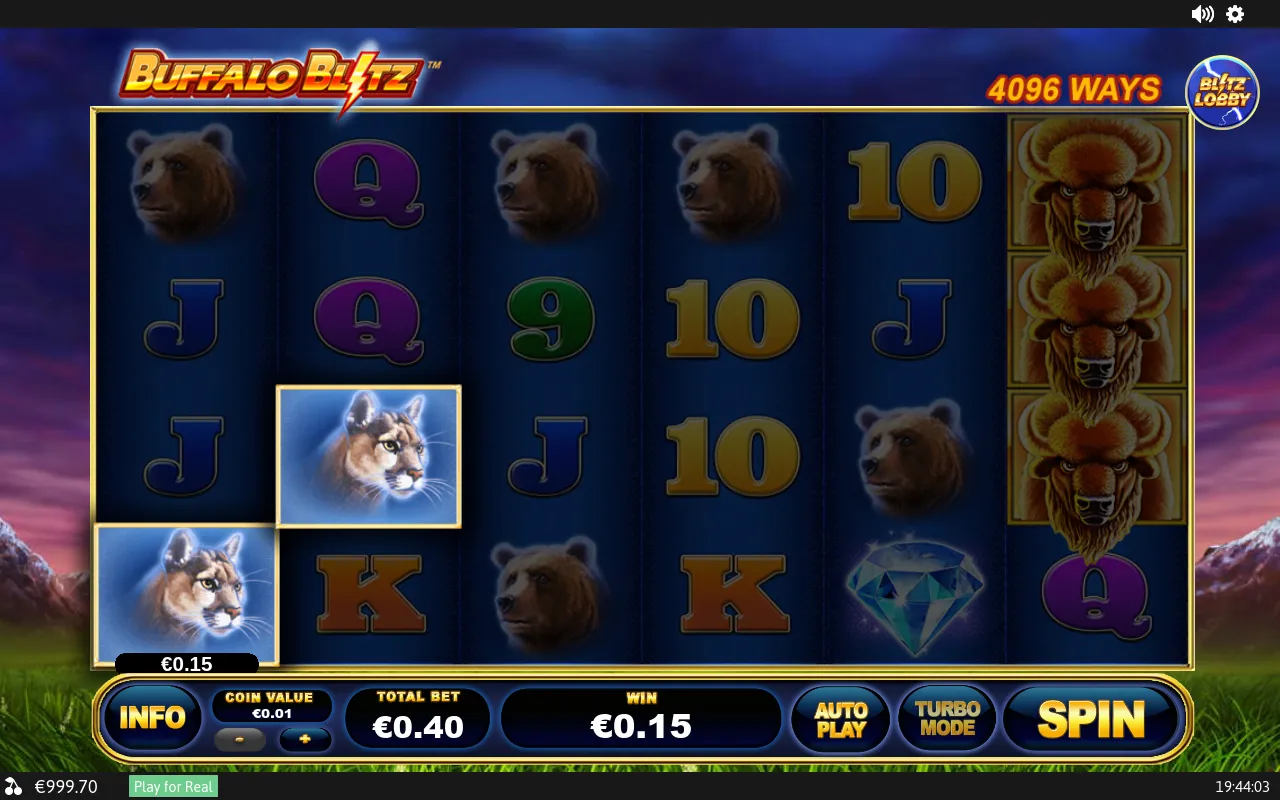
Spin 37 added a €0.15 cougar pair with a Buffalo stack on the right that did not extend its line further than three reels. That sits in the same category as most of the run's small wins: the wild was present and the geometry was halfway there, but the rest of the symbols would not commit. Across 192 spins the four entries above are the paying lines worth naming. Everything else lived between €0.05 and €0.20 and washed against the stake on the next two spins.
The Golden Buffalo as scaffolding, not a finisher
The Golden Buffalo on this build doubles as the wild and the top premium symbol. It is the piece the whole 4,096-way math leans on, substituting for the other paying animals when needed and combining with itself when a column comes in full. What it does not do, with any regularity in the base game, is finish a high-value line on its own. Through 192 spins I never caught a full-column Buffalo stack reading across three connected reels with another premium running through it; the closest was a Buffalo column on the right reel feeding into a raccoon line for that €0.89 settle.
That is consistent with how Playtech parks the volatility on this title. The wild's job in the base game is to bridge near-misses on low and mid symbols, keeping the run alive and the balance bumping inside a narrow band. The bigger lines and the multiplier behaviour sit inside the Free Games round per Playtech's published spec, which is the only place a vertical stack of wilds is supposed to translate to a notable payout. None of that machinery activated on this sit, and what I saw was the scaffolding doing the slow work it is paid to do.
The Free Games scatter that never paired three deep
Three or more Free Games scatters trigger the bonus round on Playtech's published spec, with the initial allocation scaling on the count up to a hundred free spins on a six-scatter hit. The base game does not offer a bonus buy on the standard build, so the only way into the multiplier system is through scatters that land in trigger numbers on a paid spin. Across 192 spins the scatter showed on the board on a steady fraction of turns. Usually it was a lone tile on reel one or reel six, with one or two boards carrying two scatters at once but never three converging on the same paid spin.
That single observation captures everything about how Buffalo Blitz distributes its return. The published volatility on this title is classed high, which means the headline pays are concentrated inside the free spins round and a long base-game sit can absorb the variance without ever reaching the compensating event. The balance reading of €8 net across the run carries no information about the slot's average return; it is just where the random walk happened to land in the absence of a trigger. A longer sit, or a stake high enough to make the wait expensive, is the structural risk on this design.
€0.40 a spin and the case for the floor
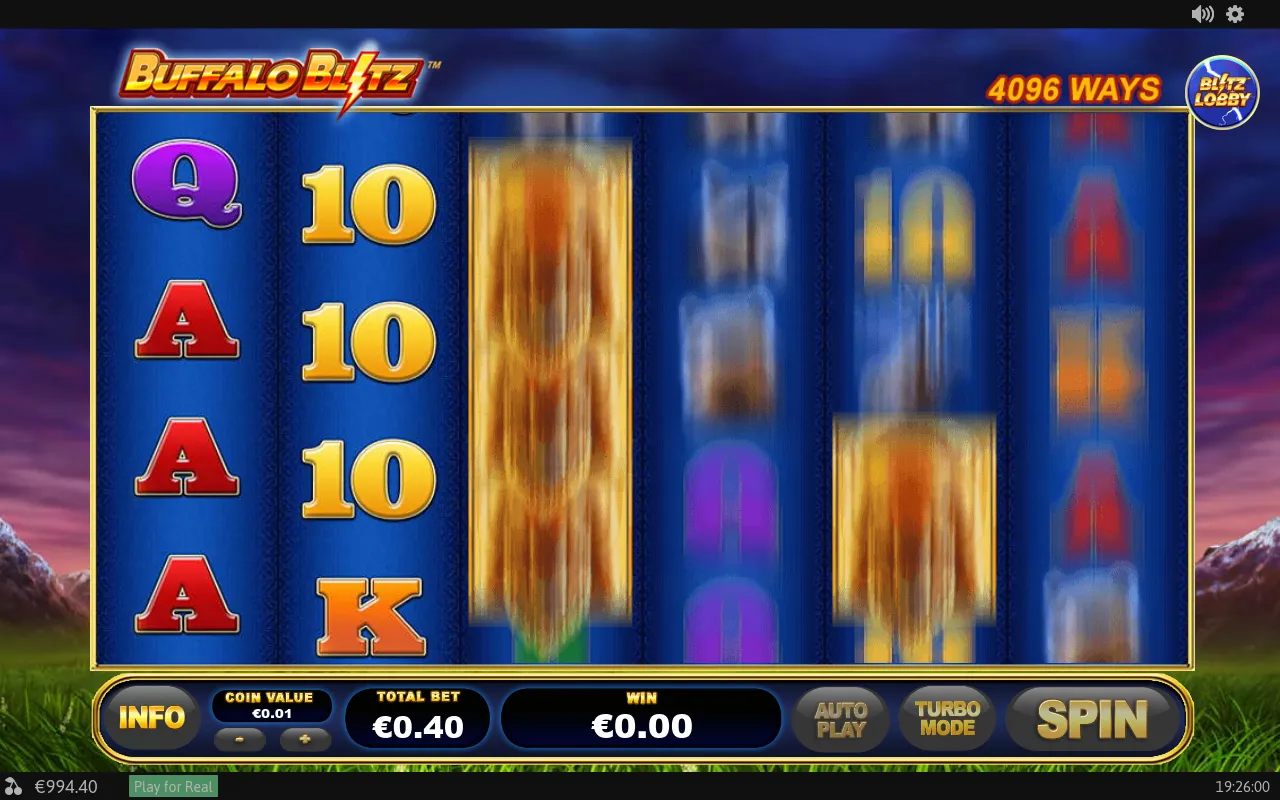
The control panel runs €0.40 at the bottom and €80 at the top across the standard build, with autoplay and quick-spin in the side menus. The €0.40 floor stake covers all 4,096 ways at once, which means there is no per-line dial to adjust and no way to economise on the count itself. The choice is the total stake; the geometry comes with it.
On a high-volatility slot where the return lives in a free spins round that requires three of a relatively infrequent scatter to open, the rational session structure is a longer sit at a stake your balance can absorb through the gap. I ran the floor for two hours and the cost of the wait was €8 net positive, which is to say almost nothing; the variance never reached me. The same two hours at the top of the bet ladder would have produced a wildly different bank movement on identical reel sequences, and on a session where the bonus also never triggers, the bigger stake just buys a longer cold stretch with the same eventual outcome.
The other variable on this slot is which RTP build your operator runs. Playtech ships Buffalo Blitz as both a 95.96% and a 94.01% configuration; the difference compounds across a long-volatility sit, and the figure your casino is serving is shown inside the game's own rules tab, not always on the lobby card outside it.
The Buffalo Blitz titles that came after
Playtech has built a small family around this original. Playtech's full studio catalogue on the site lists the variants alongside the rest of the inventory; the two worth flagging here are Buffalo Blitz Megaways, which trades the fixed 6×4 grid for a dynamic ways count that shifts every spin, and Buffalo Blitz Cash Collect, which bolts a coin-collection layer onto the same wildlife theme. Neither is a straight upgrade. The Megaways version moves the variance around inside the same multiplier philosophy and changes the texture of dry stretches; the Cash Collect version adds an accumulation mechanic that pays differently from a free spins round. All three share the same source theme and the same Golden Buffalo wild doing the substitution work.
For a 2016 release this original has aged on the cleaner end of the spectrum. The presentation does not draw attention to itself, and the math model is transparent enough that you can read what the grid is doing on every spin. The lack of a bonus buy is the kind of design choice that ages well now that the rest of the catalogue is chasing instant-feature shortcuts. Whether the patience tax is worth your bankroll depends entirely on what the rest of your session library looks like and how long you are prepared to wait for a free spins round that arrives, on average, once in a few hundred spins.