
Added: Mar 11, 2026
Updated: Apr 7, 2026
Provider:
Relax Gaming
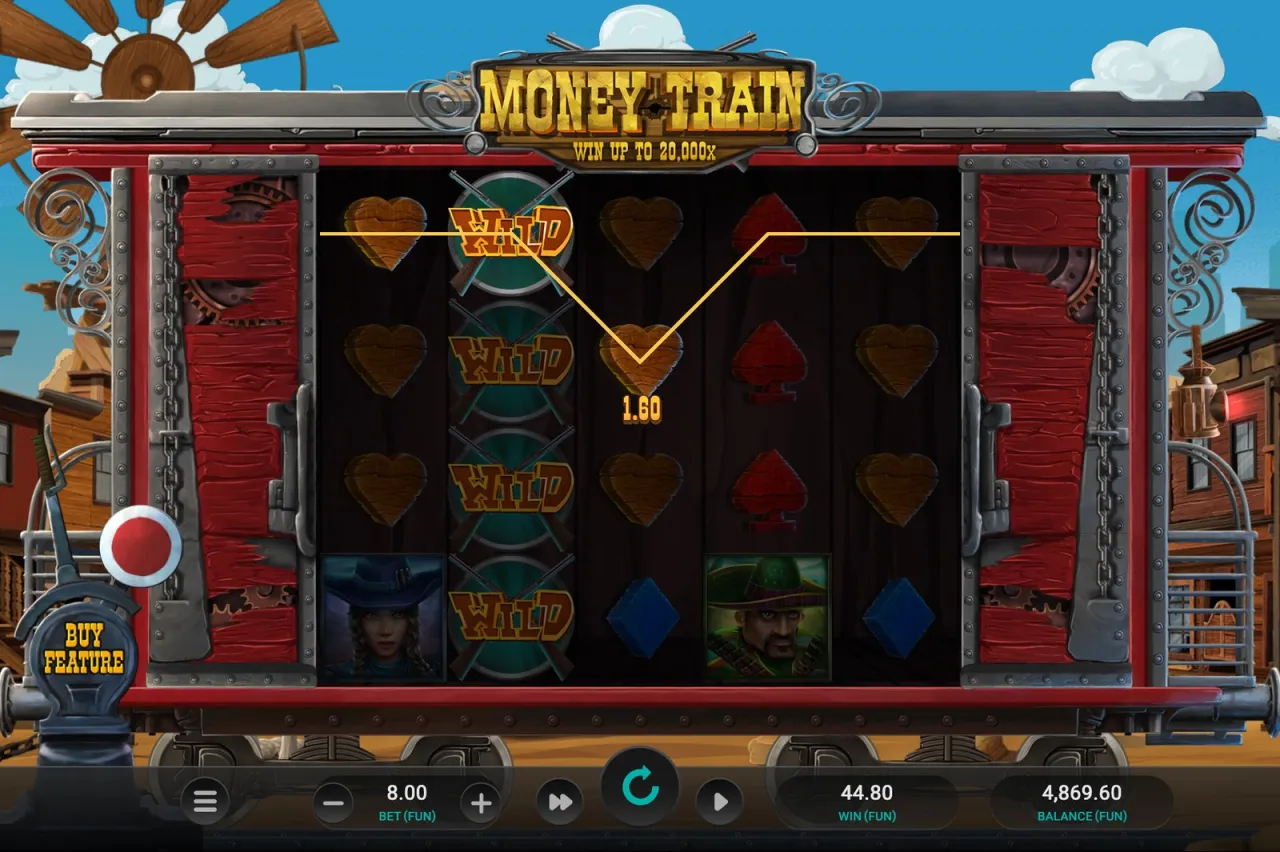
Money Train by Relax Gaming is a high-volatility Wild West slot on a 5×4 grid with 40 fixed paylines, a 96.20% RTP, and a maximum payout of 20,000× bet. The base game is deliberately lean — stacked wilds, outlaw premiums, card-suit filler — and functions almost entirely as a loading screen for the…
Released in August 2019, Money Train is the slot that turned Relax Gaming from a respected mid-tier studio into a franchise builder. The game runs on a 5×4 grid with 40 fixed paylines, a 96.20% RTP, and a 20,000× bet ceiling. It wears a gritty frontier aesthetic — outlaws, dusty towns, train carriages — but the theme is window dressing. What actually matters is the Money Cart bonus round: a sticky respin system where symbol roles interact, values compound, and the grid can physically expand. The base game is a prelude. The feature is the argument.
The design logic is unapologetic: keep the main reels simple, concentrate all the mathematical personality inside one major feature, and let the bonus do the heavy lifting. That gamble paid off. Five years and three sequels later, the original Money Train still holds up as the cleanest version of the formula — before Relax started layering in extra complexity to justify "2" and "4" suffixes. If you want to understand what the series is actually selling, this is the right place to start.
Minty Slots Verdict: The base game is a waiting room with a western paint job — card-suit noise, the occasional stacked wild, and three bonus symbols standing between you and the only part of this slot that matters. When the Money Cart does land, the cruelest outcome is a collector arriving too early, sweeping a near-empty board and delivering a payout that insults the trigger cost. But when sequencing clicks — payers boosting values, a persistent collector snowballing the accumulated total, wideners cracking the grid open to seven columns — the 20,000× ceiling stops feeling like marketing copy. High volatility, feature-first math, and zero base-game comfort blanket: Money Train is not trying to please everyone. It is trying to be unforgettable once per session.
Money Train skips the cartoon-western approach entirely. The palette is dark, the outlaw characters are drawn with grime rather than charm, and the soundtrack leans into dread over excitement. That tone is a deliberate signal: this slot is not asking you to relax. The visual language stays intentionally sparse — train parts move in the background, the frontier town looms — but nothing competes with the reel symbols for attention. Relax built a presentation that makes the bonus symbols easy to track under pressure, which matters when a collector and a persistent payer land simultaneously and you need to understand what just happened to your grid.
Lower-value symbols are card suits. Premium symbols are gang members and the sheriff. The shotgun wild substitutes for standard symbols and appears stacked, which is the only real base-game device delivering line-win density. It does its job — keeps the main reels from feeling completely inert — but nobody is playing Money Train for wild combinations. The theme earns its keep by making the dangerous math feel appropriately dangerous, and by that measure it succeeds.
Five reels, four rows, 40 fixed paylines, left-to-right wins. The bet range opens at 0.10, which keeps entry accessible, but the low floor does not imply low variance — this game is built squarely for players prepared for uneven sessions. Base game hits come from card-suit combinations and premium character clusters, assisted occasionally by stacked wilds. That is the entire inventory of base-game entertainment.
Relax stripped the main reels deliberately. There is no expanding-symbol side feature, no cascading multiplier track, no pick-me distraction. The base game exists to pace the session and deliver the bonus trigger. Three Money Cart symbols anywhere on the reels launch the feature. Between triggers, the slot runs as a straightforward payline grinder — functional, quiet, and honest about what it is. If you need the main reels to carry the entertainment load, Money Train will test your patience before it touches your bankroll.
The published RTP is 96.20%, but that number requires context. A significant portion of the long-run return is concentrated inside the Money Cart bonus round. Base game spins distribute value sparingly — small line wins, occasional wild contributions, mostly rhythmic noise. The meaningful math lives in the feature, which means session-to-session variance is pronounced. Dry stretches in the main reels are the norm, not the exception.
Volatility is high, and the numbers support that label without argument. Wins in the base game arrive in modest increments. The feature, by contrast, can scale in sudden jumps when collectors chain off payer-boosted values or when wideners open new landing space mid-respin. Return is back-loaded by design: the slot is not trying to keep you comfortable across the session — it is trying to make one or two features per session count for a lot. The maximum payout is 20,000× bet — a fixed ceiling, not a progressive pool — and reaching it requires a feature where persistent modifiers, reel expansion, and high-value symbol placement all converge at the right moment.
The Money Cart bonus starts with three respins. Every time a new bonus or special symbol lands, the counter resets to three. The feature stays alive as long as fresh symbols keep arriving; once the respins run out with no new landing, the round ends and total values are paid. Every symbol that lands is sticky — it holds its position for the remainder of the feature. The grid accumulates. The order in which symbols arrive determines everything.
The triggering bonus symbols carry bet multiplier values displayed on the face. Additional value symbols can join them during respins. The real intelligence of the feature, however, comes from role-based symbols that do not just add a number — they change the state of the entire board:
The widener is the feature's most decisive symbol. A board that looks capped on a standard grid can turn genuinely explosive once extra columns are open and persistent modifiers have more surface area to operate on. Landing wideners early is the difference between an ordinary feature and one that approaches the ceiling.
Money Train's feature is most accurately understood as a sequencing problem. A collector that lands on respin one — when the board holds only its own triggering value — sweeps almost nothing. The same collector landing on respin seven, after three payers have boosted a full board, sweeps an accumulated total that can define the entire session. Same symbol type, radically different outcome, entirely determined by arrival order.
That sequencing tension is what made this format replayable and what drove Relax to build a sequel series around it. The sticky grid means every landing is permanent and consequential. Persistent effects compound over time rather than firing once and disappearing. The respin reset keeps the feature alive under the right conditions, injecting drama into what could otherwise feel like a passive watch-the-numbers-go-up exercise. Anyone who explores more Relax Gaming titles will find this same DNA across the later Money Train entries — refined but immediately recognizable.
A bonus buy option is available, and its existence confirms the slot's honest self-assessment: the base game is not the point. Players who want to skip the main-reel holding pattern and go directly to the feature can do so at a set cost. Whether that cost is rational depends on bankroll size and patience threshold — the feature math is identical either way. You are buying time, not an edge.
The layout holds up well on mobile. Bonus symbols stay visually distinct at smaller sizes, which is non-trivial when a persistent collector and two payers are simultaneously active and you need to track interactions in real time. The demo mode functions as a practical teaching tool — running two or three feature rounds in free play will show you how respins reset, how wideners shift the ceiling, and why a persistent payer landing early carries a fundamentally different weight than one arriving late.