
Valley of the Gods Slot – Free Demo
Provider:
Yggdrasil Gaming
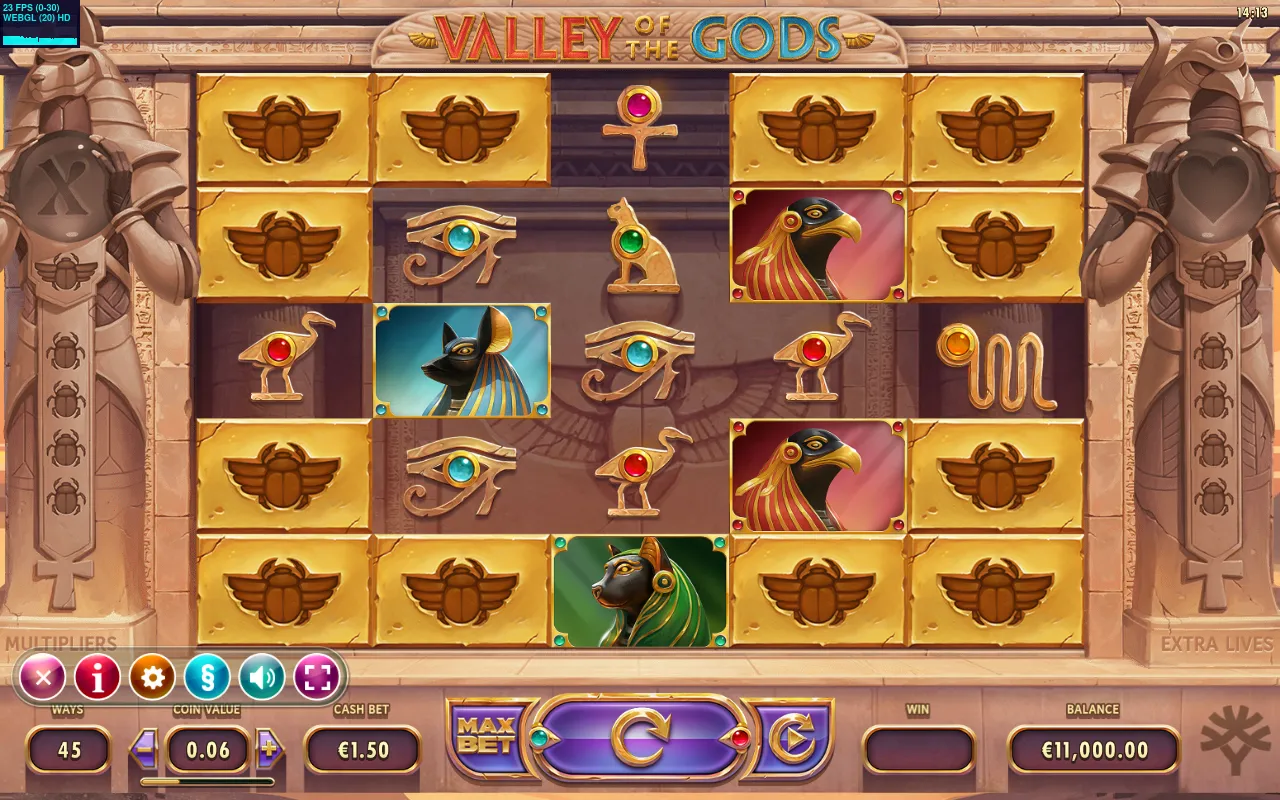
I sat down with Valley of the Gods on a flat €1.50 bet and a balance of €11,000, and for a long opening stretch it barely registered. Yggdrasil builds this on a 5x5 grid that opens at only 45 ways, and it stays that narrow until your wins start clearing the winged-scarab tiles covering most of the…
Play Valley of the Gods demo
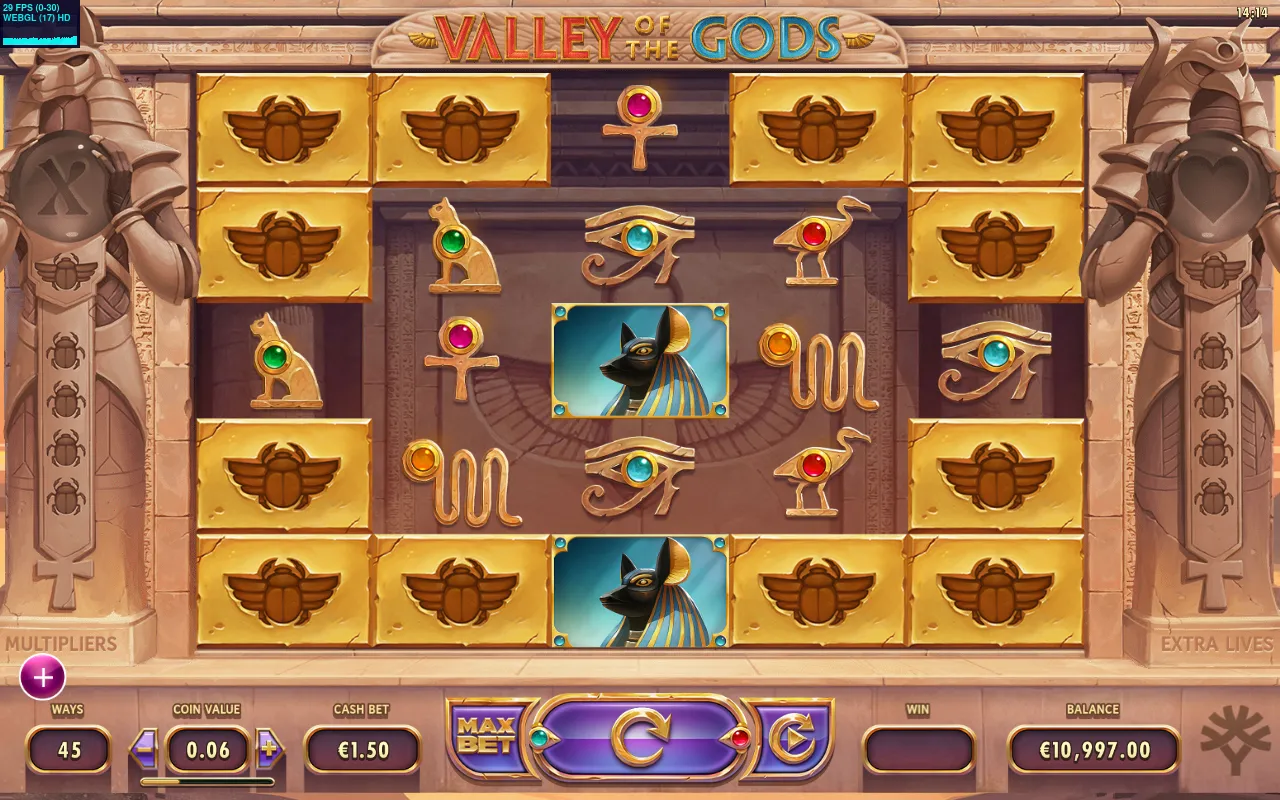
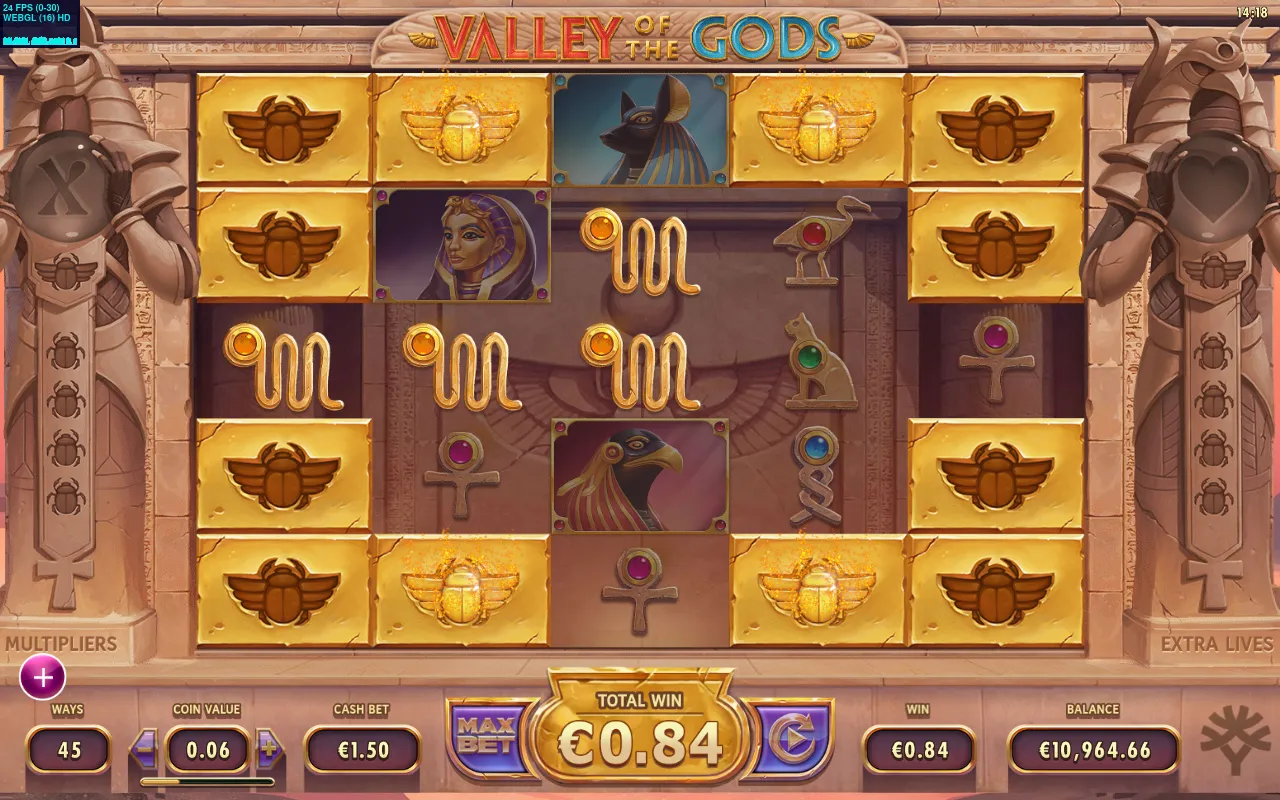
The Grid Starts at 45 Ways and Makes You Earn the Rest
Most of the board is locked when you start. Every position not in play wears a golden winged-scarab back, and the game treats those as blockers. You open with 45 ways, and the only route to more is winning: each cascade clears a scarab or two and drops a fresh symbol into the gap, nudging the ways count up. Spin without connecting anything and the grid never widens. My first dozen turns were exactly that, scarab backs staring back while the balance ticked down in small bites.
That makes the early game slower than a lot of modern Egyptian slots, where a scatter can rescue a dead spin out of nowhere. Here there is no rescue. The board only pays momentum, so a quiet stretch stays quiet until a win finally lands and the cascades take over. I sat through settled grids with four god portraits lined up two columns deep that paid nothing, the kind of close landing that looks like it should connect and doesn't.
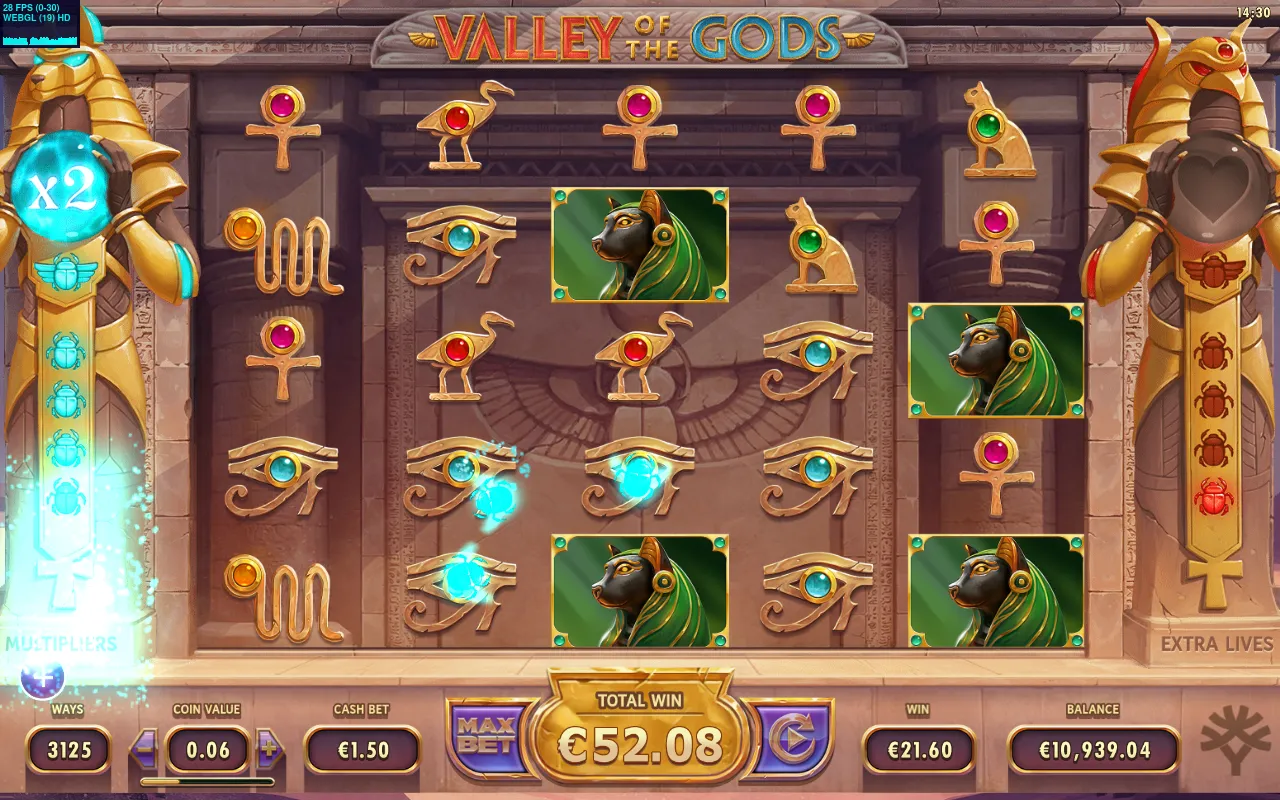
The Minty Take: Valley of the Gods is a patience game. The 5x5 grid opens at 45 ways and only widens toward its 3,125-way ceiling when your wins keep clearing scarab tiles, so the value sits in the streaks and not the spins between them. My best run lit the obelisk feature, stacked a x2 multiplier and paid €52.08 from a €1.50 stake, well short of the 4,500x the paytable holds at the top but enough to carry the session. Mid volatility, and it plays exactly like it.
Watching the Ways Counter Climb: 45, 320, 1,125, 3,125
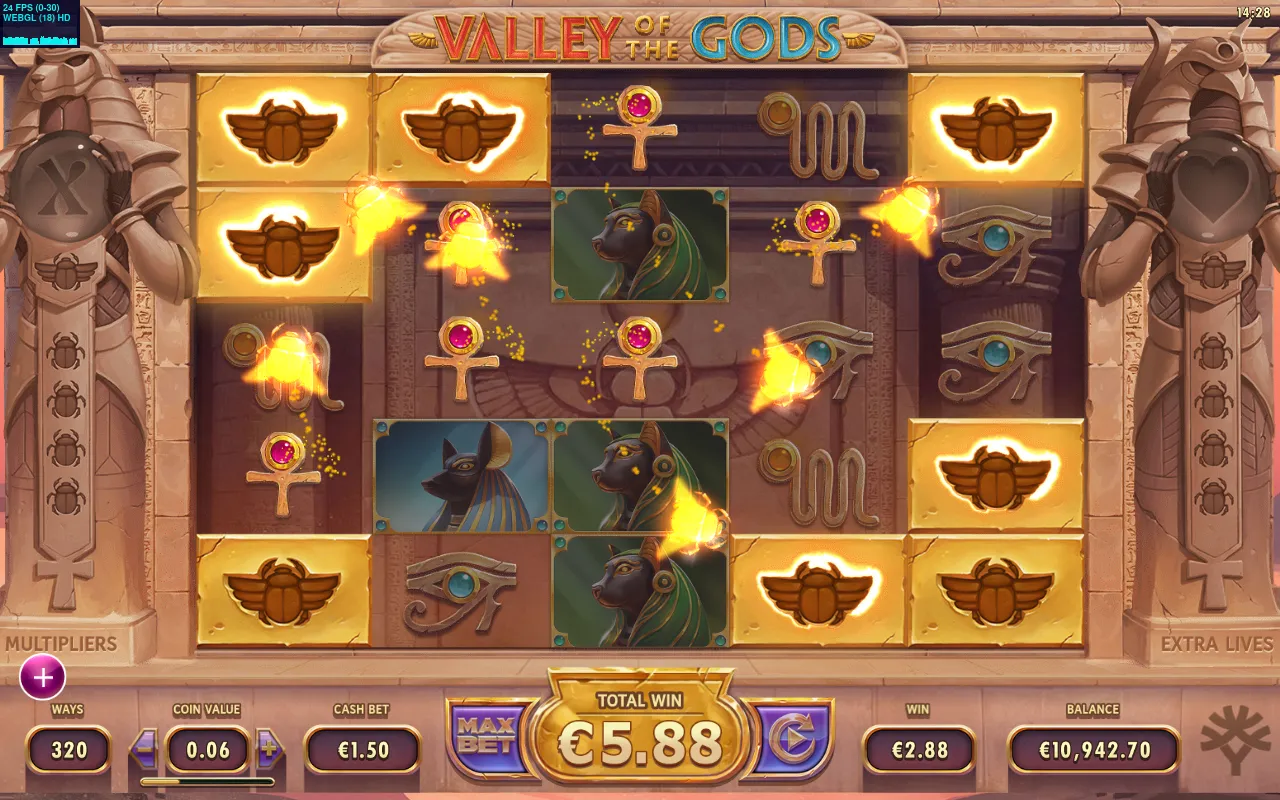
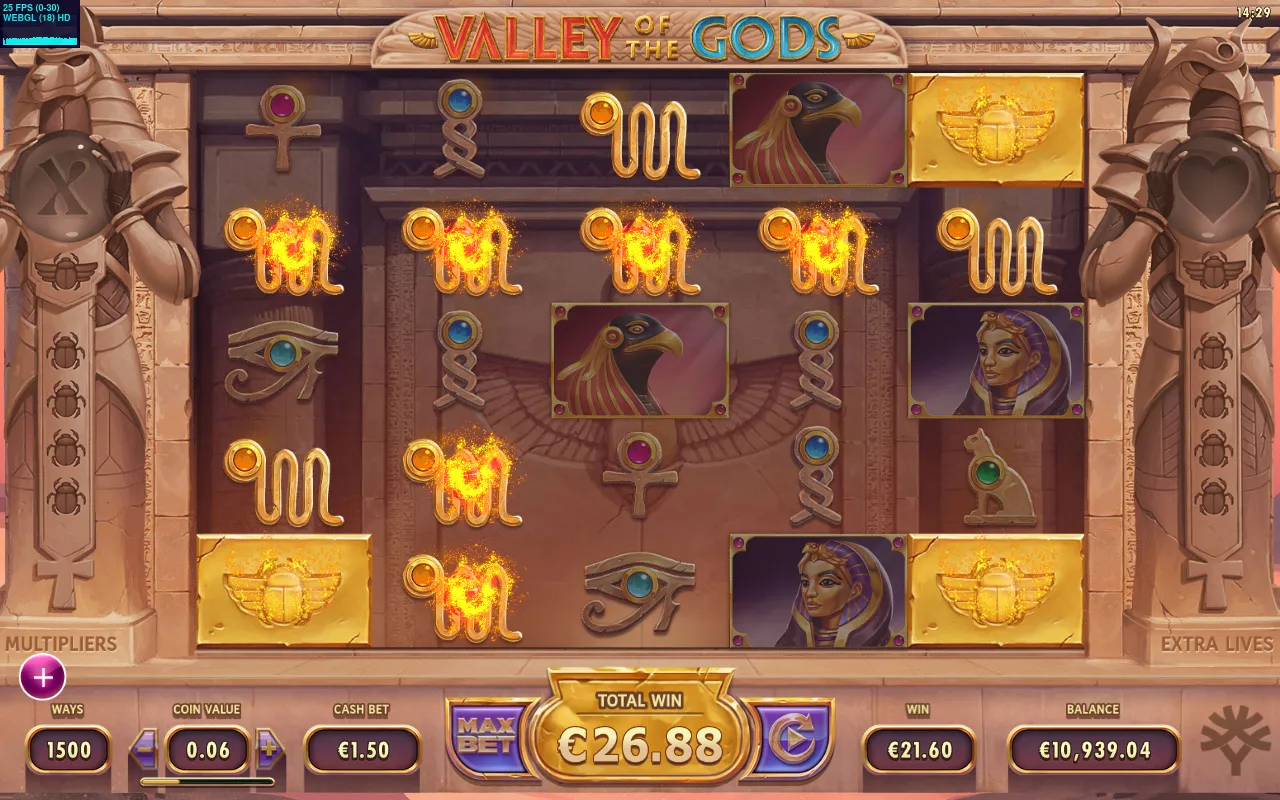
When a run does get going, the climb is the best part of the game. My middle stretch is where it clicked: a scarab row ignited for €2.88, the cascade cleared tiles, and the ways counter jumped from its base 45 past 320. The next chain carried it to 1,125, then 1,500, each cascade unlocking more of the grid and paying a little more than the last because there were suddenly more ways for symbols to align. By the time the feature kicked in the counter read 3,125, the fully open 5x5 board.
This is the loop the whole slot is built on, and it is genuinely good to watch once it starts. The catch is that it needs a seed win to begin, and on cold spins that seed never arrives. When it does, a €0.48 nudge can snowball into a board paying across more than a thousand ways inside a few tumbles.
The Obelisks: a x2 Multiplier and One Extra Life
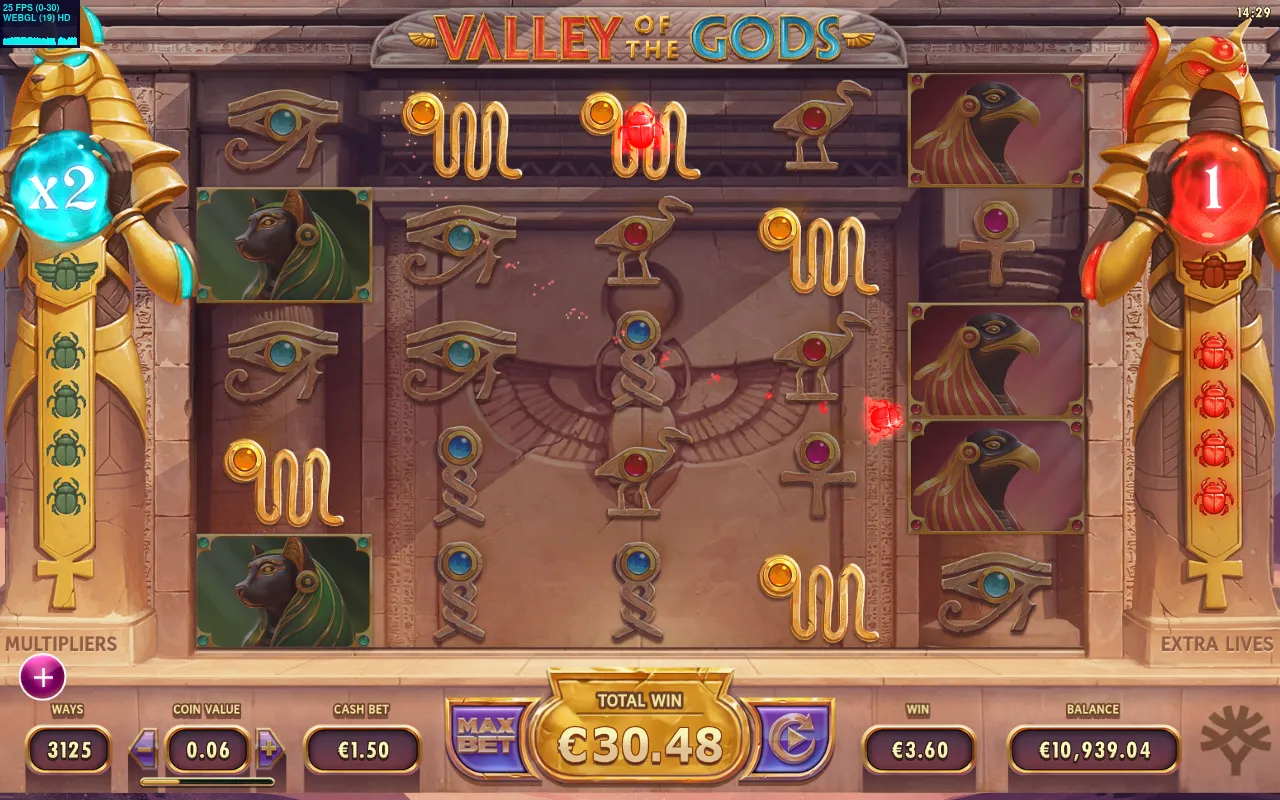
Two stone obelisks frame the reels, and they are the feature trackers rather than decoration. The left one carries a blue scarab orb that sets the multiplier; the right one holds a red orb counting Extra Lives. Both stay dormant through normal play and only wake up when a cascade chain runs long enough. On my big streak the left obelisk lit to x2 and the right showed a single Extra Life, and the on-grid wins kept tumbling with the multiplier applied.
That sequence is where the session turned. The total had already built through €26.88 and €30.48 when the feature engaged, and the cascades under the x2 produced the run's best hit at €52.08 off my €1.50 spin, about 35 times the stake. The Extra Life never had to step in; the chain held on its own. When the matches stopped, both obelisks reset to nothing. The feature is strong while the streak lasts and gone the instant it breaks.
Four Gods Stack, the Eye of Horus Fills In
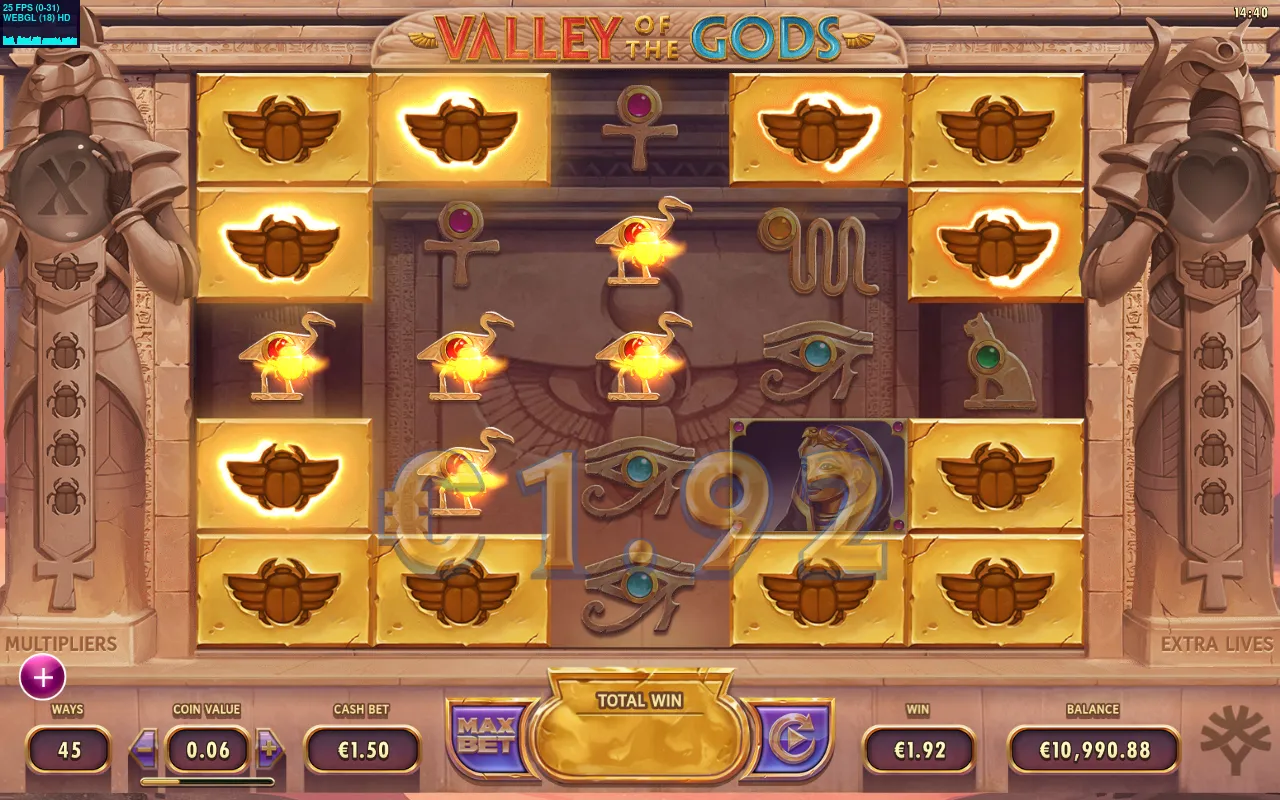
The top of the paytable is four god portraits. Anubis sits on a blue tile and the black cat goddess Bastet on a green one, with the falcon-headed Horus and the pharaoh queen rounding out the premiums. They land as single tiles on the inner area and stack vertically when they hit, and stacked Anubis columns delivered most of my better pays. Under them sit four hieroglyph glyphs: the Eye of Horus and a wavy serpent rune, plus the ankh and a small ibis. These are gold-backed tiles that burst into flame and drop away when they join a win.
The Eye of Horus also turned up as a wild during the feature cascades, filling gaps so the chains kept resolving. None of the symbols carry a dramatic spike on their own. The strength comes from the board state: a wide grid full of stacked gods paying under a multiplier.
What €1.50 a Spin Gave Back Across Two Hundred Spins
Across about two hundred spins at €1.50 the session finished down a little under €15, opening at €11,000 and closing near €10,985. The shape behind that number was mid volatility doing its job: most spins paid nothing or a few cents back, then every fifteen or so a cascade broke through and ran into double digits. The catalogue lists variance as medium, and after a run like this I would agree, since it never went stone cold for long and never paid anything close to its top number either.
That top number is a 4,500x ceiling on the paytable, and my best €52.08 came in around 35x, so there is a lot of headroom I got nowhere near. Yggdrasil put the headline return around 96% at release, though the catalogue marks this as a multi-build slot, so the percentage actually running depends on the operator. The game's help screen is the one place it is named; give it a read before you put real money down. One note on the controls: this build had no autoplay, so every spin is a tap of the button or the space bar, which suits a game you are meant to sit and watch cascade. Stakes run from €0.10 up to €150 if you want to push past my flat €1.50.
If You Need Something Every Spin, Look Past This One
Valley of the Gods is not the slot to load if you want constant small action. The base game is deliberately stingy until a streak catches, and there were patches where I tapped through twenty cold spins watching scarab backs and little else. A player who likes a steady drip of wins, or a scatter that can drop a bonus on any spin, will find this one quiet and now and then irritating.
What it rewards is the other temperament: sitting through the dead air for the moment a cascade unlocks the grid and the obelisks wake up. If that climb from 45 ways to a full board paying under a multiplier sounds like your kind of payoff, it holds up well for a slot this old. Yggdrasil's back catalogue runs in a similarly inventive direction, and you can dig through it over at Yggdrasil Gaming.