

Gonzo's Quest Slot – Free Demo
Provider:
NetEnt
Across about half an hour at NetEnt's Gonzo's Quest the Free Falls bonus triggered twice — three gold-rimmed scatters from reel one, the CONGRATULATIONS banner reading 10 FREE FALLS with the boosted X3 / X6 / X9 / X15 multiplier ladder lit along the top. That boosted ladder is the slot's headline…
Play Gonzo's Quest demo
Two Free Falls triggers and the Avalanche underneath
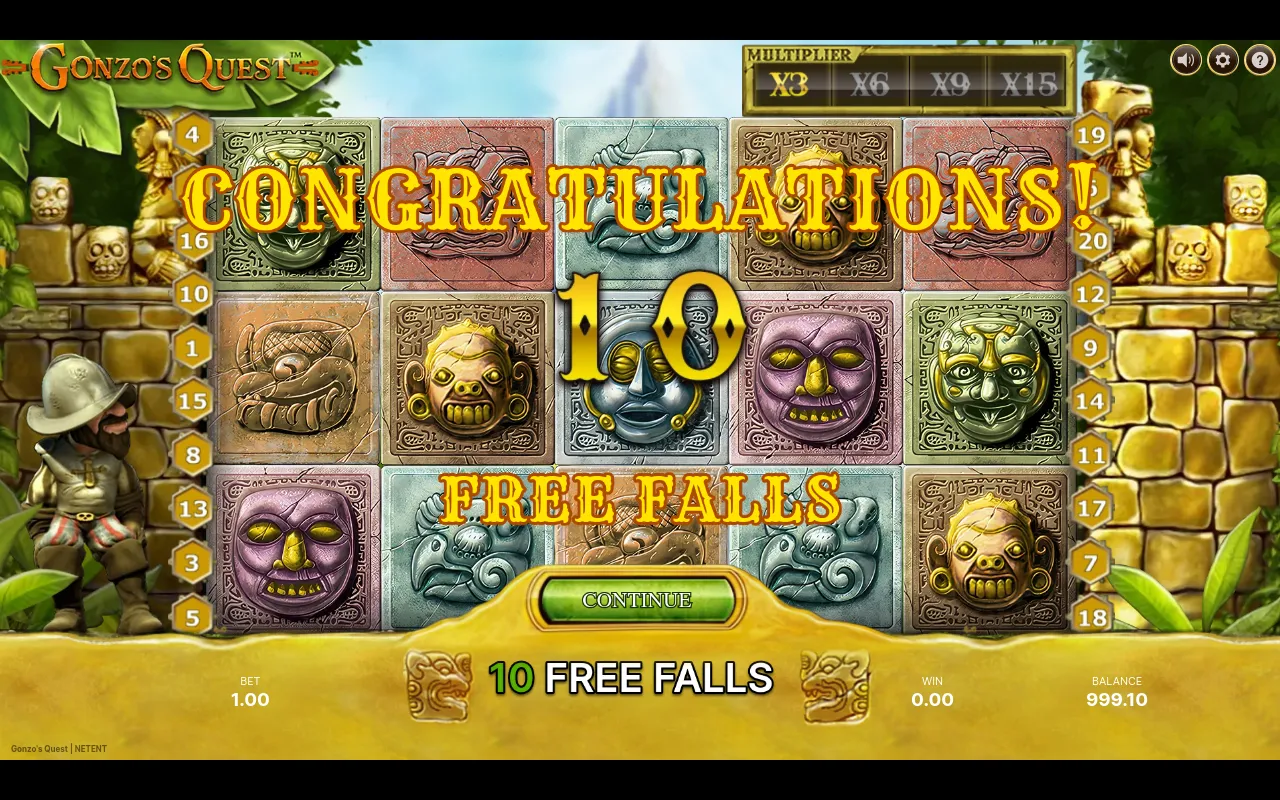
Gonzo's Quest hangs its name on the Free Falls bonus, and across my session the trigger fired twice — three of the gold-rimmed Free Fall scatters landing on a payline from reel one, the screen cutting to the award banner. CONGRATULATIONS sat above 10 FREE FALLS with the boosted X3 / X6 / X9 / X15 multiplier ladder lit across the top. That boosted ladder, well clear of anything the base game reaches, is the whole reason the feature is the headline.
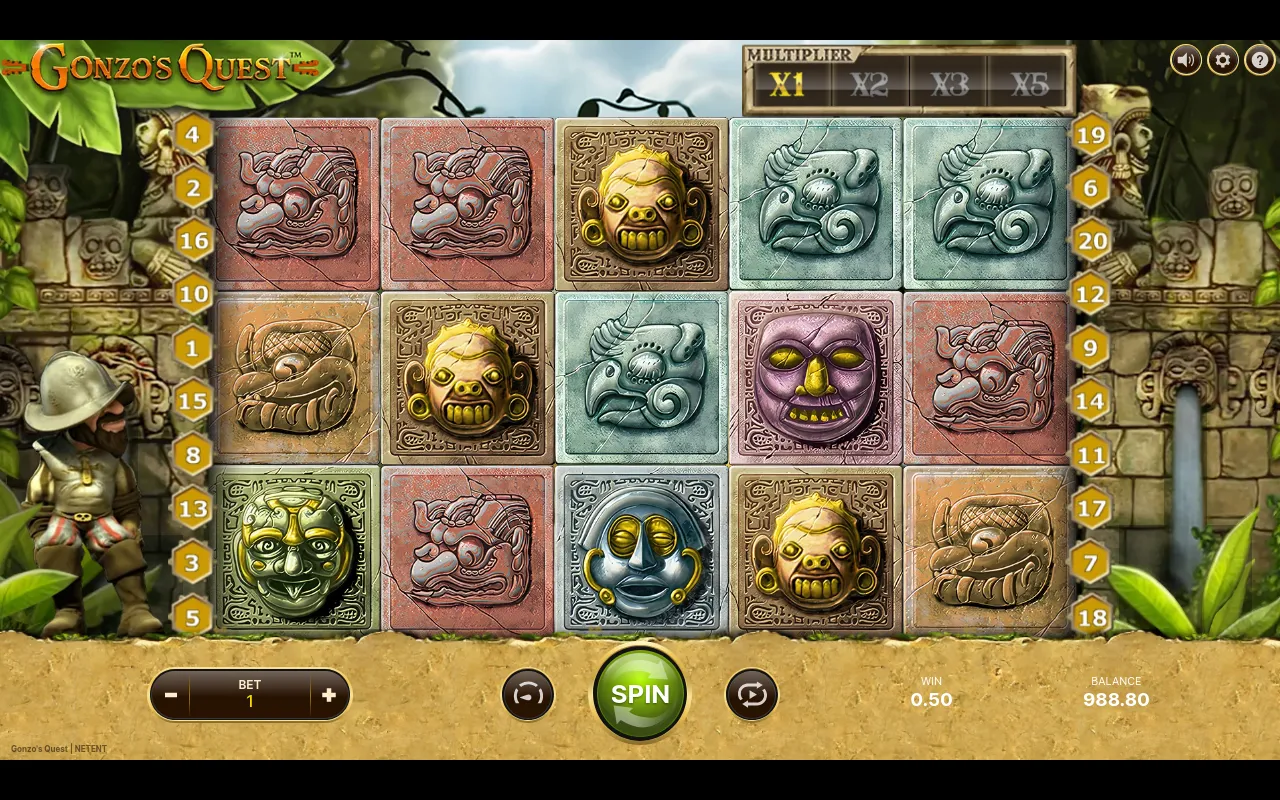
Underneath it sits the part my 109 spins mapped in full: the Avalanche base game on a 5x3 Aztec grid, where stone glyphs drop instead of reels spinning and a smaller X1-X5 ladder runs the show. Half an hour at BET 1 gave a clean read on that rhythm and the two wilds that drive it.
Minty's Closing Thought: 109 spins at BET 1 across about half an hour. The Avalanche base game ran in short bursts of small chain wins between dead stretches, the multiplier ladder topping out at X5 on a 1.75 line where a '?' wild bridged the grid. The Free Falls feature triggered twice — ten free spins on the boosted X3-X15 ladder, and that boosted track, not the base X1-X5, is where the slot's published upside is built to come from. The base game on its own is low-key; the headline is the feature on top of it.
The 5x3 Aztec grid and the chain that follows a win
Gonzo's Quest does not spin. The reels do not move in the conventional sense. Stone glyphs drop into a 5x3 grid with twenty fixed paylines underneath them, and the columns settle when the drop animation finishes. Wins read left-to-right from reel one, in lines of three or more matching glyphs along one of the paylines.
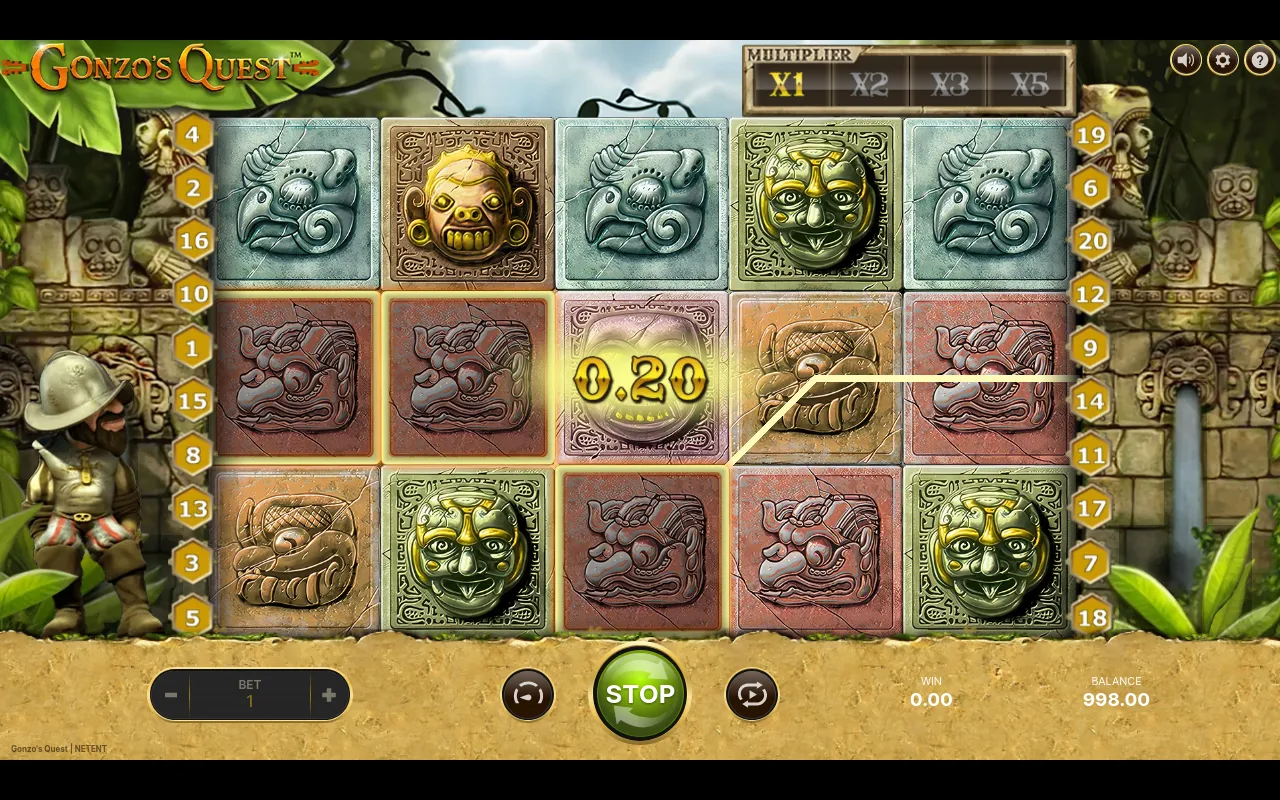
When a payline does resolve, the winning glyphs crumble and disappear, and new stones drop into the empty slots from above. The slot calls this the Avalanche, and it is the whole rhythm of the base game. A small first line can extend into two or three drops before the chain dies. The multiplier ladder above the grid ticks up one rung per resolved line inside the same paid spin, sitting at X1 at the start and topping out at X5 if the chain runs long enough.
Once the chain ends with a settled, non-paying board, the multiplier resets and the next paid spin starts again at X1. A short flat window then resumes until a new paying line appears. That cadence held through most of my run: short bursts of small chain wins between longer dead stretches. The X5 cap got reached on the 1.75 spin I keep coming back to. Outside of that, base-game multipliers sat at X1 or X2 the rest of the run.
The golden sun, the carved '?' and the 1.75 line
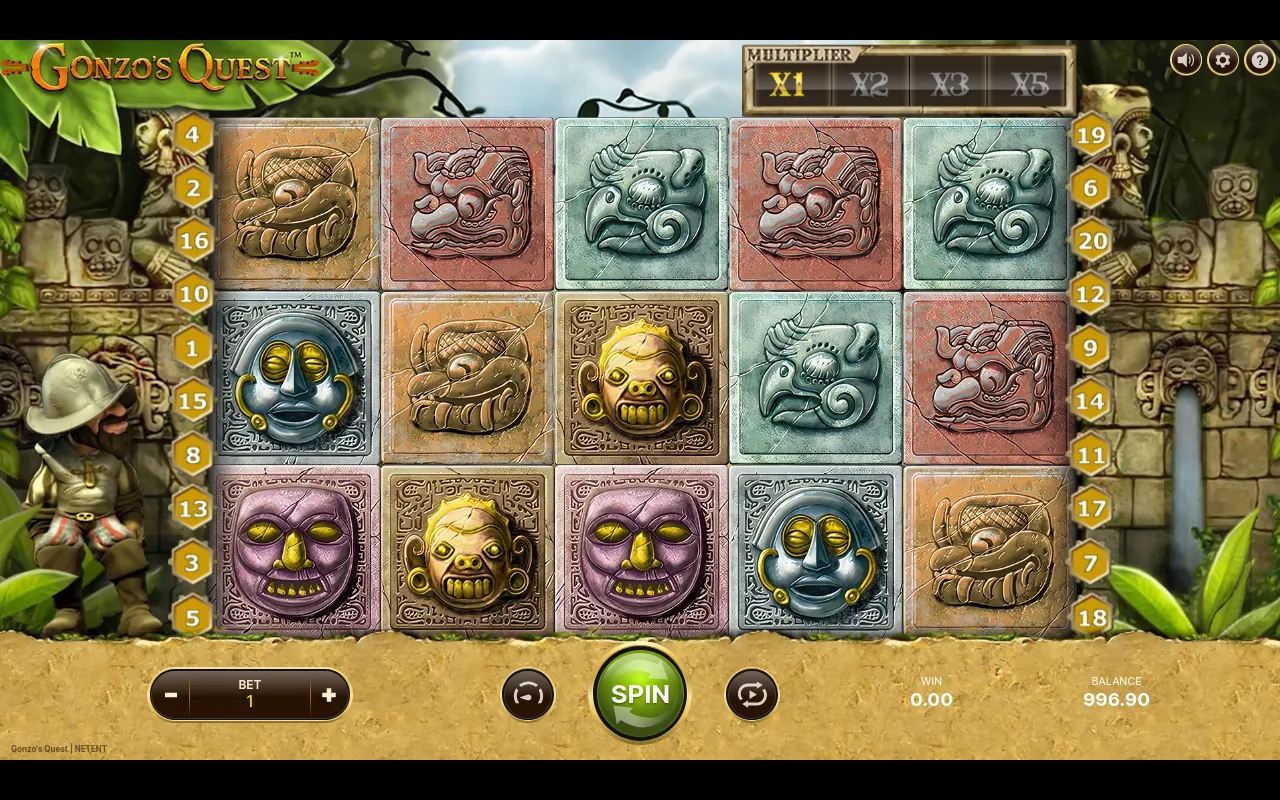
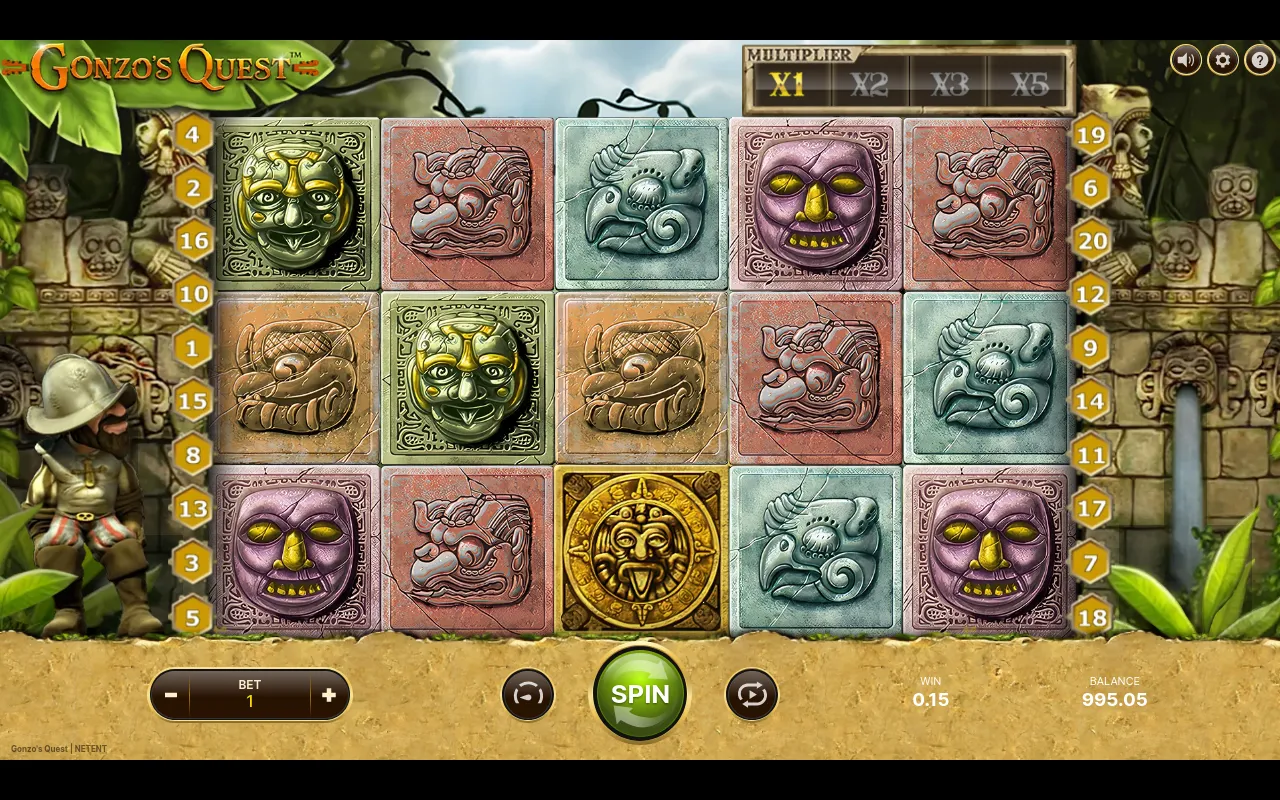
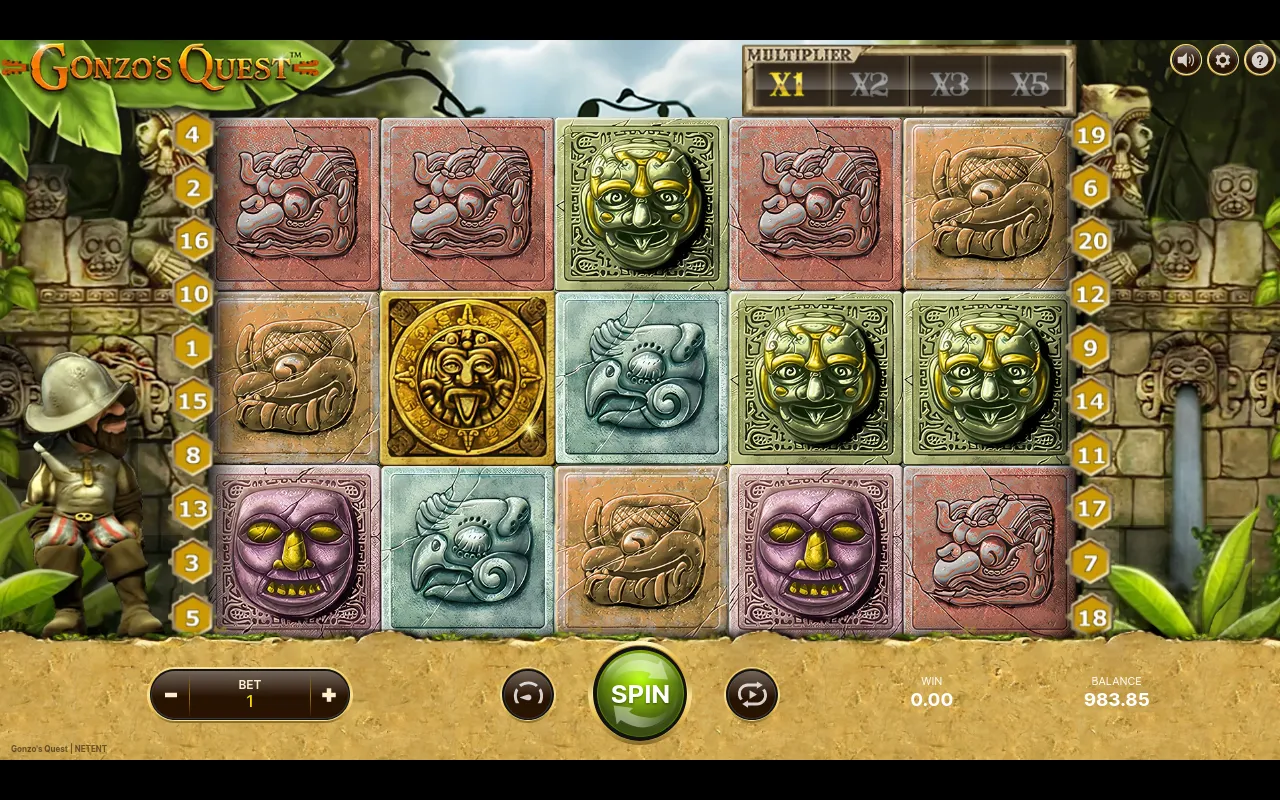
Gonzo's Quest carries two wild glyphs and they do different work on the screen. The first is the golden Aztec sun, a circular sun-face tile with rays carved into the stone, which substitutes for every regular mask in a paying line. The second is a separate question-mark stone that acts the same way but reads as the more obvious feature. Either of them on the right reel turns a near-miss into a settled line.
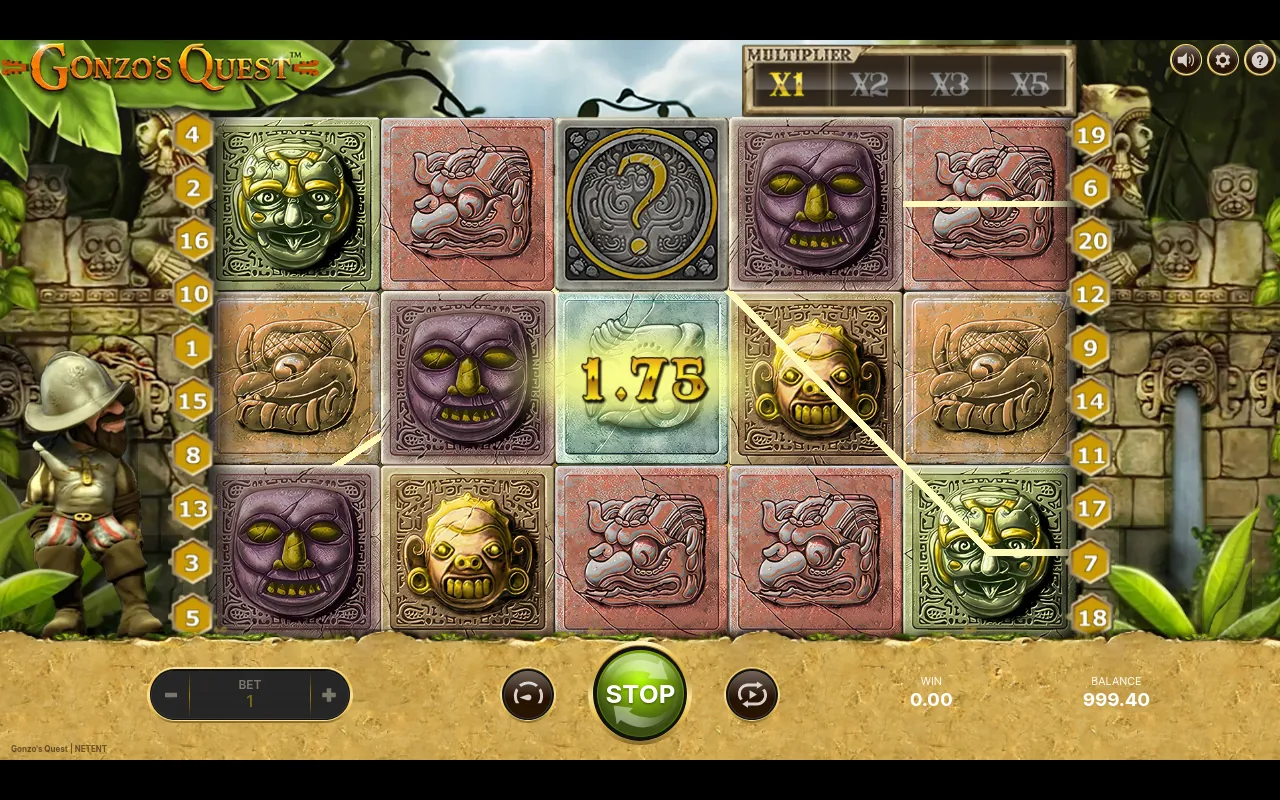
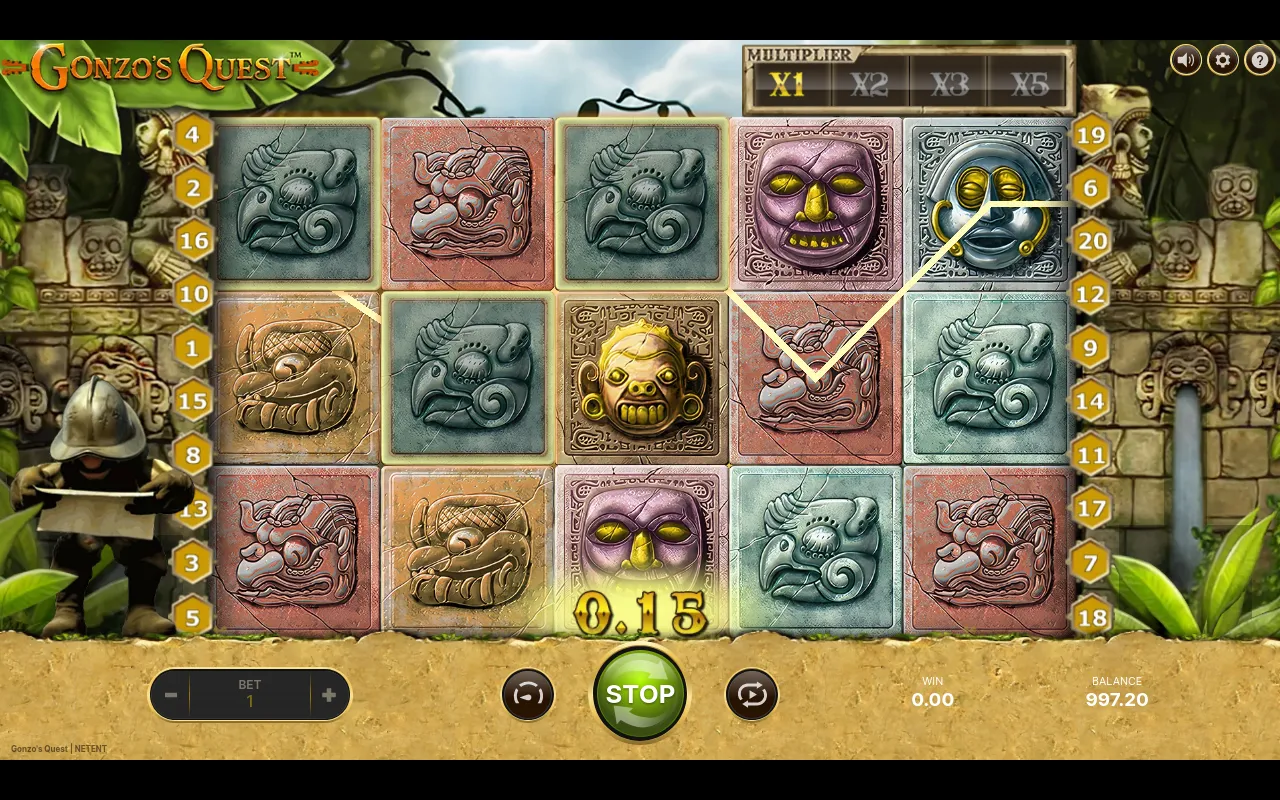
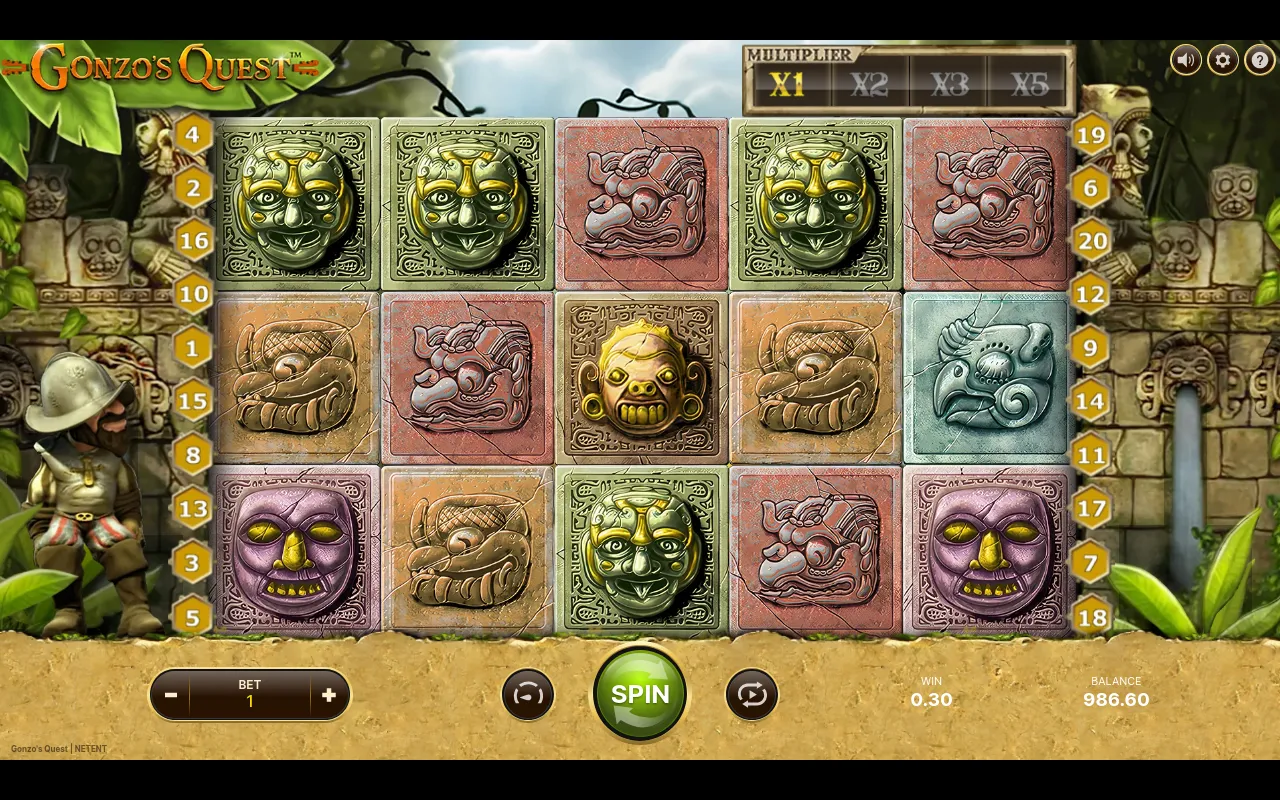
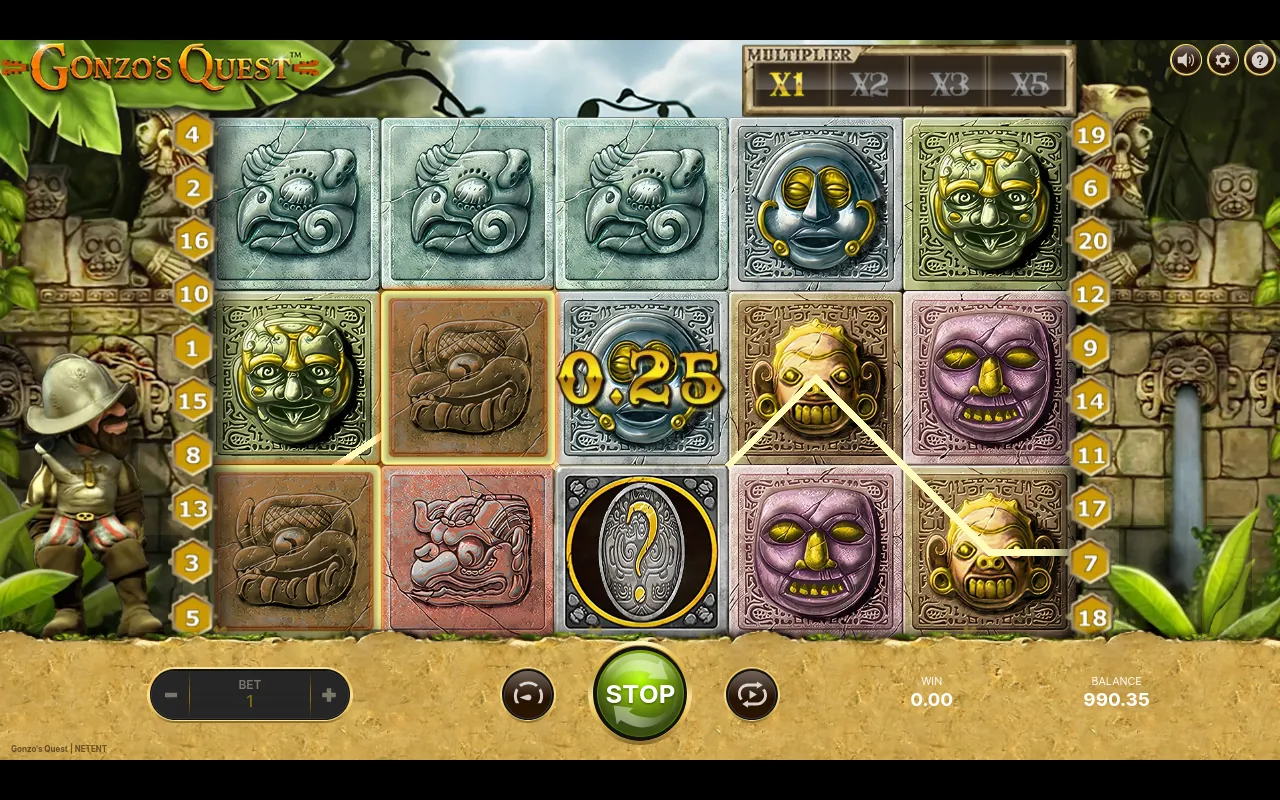
Most of my session's paying lines came in the 0.15-to-0.50 band on BET 1, and a fair share of them had a sun glyph or a '?' stone somewhere along the line. A 0.15 line came off the carved-mask family with a sun in support. A 0.30 settled across a row of higher-paying golden masks with a '?' tile filling out the chain. The 0.50 came on a spin where both the sun and the '?' were on the grid at the same time, with the '?' wild bridging high-paying masks across the centre two rows.
The biggest single line came on a base-game spin where a '?' wild dropped onto the bottom row and connected several mid-tier masks into multiple paying lines at once. It settled 1.75, the run's high-water mark in the base game. The Avalanche multiplier ladder was sitting at X1 for that spin. The '?' wild did the work on the line count rather than the multiplier.
The X1-X5 multiplier ladder in practice
The ladder is the engine that makes the base game interesting on paper, and in 109 spins I got a clear-enough view of what it delivers in practice. Most paid spins resolved with a single paying line and no chain extension. The line paid at X1, the multiplier reset, the next paid spin started fresh. That was the bulk of the run.
The chain extensions, when they happened, were short. A 0.15 base line picking up another small drop for an X2 chain was the most common shape. I caught maybe four or five chains that reached X3 and one that touched X5. The 1.75 spin was that one. Even on the X5 spin the multiplier did not do the heavy lifting; the line count and the high-paying masks did.
What the ladder really does is set a ceiling on how big a single paid spin can pay. With the base X1-X5 in play and the boosted X3-to-X15 stack reserved for the feature, the base game's upside is capped wherever X5 happens to land you. In the run I played, X5 landed on a chain that turned a low-value initial line into the 1.75 settle. Useful, but a long way short of what the slot's published max-win suggests is possible.
The Free Falls arena and the boosted X3-X15 ladder
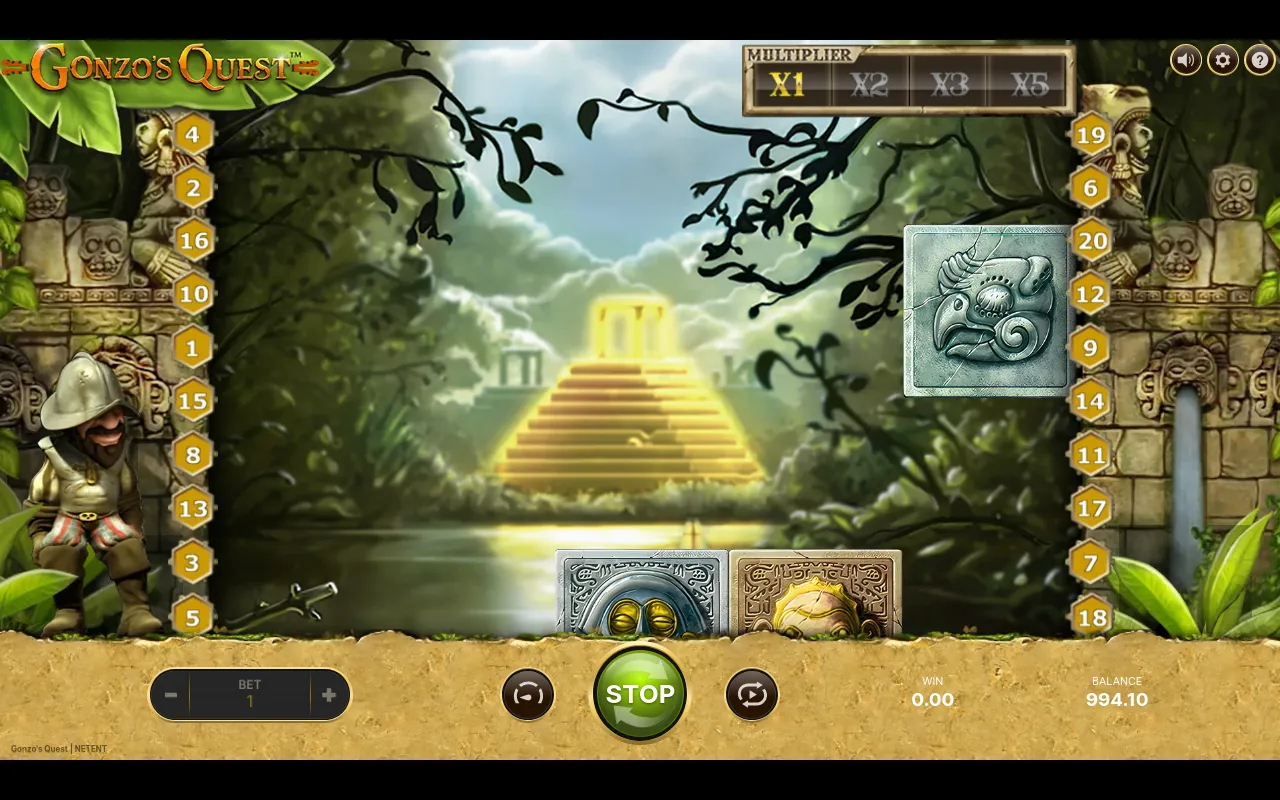
Gonzo's Quest hides its real upside behind the Free Falls feature, which is the slot's free-spins round with its own multiplier ladder. The trigger is three of the gold-rimmed Free Fall scatters on a payline starting from reel one, and when it fires the screen cuts to an animated jungle pyramid backdrop. The base-game grid drops away and a new arena loads, where the Avalanche mechanic continues but the multiplier ladder runs the boosted X3, X6, X9, X15 rungs in place of the base X1-X5.
An award screen announces the round first: the CONGRATULATIONS banner, 10 FREE FALLS beneath it, and the boosted ladder lit across the top. Both triggers in my run arrived the same way — three Free Fall scatters lined from reel one — and both threw the same ten-spin award with the X3, X6, X9 and X15 rungs showing.
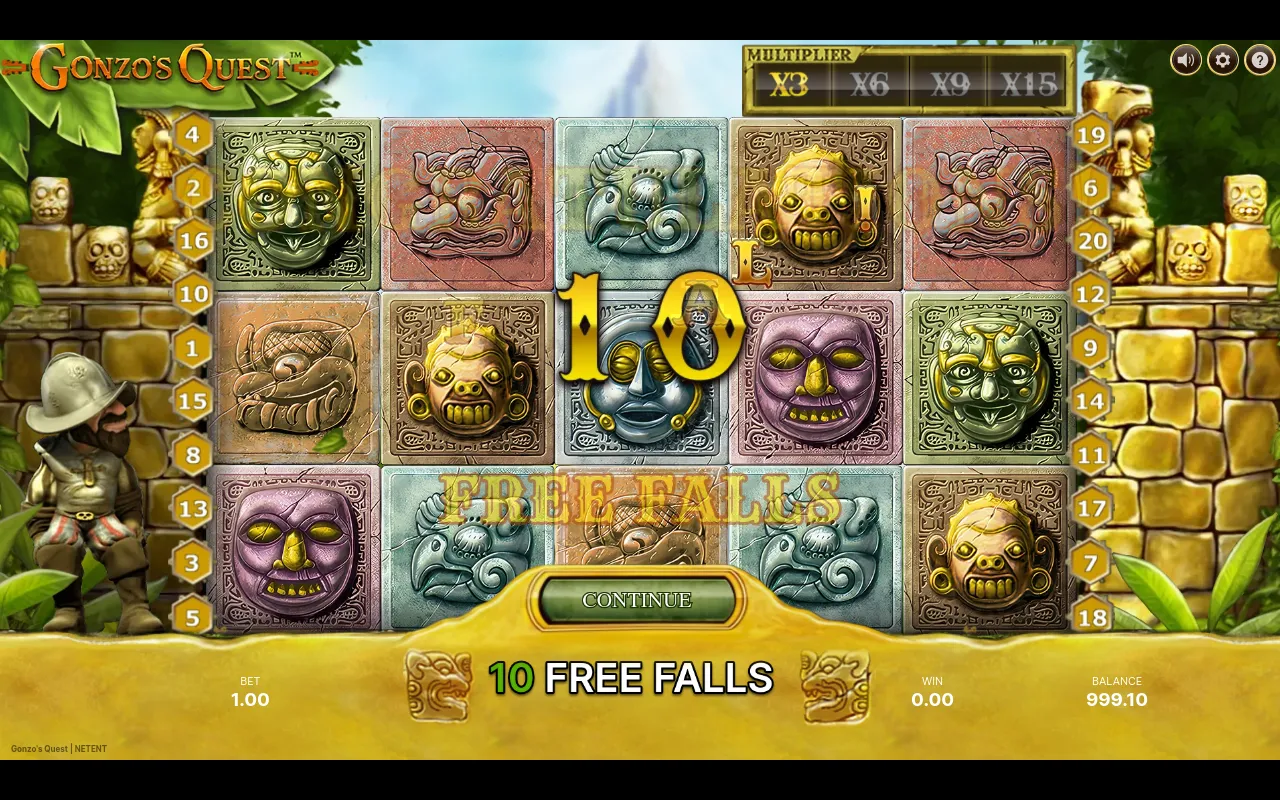
The boosted ladder is the structural difference that matters. Where the base game caps at X5, the Free Falls round stacks X3, X6, X9 and X15, and that multiplier track is where the slot's published max-win is built to come from. The ten-spin count is fixed; the ladder is what separates a flat free-spins round from the slot's real ceiling.
The Megaways follow-up and what the original still does
Gonzo's Quest is one of the older avalanche slots and NetEnt has since shipped a Megaways adaptation that pushes the same idea onto a variable-reel grid. The follow-up keeps the cascade and the boosted free-spins multiplier ladder and widens the bet ladder. The original's fixed 20-payline structure stays a cleaner read for what the Avalanche mechanic does spin-to-spin. If you want the cleaner version of the math the 5x3 grid is where it lives, while the Megaways adaptation carries the wider variance.
The bet ladder runs from 0.20 to 50 per spin on the operator side, so my BET 1 sits somewhere inside that range as a tier. The Avalanche mechanic doesn't change with stake. Neither do the X1-X5 base ladder or the X3-X15 boosted ladder inside the Free Falls. The stake just scales the line wins.
Gonzo's Quest ships in more than one RTP configuration. The number that matches your operator's build is printed in the game's rules section, alongside the paytable. Worth a quick glance at before you wager real money, because the figure on a marketing page is a marketing figure and the one in the rules is the math you're playing against.
What the slot left me after about half an hour was a clear read on the Avalanche rhythm and the two wilds that drive it, with the Free Falls feature triggering as advertised on top. The base game on its own is modest; the headline upside is the boosted ladder the round runs on.