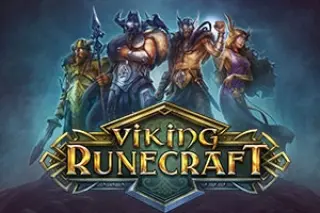
Demo slot Viking Runecraft

Viking Runecraft Slot – Free Demo

Added: Mar 18, 2026 Updated: Apr 7, 2026
Provider: Play'n GO
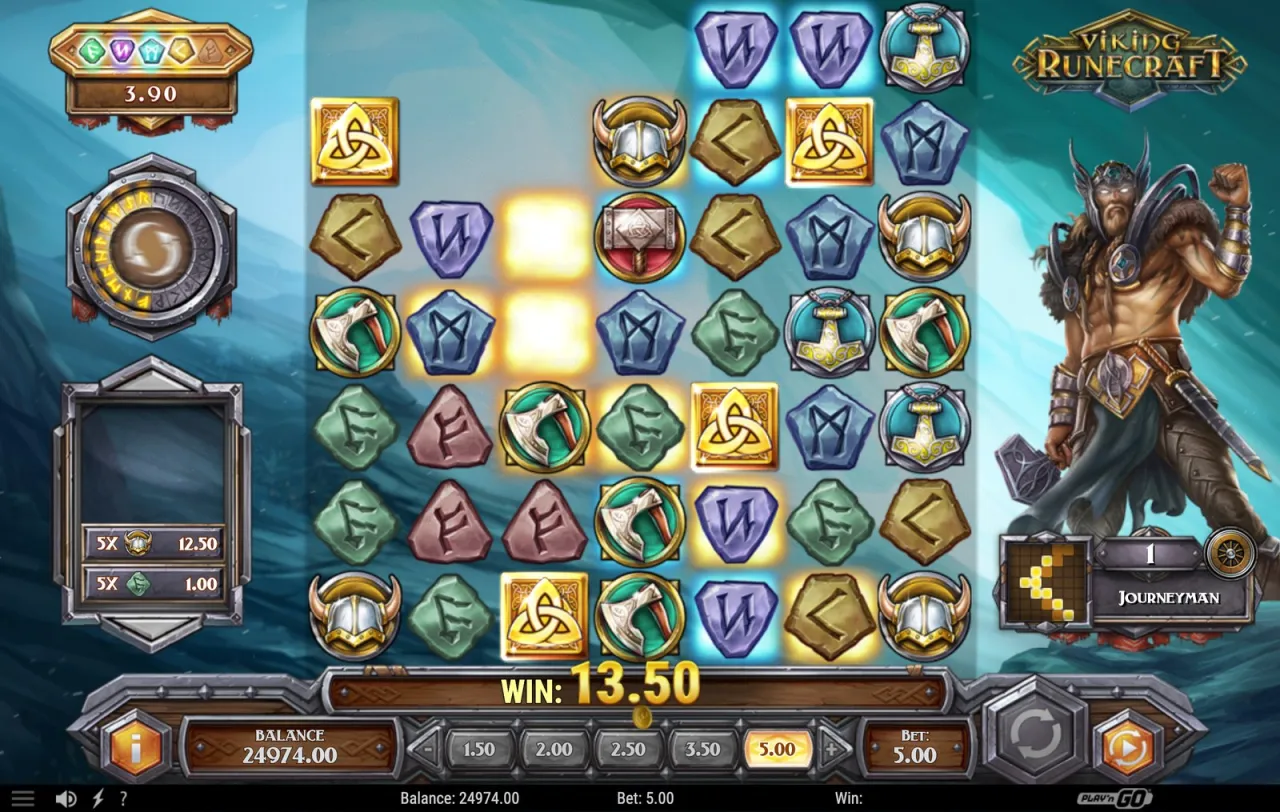
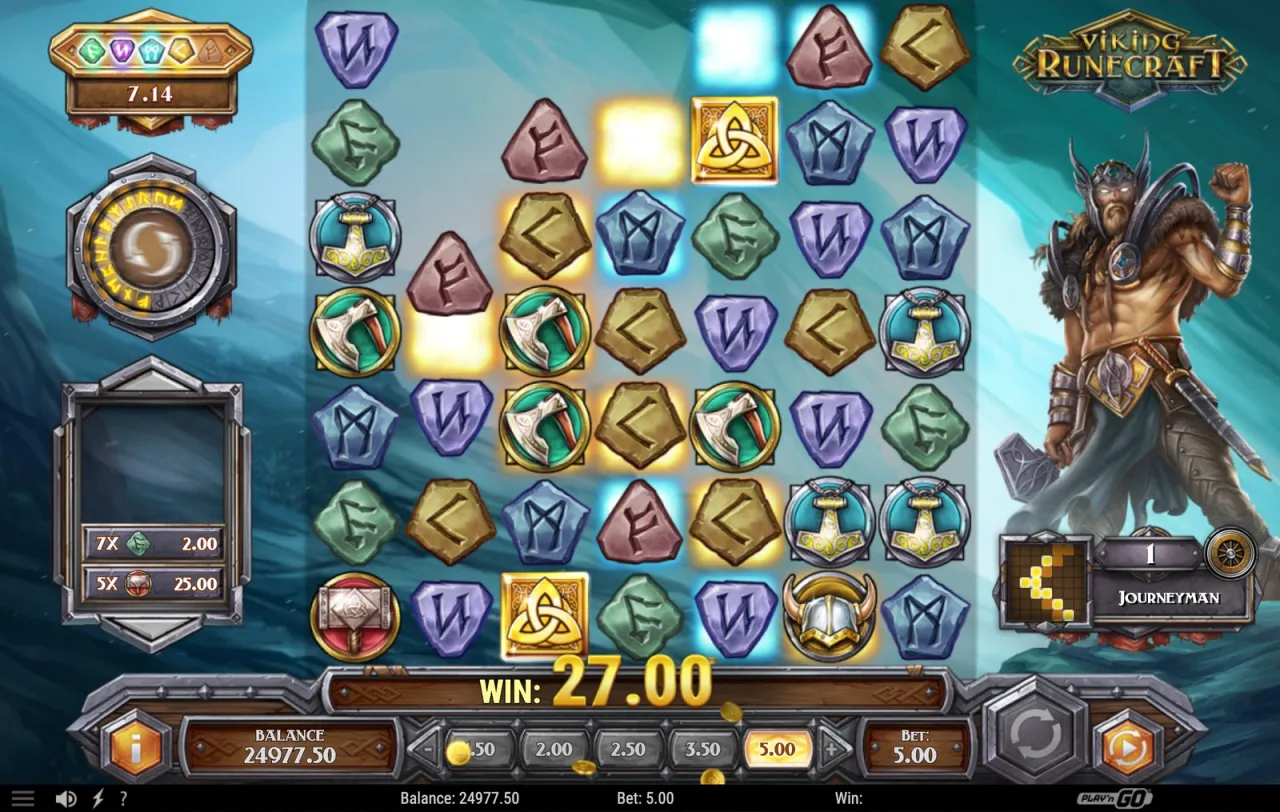
Viking Runecraft by Play'n GO drops you onto a 7x7 cluster grid where cascading wins, pattern-based leveling, four rotating god powers, a 20-step Charge of Destruction meter, and the Ragnarök free-spin bonus all compete for your attention at once. The base game is a constant meter-feeding operation…

Play Viking Runecraft demo

Developed by Play'n GO
Game details
Provider Play'n GO
Volatility High
Max Win Per Spin 5,000× bet
Min Bet 0.10
RTP 96.71%
Reels 7
Bonus Buy No
Increasing Multipliers Yes

Viking Runecraft slot review

Play'n GO shipped Viking Runecraft on April 26, 2017, and it still stands as one of their more mechanically ambitious builds. Forget standard paylines — this is a 7x7 cluster-pay grid where five or more matching symbols touching each other form a win, those symbols vanish, new ones cascade in, and every single cluster feeds at least one of the game's tracking systems. You are simultaneously completing a highlighted pattern on the grid to level up, charging a 20-step destruction meter through collected symbols, rotating between four Norse gods who each rescue dead spins differently, and chasing the Ragnarök sequence where a rising multiplier can reach 15×. Bets run from 0.10 to 100 per round, covering both cautious reconnaissance and committed bankroll deployment.

The visual presentation earns its keep — carved-stone iconography, a moody Asgard backdrop, and four deity figures flanking the grid that actually connect to gameplay rather than sitting there as decorative wallpaper. Play'n GO designed the entire session around momentum and buildup, which means even stretches where your balance flatlines can still feel productive when meters are ticking and pattern spaces are filling. Whether that "productive emptiness" is a feature or a psychological trap depends entirely on your tolerance for delayed gratification.

Our Minty Verdict: Most grid slots hand you a cascade mechanic and call it a day. Viking Runecraft hands you four interlocking progress systems and dares you to keep track of all of them while your balance slowly bleeds out waiting for the stars to align. The base game is a masterclass in the illusion of productivity — every spin moves some needle somewhere, so you never quite feel like you're losing, even when you objectively are. Watch out for The Pattern Tease: that one stubborn highlighted grid space that refuses to fill, keeping your level-up hostage for thirty spins while you burn through credits feeding a meter that might hand you Lure of Loki instead of something that actually pays. When Ragnarök finally detonates with a stacked multiplier and a full board reset, the compressed violence of the payout almost justifies the pilgrimage. Almost. This is a slot that rewards players who enjoy the grind itself — if you need instant dopamine, Asgard's gates will feel like a waiting room.

Theme, symbols, and overall feel

The art direction avoids the cartoon-Viking cliché and leans into mythic weight — cold lighting, chiseled rune textures, and a color palette that feels more battlefield monument than children's storybook. Thor, Odin, Freya, and Heimdall aren't just portraits; each god is mechanically wired into the gameplay loop, so the theme actually justifies its existence instead of being a paint job over generic math.

Lower-paying symbols are colored rune stones doing the thankless work of filling space and occasionally contributing to clusters. The premium regulars — Thor's hammer, Odin's helmet, an axe, and an amulet — carry the paytable's actual weight, with the hammer sitting at the top. There is no permanent wild icon camping on the reels every spin. Wild creation is temporary and comes exclusively through god powers, which means the board's shape and rescue potential shifts every time you level up and rotate to the next deity. It keeps dead spins unpredictable instead of formulaic.

Grid mechanics and the base game grind

Clusters of five or more identical touching symbols pay out, disappear, and let fresh symbols cascade into the vacated positions. That much is straightforward. What turns Viking Runecraft into a multi-layered endurance test is everything bolted on top: a pattern overlay on the grid highlights specific positions, and your clusters need to cover those spots to complete the current level. Simultaneously, every winning symbol gets collected into a 20-step Charge of Destruction meter running alongside the grid.

The result is a base game where small hits carry weight beyond their immediate payout. A modest five-symbol cluster might advance your pattern by two spaces, add three charges to the destruction meter, and set up the board for a follow-up cascade — all from a win that barely registers on the balance. You're not just chasing direct cashouts; you're feeding an infrastructure of meters and trackers that eventually produce the modifiers where the real mathematical violence lives.

This design fundamentally changes the session tempo. Conventional reel slots have dead spins that are genuinely dead. Here, a non-paying spin can still trigger the active god's intervention, which drops wilds onto the board and potentially rescues the entire round. That constant sense of "something might still happen" is the slot's strongest hook — and its most effective bankroll-draining mechanism.

God powers, destruction modifiers, and Ragnarök

Gift of the Gods

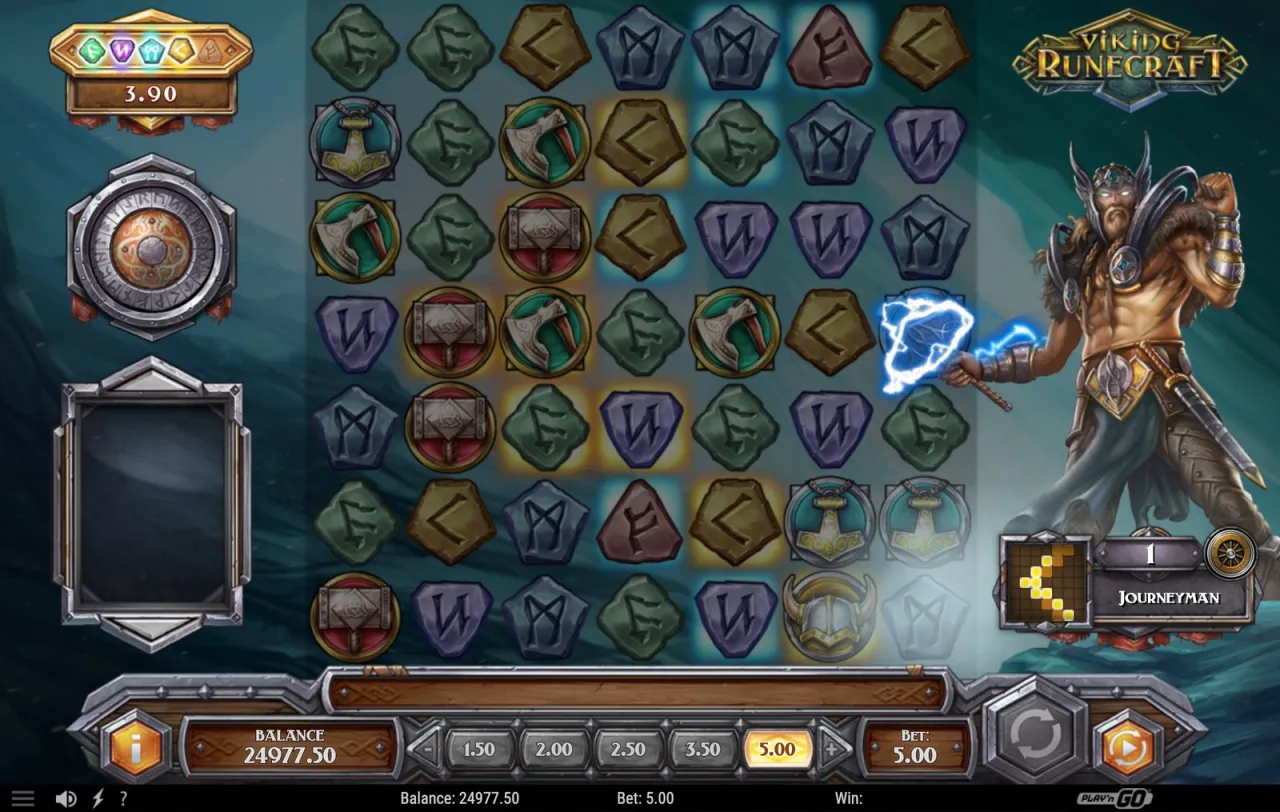
Each deity rescues failed spins differently. Thor strikes positions into wilds, Odin drops paired adjacent wild clusters, Freya grows inner-grid wild formations until something hits, and Heimdall plants a wild on every row. Only one god is active per level, so the texture of your dead spins rotates as you progress. It's a clever system that creates genuine variation without bolting on a separate pick-and-click bonus every few minutes.

Charge of Destruction

Fill that 20-step meter and the game fires one of four random destruction effects: Fury of Fenrir, Judgment of Jörmungandr, Scorching of Surtr, or Lure of Loki. Each one reorganizes the board by removing, converting, or spreading symbol types, and the follow-up cascades can snowball fast. The randomness here is the knife's edge — you might get Surtr clearing the way for a massive chain, or you might get Loki rearranging deck chairs on a dead board.

Ragnarök

The headline event. Ragnarök triggers after a strong collection run and delivers a fresh board with destruction effects baked in and a multiplier that climbs with each winning cluster up to 15×. It's not a standard ten-free-spins package — it's a shorter, sharper burst where everything depends on whether the reset grid cooperates immediately. When it chains, the compressed payout can define an entire session. When it fizzles after two clusters, you'll question every spin that led you there.

Runes of Valhalla

Rune clusters collected during play activate positions on a bonus wheel. Level up and you spin that wheel for a chance to bank the accumulated value. It's the slot's fixed-prize mechanism, and it replaces the hold-and-win or sticky-coin loops that dominate modern releases. Whether that's refreshing or just different packaging for the same delayed-gratification treadmill depends on your perspective.

RTP, volatility, and max win

Top-listed RTP sits at 96.71%, which is reasonable for a slot that distributes its value across multiple overlapping feature systems rather than through frequent standalone base hits. Be aware that lower configurations exist, ranging from 84.66% to 94.66%, so verifying the operator's active setting before committing real money is non-negotiable.

High volatility is baked into the architecture. The base game produces constant micro-activity — meters filling, patterns advancing, gods intervening — but the concentrated payouts live inside those rare moments when cascades, destruction modifiers, level completions, and multiplier support all collide. The gap between "things are happening" and "things are paying" can stretch wide enough to drain a session before the convergence arrives.

The maximum win is 5,000× bet — respectable but not chart-topping for a feature-dense grid slot. No progressive jackpot exists, so the ceiling is fixed and entirely dependent on stacking the right mechanical sequence rather than hitting a separate pool. For a 2017 release with this much structural depth, the cap feels earned rather than limiting.

What the slot deliberately avoids

No hold-and-win chamber. No coin-collect loop. No progressive jackpot counter ticking in the corner. Viking Runecraft builds its entire identity through cluster mechanics, temporary wild generation, meter charging, and the Valhalla wheel — a refreshing absence of copy-paste link-game DNA for anyone suffering from bonus-buy fatigue. The trade-off is that the slot demands more attention per spin than most modern releases, and players who prefer passive dopamine delivery will find the cognitive overhead unwelcome.

Mobile and demo value

The 7x7 grid with its meters and side panels could easily become unreadable on a phone, but the layout holds together because the tracking information is tied tightly to the central grid and the indicators are simple enough to parse after a couple of rounds. It's dense, not broken.

A demo session is borderline mandatory here. Viking Runecraft has more moving parts than a standard three-scatter trigger slot, and burning real credits while still figuring out what the pattern tracker does is a waste of bankroll. Run the free version, learn why a failed spin can still matter, understand how the god rotation changes your rescue odds, and only then decide if the high-variance rhythm is something you want your money attached to.

Why Viking Runecraft still holds up

In a market flooded with reskinned link games and lazy sequel mills, Viking Runecraft remains a structurally distinctive grid slot. The pattern-based leveling, rotating god interventions, and layered meter systems give it a mechanical identity that most myth-themed competitors never bothered to develop. It helped shape Play'n GO's later feature-dense releases, and players exploring the studio's broader catalogue can browse more games from Play'n GO to see the lineage. The 5,000× ceiling won't set records, but the journey toward it has more texture than most slots twice its age. Learn the system in demo, respect the volatility, and decide if you're the type of player who finds the grind itself rewarding — because that's the price of admission to Asgard.

Viking Runecraft FAQ

  • Q: Is it possible to test Viking Runecraft without depositing?
    A: Absolutely — a free demo version is embedded right on this page, letting you explore the cluster grid, pattern-completion system, and rotating god powers at zero cost before committing any real stakes.
  • Q: Which studio is behind the Viking Runecraft slot?
    A: The game was developed by Play'n GO, and it became a cornerstone title in the studio's lineup of mechanically complex grid-based slots.
  • Q: Can I trigger a free-spin round, and is a jackpot attached?
    A: Ragnarök serves as the free-spin bonus, featuring a multiplier that scales up to 15×. No progressive jackpot is wired into the game — the payout ceiling is capped at a fixed 5,000× bet.
  • Q: How high is the return to player, and what variance level should I expect?
    A: The highest available configuration offers an RTP of 96.71% paired with high volatility. Operators can deploy lower RTP versions (as low as 84.66%), so confirming the active setting at your chosen casino is essential.
  • Q: Can I pay to skip straight into the bonus feature?
    A: No — Viking Runecraft does not include a bonus buy mechanic. Reaching Ragnarök and the Charge of Destruction modifiers requires organic gameplay progression through cluster wins and meter completion.