

Retro Tapes Slot – Free Demo
Provider:
Push Gaming
A magenta cassette cluster pulled through five rows on the right of the board for 2.25, the kind of mid hit Retro Tapes leans on while the bigger pieces wait their turn. Push Gaming's six-by-nine cluster grid grinds in low denominations: connected colours pay a fraction of stake, and either a wild…
Play Retro Tapes demo
Cluster Link on a six-by-nine
The 2.25 was a magenta tape connecting up the right side of the grid, five tapes vertical and a couple stepping in from the next column. It paid 4.5x the 0.50 stake. The cassettes flashed once and cleared; fresh tiles dropped from above into the gaps. That's the whole loop of Retro Tapes: five or more matching cassettes across the 54-cell grid pay as a cluster. The winners vanish; the cascade fills the empty space until nothing new connects.
Our Minty Verdict: Retro Tapes wants a player happy to ride low-denomination cluster traffic and let one prize-coin landing tell the day's story; if you need the base game to climb on its own, this isn't the engine. The 96.47% return reads as published, and a base game that ran in fractions of stake across the whole session points the bigger upside straight at Top Charts and the Bonus Buy menu.
The cassette palette runs to seven colours, with the bright neons sitting at the top of the paytable and the cooler greys at the floor. Clusters at the floor end of the paytable, which is most of what 143 spins gave me, came in around 0.20 to 0.80 credits a hit. The 2.25 mentioned above was the cleanest mid-board pay of the run, and a 3.75 later on (7.5x stake) was the high-water mark.
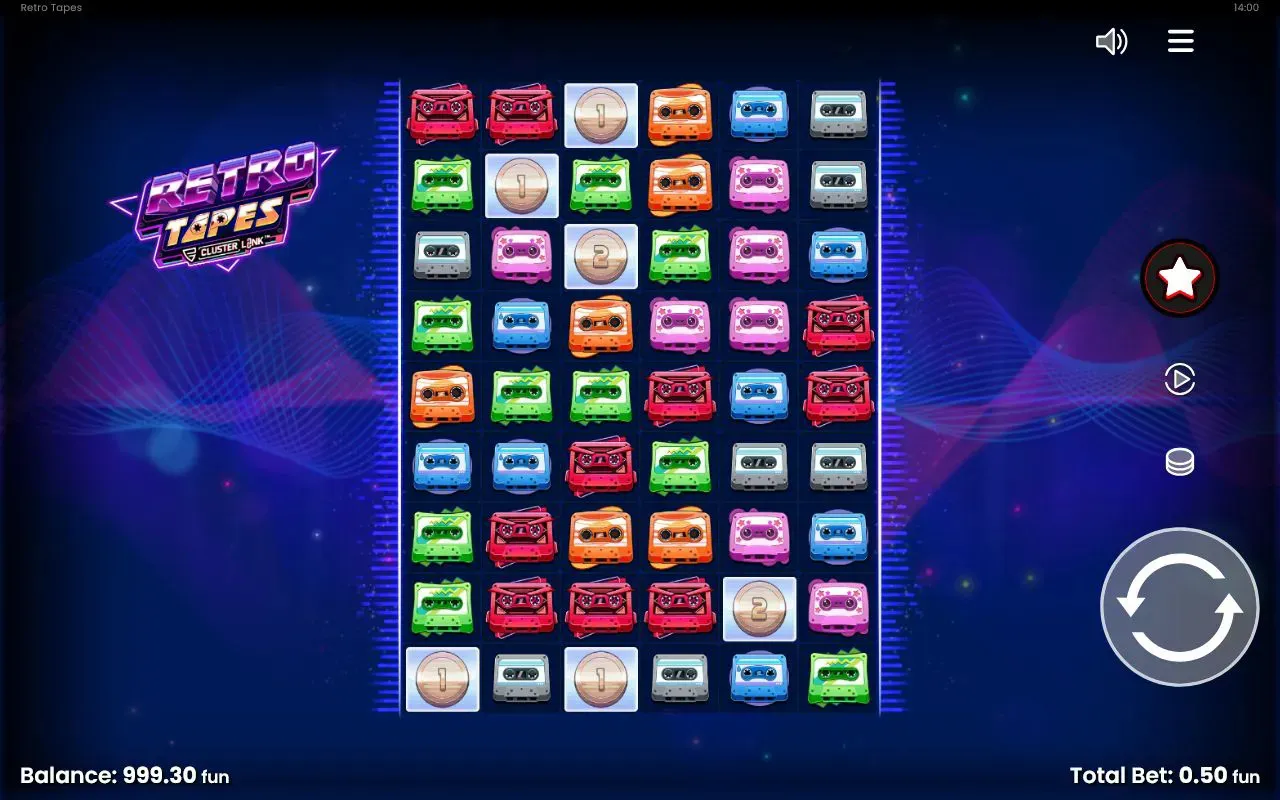
The base game on a Cluster Link build like this one is a metronome more than a slot machine, and Retro Tapes plays that to the letter. Winning spins arrive often; a typical stretch of ten spins gave me three or four small connections. The cascades clear and refill quickly enough that the screen rarely stops moving long enough for the run to feel dead. What it doesn't do is build. Single-stake fractional pays drip in, anything near stake-back is common enough. Anything north of 2x stake takes a moment to register because it's so out of step with the rest of the rhythm.

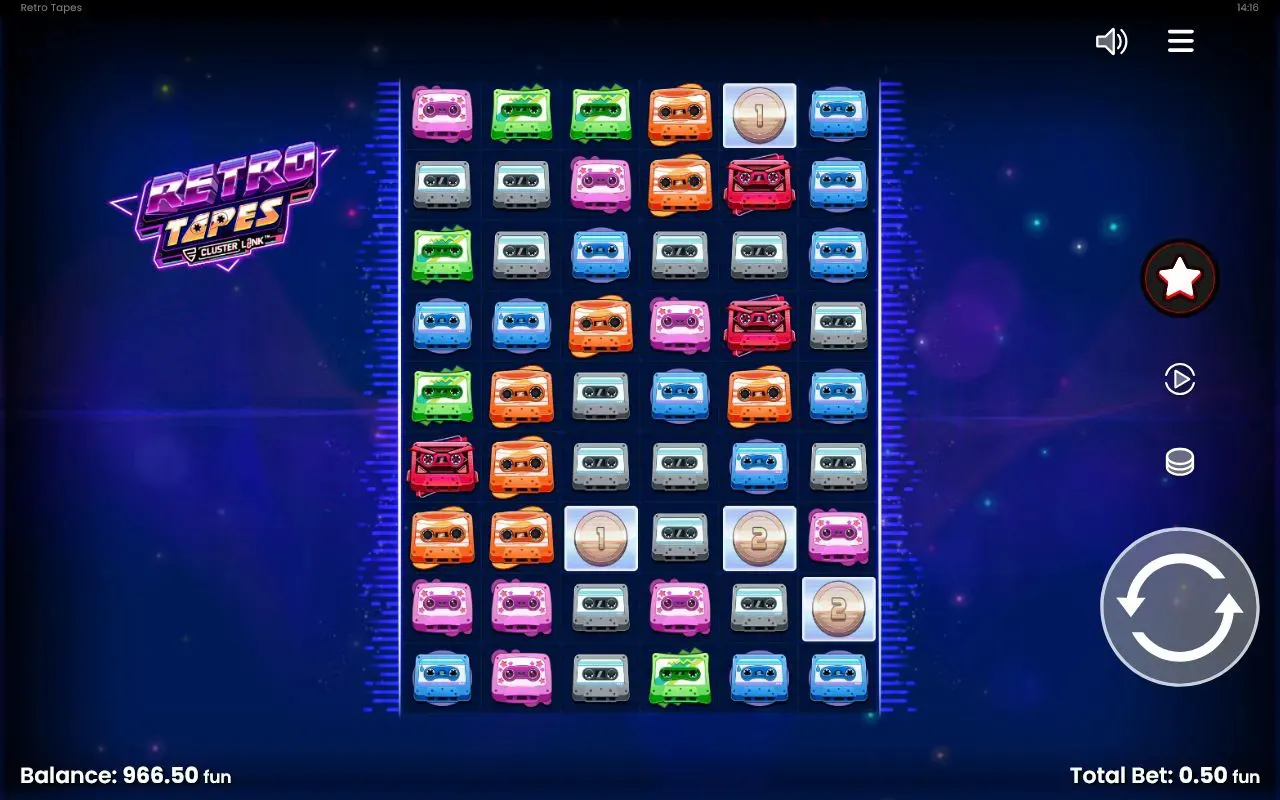

Why the vinyl coins outweighed the cassettes
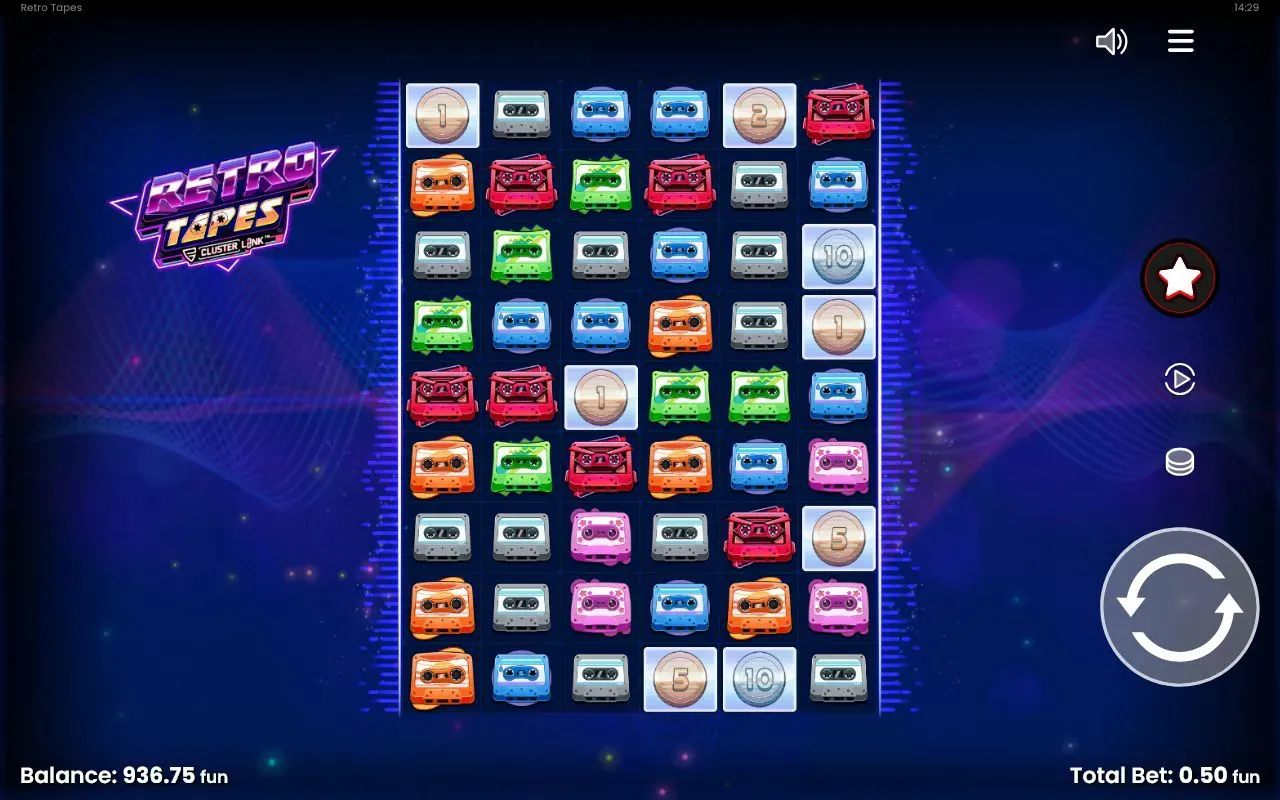
Between the colour clusters, cream vinyl-record tiles and metal coins keep landing on the grid, each stamped with a number. The low-value 1s and 2s turn up most often, and 5s and 10s appear less frequently but often enough that you stop noticing them after the first session-quarter. They aren't part of the cluster pays. They sit alongside the cassettes and read like a separate, parallel mechanic, the cash-collect layer on top of the colour game.
The standout moment of the session was a bright gold 100 prize coin landing mid-board, the highest value I saw across 143 spins. The next-highest single coin I caught was a silver 10. The gap between those two is the texture of the prize-coin side: most coins are throwaway low-tens contributions, and the run hinges on whether the rare 100 lands somewhere it counts.
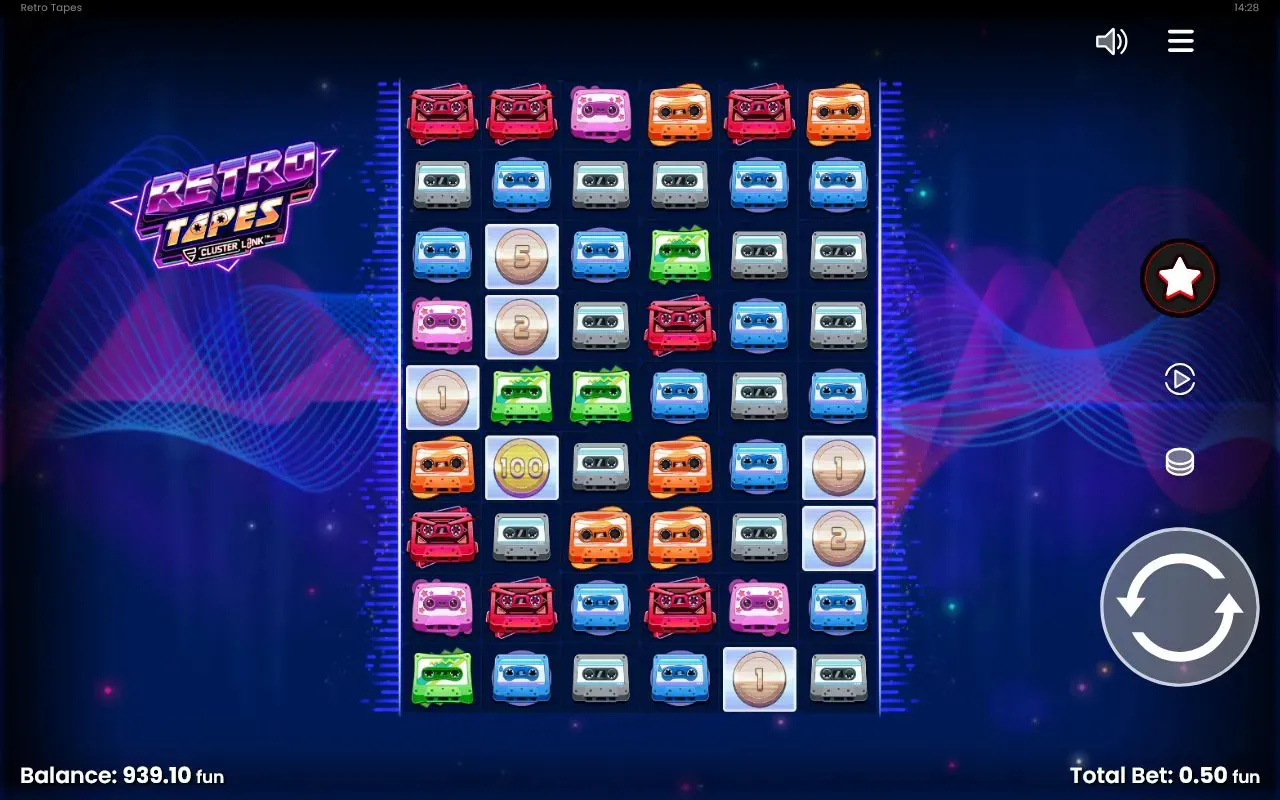
None of those coins paid out on their own in the base game. They sat on the screen as collectibles, waiting for something to redeem them. The slot advertises a Magnet symbol whose job is to pull matching coins into a cluster, and the Top Charts bonus locks landed prize coins in place to the end of the round. Neither showed up this run, so the 100 went unredeemed. It's a frustrating shape: the slot gives the coin gold weight on screen, then asks a feature that never trips to do something with it.
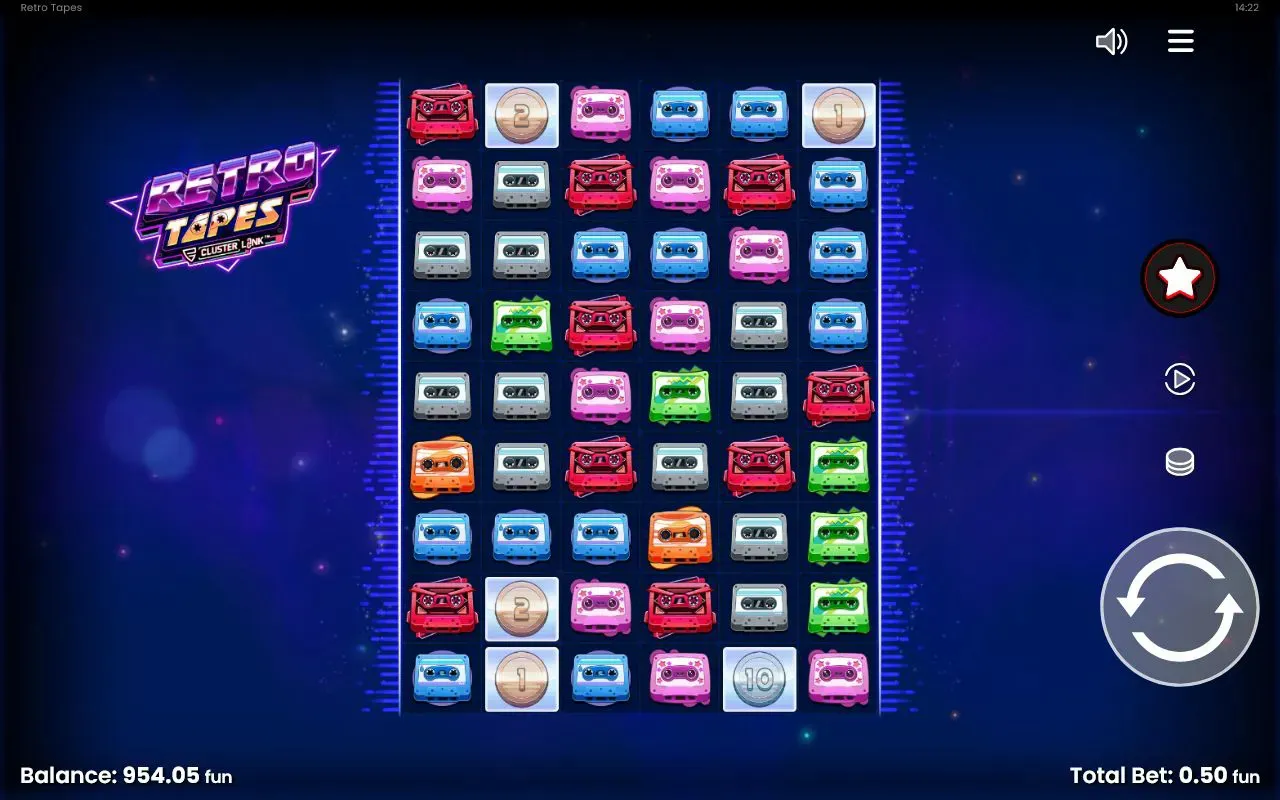
Wild multipliers, both at the lower end of the range
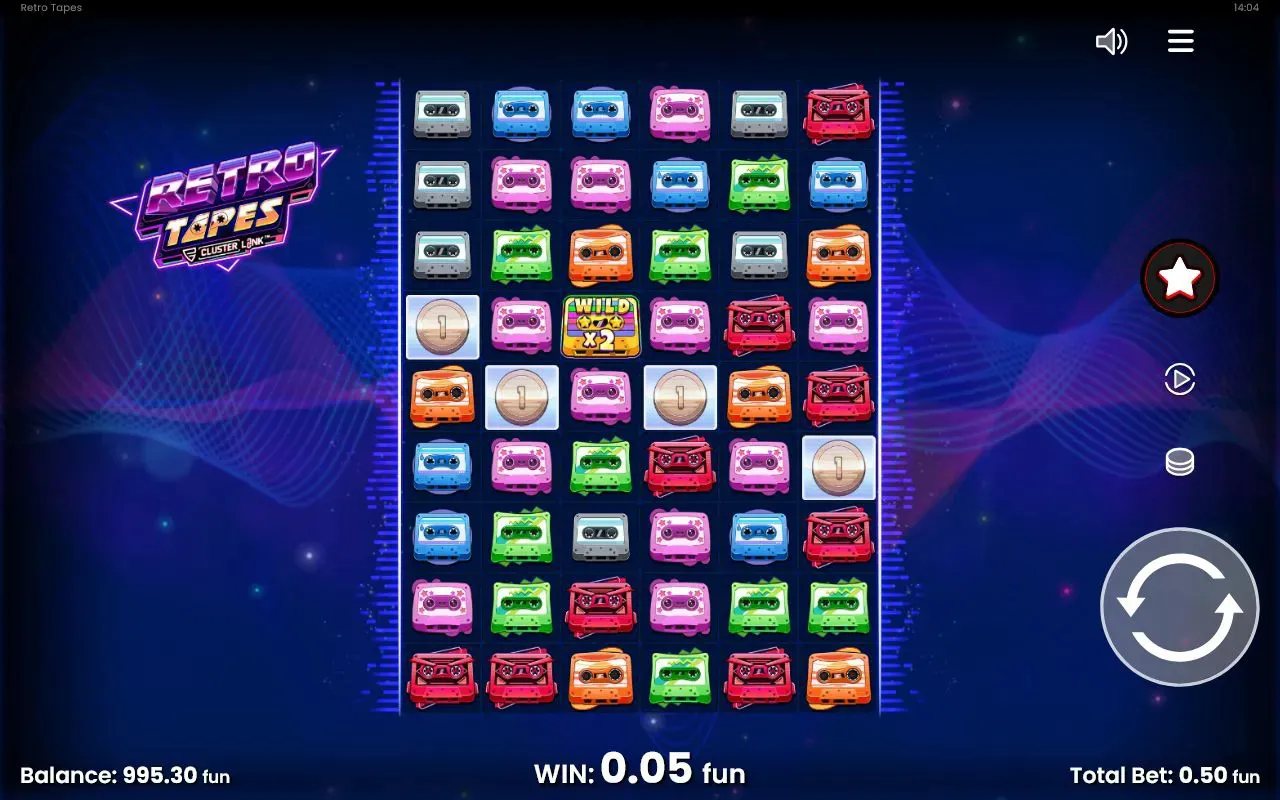
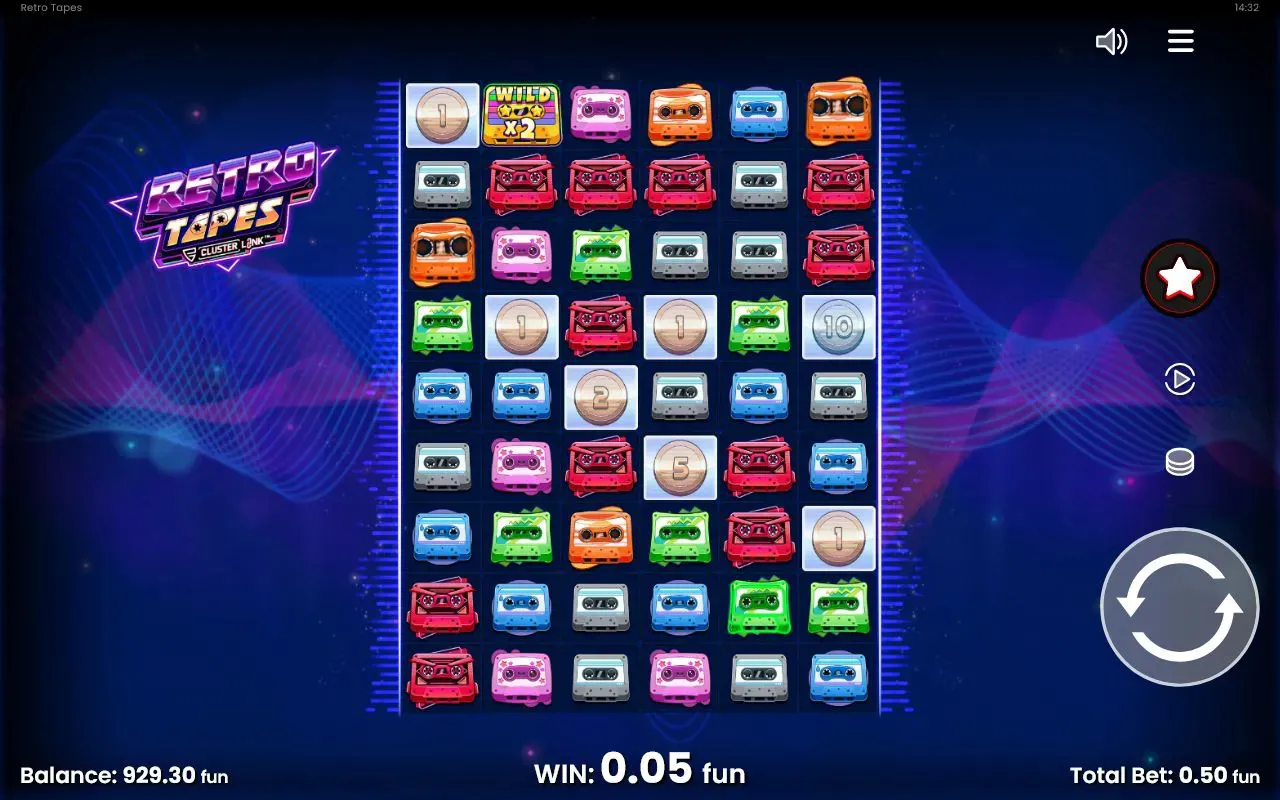
The wild tile in Retro Tapes lands with a printed multiplier on its face, and over 143 spins the only multipliers I saw printed were x1 and x2. The x2 is the more useful of the two: when it joined a cluster, the connected pay doubled before the cascade cleared, and a 0.40 base hit turned into 0.80 the moment the wild registered. The x1 wild acts like a colour-neutral tape that completes the cluster without lifting the size.
What I didn't see was the multiplier climbing. The slot advertises increasing multipliers as a marquee feature, the idea being that a wild on a paying cluster keeps escalating as the cascade chain continues. Either none of my wilds rode a long-enough chain to grow past x2, or the climb happens only inside Top Charts where the wilds are sticky. Either way, x1 and x2 are what the base game paid out in this run.

The bonus side I left untouched
The advertised bonus side of Retro Tapes is its Top Charts free spins, triggered when three or more wild tapes show up on the grid in the same spin. The published headline figure is 10,000x stake at the top end, and the round is also reachable through a Bonus Buy in the menu corner. Nothing on that side surfaced organically across 143 spins, and I left the Bonus Buy alone this time to see what the base game does on its own.
The Magnet is the other feature I never saw. Going by what the slot's load screen and intro panels suggest, it lands as a standalone tile that picks one symbol type and pulls every matching tile on the grid into a cluster. That includes the prize coins, which is the mechanic that would have turned the gold 100 I caught into a paid line instead of a stranded collectible.

Working off the published 96.47% and a base game that paid in fractions across the whole session, the return shape is back-loaded into the bonus. That's a familiar Push Gaming shape and not a fault of the math, but it does mean any session that doesn't trigger Top Charts is going to look like mine did: a low, fairly even decline with a single bright moment (the gold 100) that the base game can't redeem.
What a three-wild trigger actually costs in patience
The thing worth knowing about Retro Tapes ahead of a session is that the Top Charts trigger needs three wild tapes on screen at the same time. That's a stricter ask than three scatters falling individually across many spins. Each spin's worth of wild tapes either coexists on the same grid or doesn't; the trigger doesn't accumulate. The base game leaks wilds in ones and twos, and a board with three of them simultaneously is a fairly rare event.
What that buys you, design-wise, is the freedom to make the bonus heavy enough to matter (sticky prize coins, climbing multipliers) without the trigger arriving so often that the math tips out of line with the 96.47% headline. The cost to the player is patience, or a willingness to skip the wait and hit the Bonus Buy. My 143 spins never lined up three wild tapes in one frame, and that wasn't bad luck so much as the trigger doing what it's designed to do.