
Valley of the Gods 2 Slot – Free Demo
Provider:
Yggdrasil Gaming
Every win buys another spin, and each one hands over Scarabs that chip away at the Blockers covering the grid. Clear them all and the Collections open — a x2 multiplier, extra lives, wild reels — while the reel set stretches from three rows to eight and 240 ways up to 20,160. Over 300 spins it…
Play Valley of the Gods 2 demo
Egypt again, this time under Blockers
You're likely already familiar with the tomb-raiding style, if you've watched the 1999 adventure The Mummy featuring actor Brendan Fraser. It was set in the early 20th century in Egypt. If, on the other hand, you are a degen punter like the remainder of us, odds are you first came across the phenomenon through online slots such as Book of Dead (Play'n GO) and Legacy of Egypt (Play'n GO). This peculiar North African theme is distinguished by scarabs creeping over sand-scoured stone, swift strings of respins, as well as soaring multipliers. Valley of the Gods 2 puts all three to work: Scarabs are collected, respins run off wins, and a Win Multiplier climbs alongside them. Some of these have been adopted by their European counterparts and are still employed today.
The ancient Egyptian theme is a favoured selection in the entertainment industry and often adapted into films and video games. So I'm not surprised to see Yggdrasil Gaming crank out an Egypt slot of its own. The Blockers sit on the reels from the start, and the grid grows as they are destroyed. Just by looking at it, the slot doesn't seem to stand out in any particular fashion aside from the Blockers stacked across the reel set, and those fuel the Scarab Collections which I will examine further below.
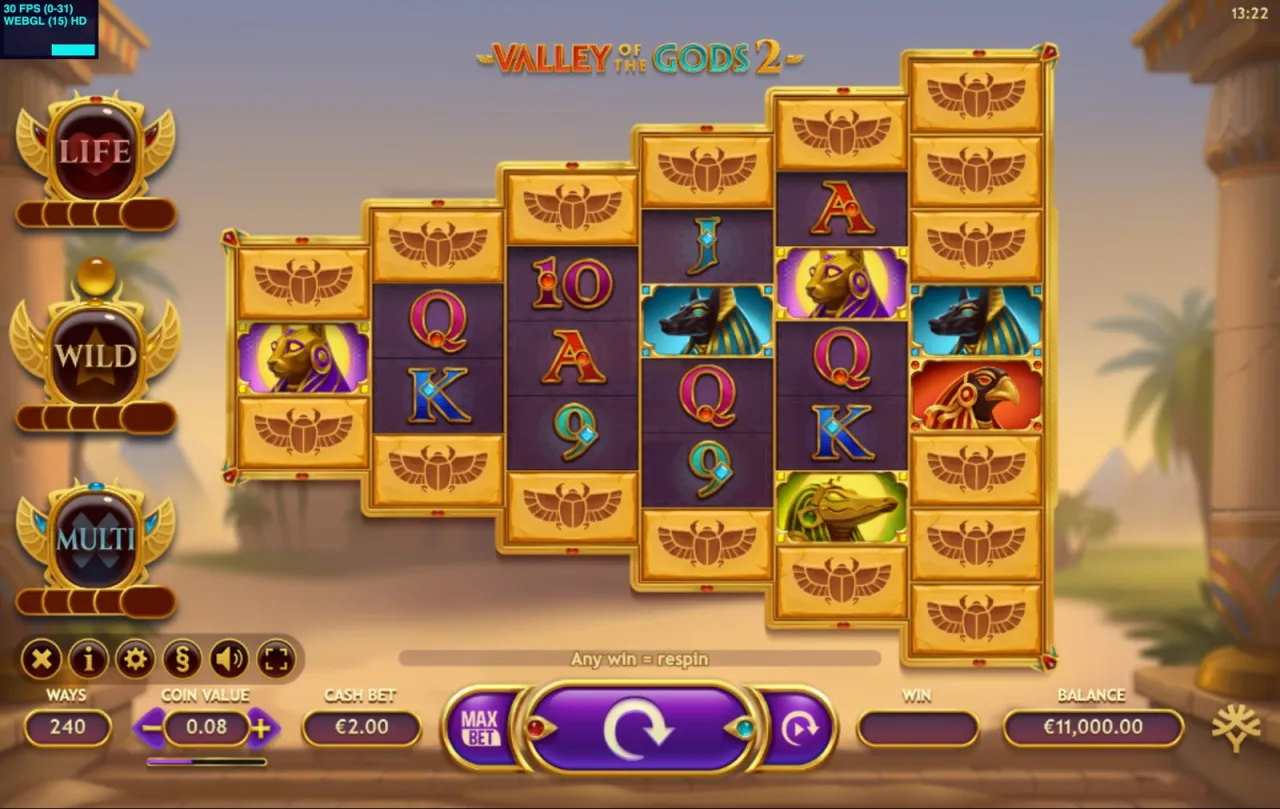
The setup is nothing out of the ordinary and pretty much what I've come to expect from Yggdrasil Gaming by now, and it arrives with an expanding 3×4×5×6×7×8 reel set and 240 up to 20,160 ways to win. The count only reaches that top figure once every Blocker has been cleared.
Visually, it's a sombre, simple slot with stone-carved artwork. It has plenty of gold, wind, and ritual drums, and a desert tomb serves as the backdrop.
Cats, crocodiles and a wild that never lands on its own
The paytable is displayed in cash at an unrecorded bet level, so the top symbol's 32.00 for six of a kind cannot be translated into multiples of the stake, and wins arrive from 3 or more identical symbols on adjacent reels, left to right. Several winning symbols on one reel multiply the win. The four premiums are the cat, the crocodile, the falcon and Anubis, with A, K, Q, J, 10 and 9 filling out the rest.
The wild symbol substitutes for all symbols and always covers an entire reel. It stays on that reel until it is part of a win. It never lands naturally. Wild Reels handed out by the Gold Scarab collection are the only way one arrives.
How the Scarab Collections split three ways
Featured in Valley of the Gods 2 is the respin chain. It is the only feature the game carries, so the base reels have to produce the whole return. It triggers in the main game every time a win lands, and each winning symbol awards Scarabs. Each respin also unlocks more Ways to Win. Scarabs destroy Blockers, and destroying all of the Blockers activates Scarab Collections. Across my 300 spins a win landed on 70 of them, so that is how often the chain got going.
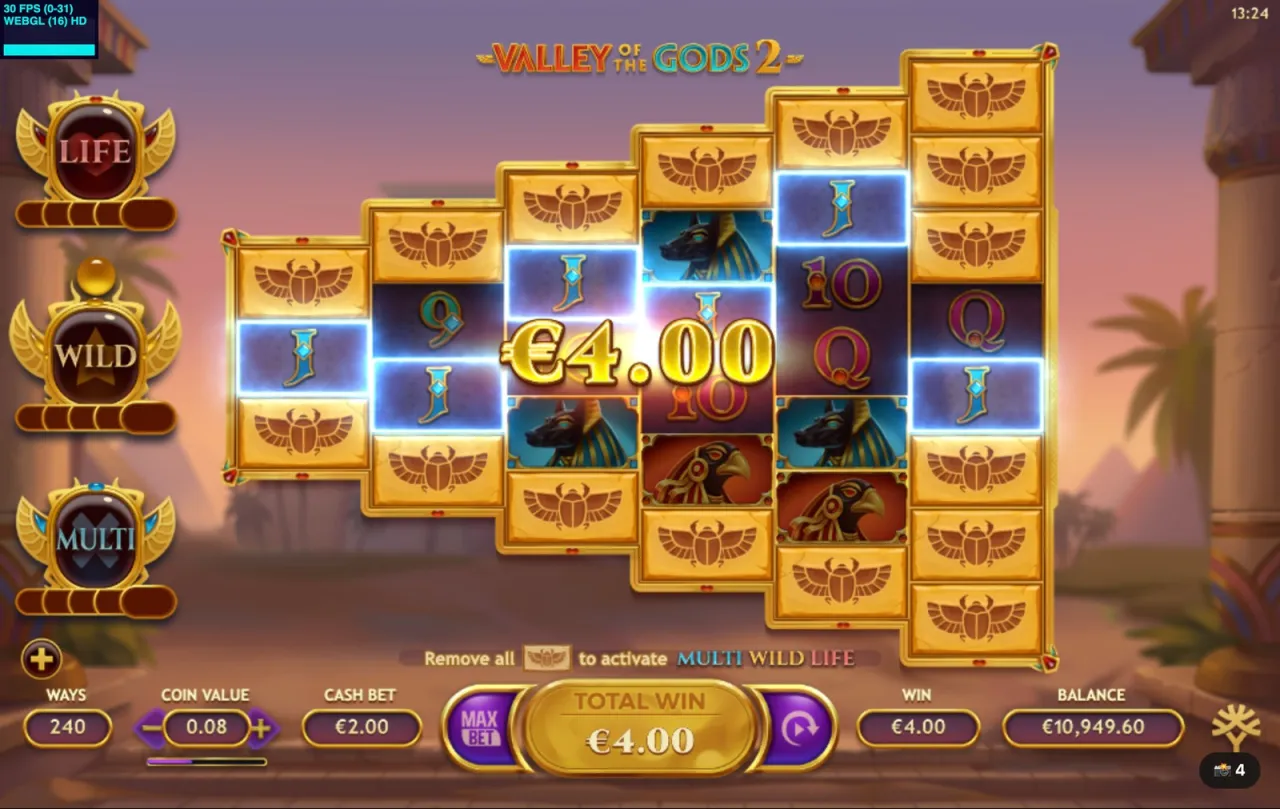
Now, once the Collections are active, three things are collected at once. The colour of the Scarab decides which of the three it feeds. Blue Scarabs lift the Win Multiplier, which begins the round at x2 and adds +1 for every 5 collected. That multiplier then applies to any further wins in the round. Red Scarabs award Extra Lives, one to begin with and +1 more for every 5, each life triggering a respin on a losing spin, and every 5 Gold Scarabs add +1 Wild Reel to the next spin. Each of those Wild Reels covers a full reel on the spin it is added to. Those wilds remain through respins until they are part of a win. My longest stretch with no win at all ran 18 spins and ended on spin 143.
Our Minty Verdict: The respin chain fires often enough — something landed on 70 of my 300 spins — but 300.00 staked came back as 197.80, a 65.9% return that never once put the balance above the 1,000.00 I started with.
300 spins with the flat line
Valley of the Gods 2 is a middling slot at best. Even if it's superior to most of the slots made by Yggdrasil Gaming's affiliated studios, it really doesn't say much in context, and being a 4 out of 5 volatility game with no bonus round at all, the respin chain is triggered quite often. Respins, Win Multipliers, Extra Lives and Wild Reels are the whole of the feature set. The payouts are seldom anything to get even remotely thrilled about. Behind spin 257 my next best returns were 16.00 on spin 65, then 7.60, 6.00 and 5.20. Over 300 spins at a 1.00 stake I handed back 300.00 and won 197.80, a 65.9% return, with only 70 paying spins and 40 of those paying less than the stake. The low point of the session was 837.80. The balance never once rose above the 1,000.00 it began from. It finished at 897.80.
My best spin was 95 times the stake on spin 257. That one spin was close to half of everything the session gave back, and it left the balance at 931.80. After that the run slid straight back down, and furthermore, as the game supplies quite a constant stream of wins, it can certainly be a passable wagering slot. Wins came on 23% of my spins. As a punter, however, I want to sense the pulse. Regrettably, all I receive playing Valley of the Gods 2 is a flat line.