

First Person Mega Ball Slot – Free Demo
Provider:
Evolution
Mega Ball isn't really a slot. It's a bingo-and-lottery round dressed in a casino studio, and First Person is Evolution's solo, software-run version of the same game its hosts deal live. I sat thirty-four rounds and bought the maximum 400 cards every time, paying $0.20 a card for $80 a round, and…
Play First Person Mega Ball demo
How a Mega Ball round actually plays
You buy bingo cards, balls get drawn, your matches complete patterns on the cards, and the patterns pay. That's the entire base game. The cards are 5×5 grids with numbers pulled from a 1-to-51 pool, you can run anywhere from a single card to four hundred of them at once, and each card has a value you set in the betting bar. The low end is $0.20 a card, the top end of the in-game bet range is $100 a card.
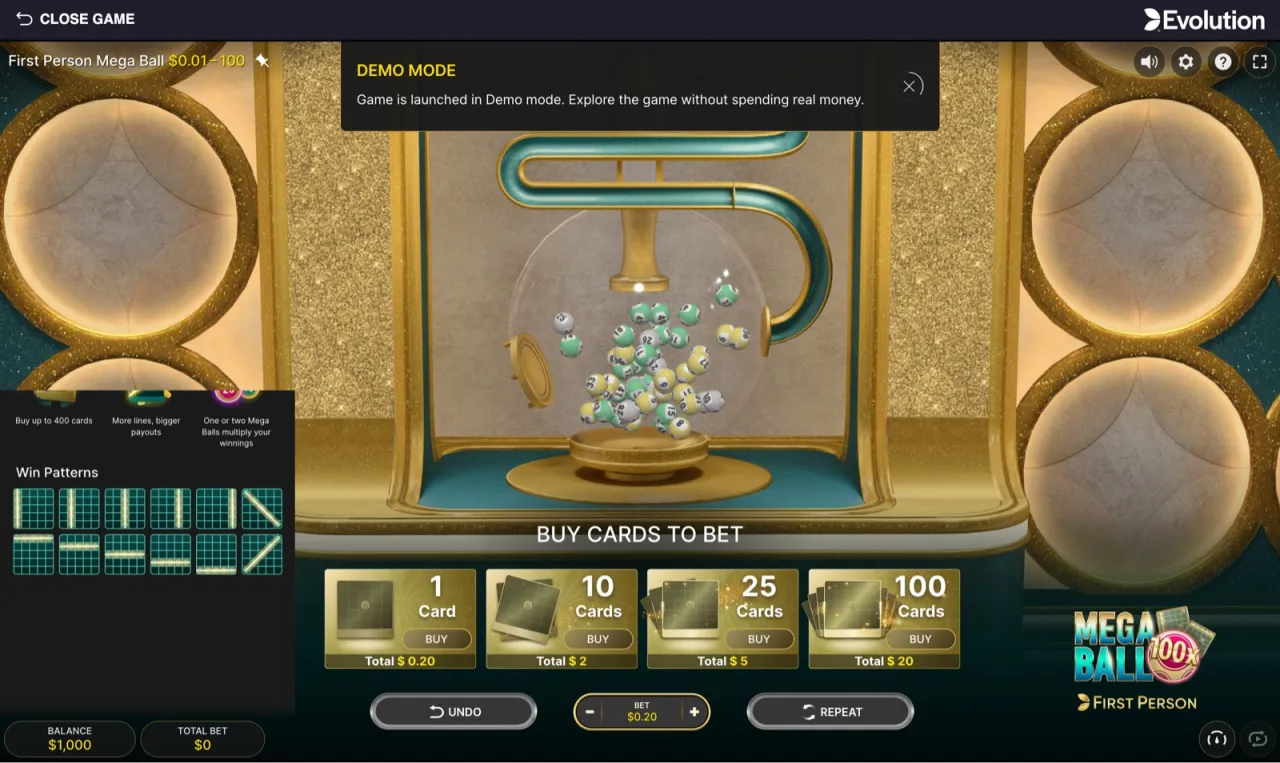
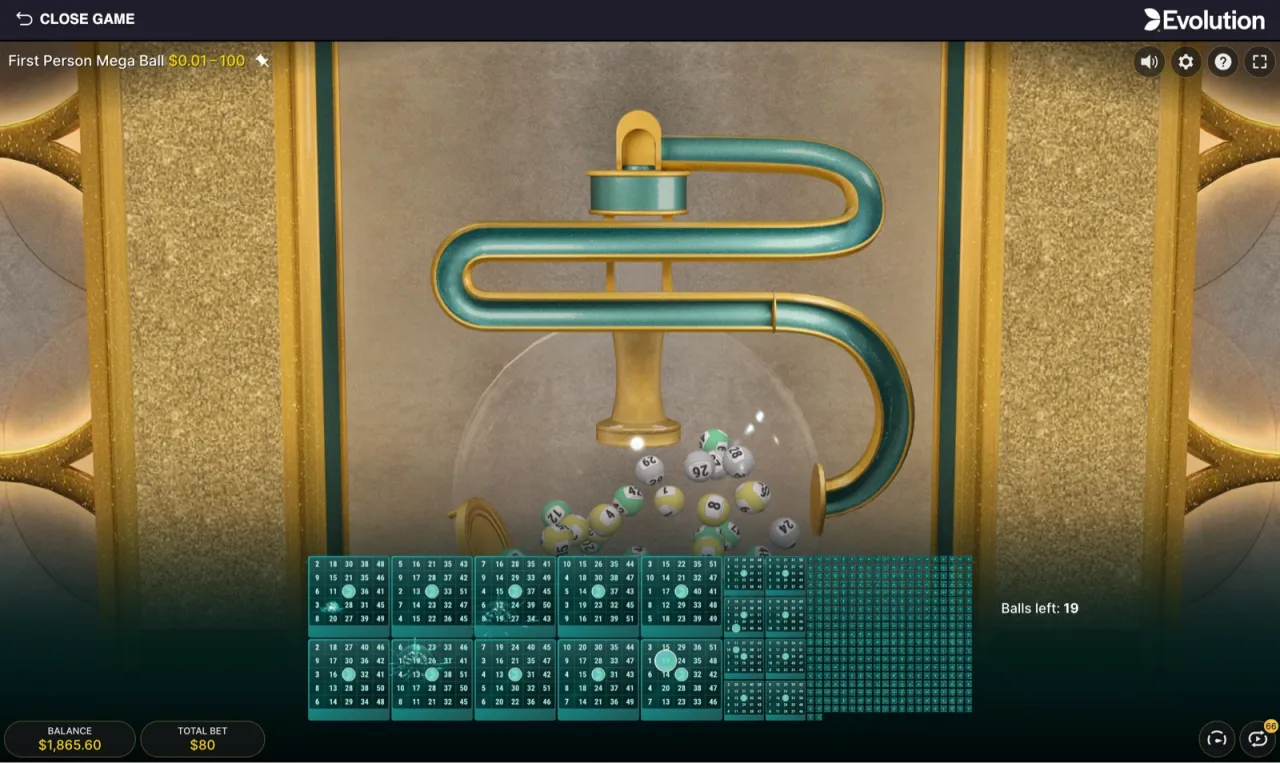
Once the cards are bought you press play and twenty balls drop from the ball trumpet at the top of the table. Numbers get marked automatically as they land. The Win Patterns chart on the left tells you which shapes pay: rows, columns, diagonals, X, T, plus, full card, the usual bingo set. Then comes the part the game is named for. After the 20 regular balls, one or two extra Mega Balls land, each carrying a random multiplier from 5x up to 100x. The catch is that a Mega Ball only pays if it completes a winning pattern that wasn't already finished by the first twenty.
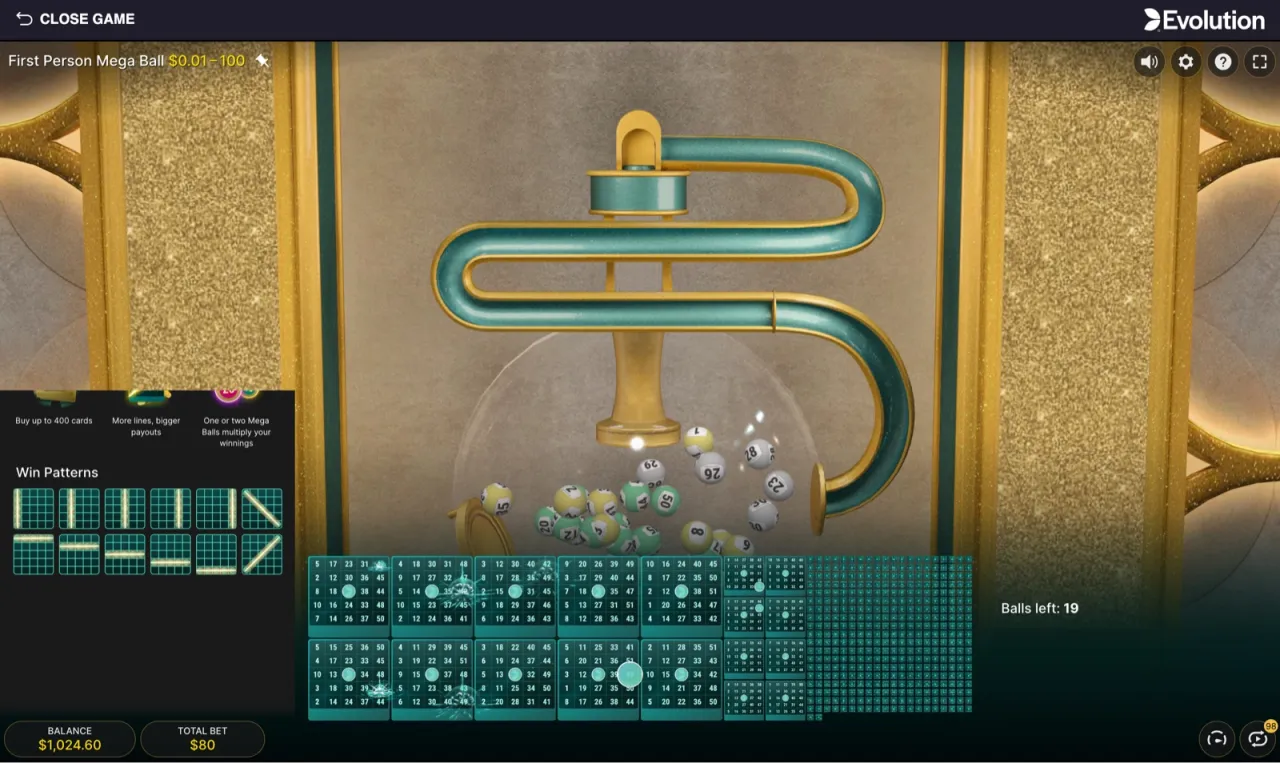
So a round has two halves. The first half is the regular bingo bit, where lines complete and pay out at standard table values. The second half is the multiplier roulette, where one extra number (chosen at random from the leftover pool) can turn a $20 round into a $940 round if the multiplier happens to be big and the ball happens to land in the right place.
Minty Slots Verdict: A bingo-lottery hybrid that lives or dies on whether the Mega Ball connects. Across thirty-four rounds with 400 cards apiece the session finished up $908.40, almost entirely because round 2 caught a 50x multiplier worth $946.60. The published 95.05% RTP describes the long-run math; the 100x multiplier cap describes the ceiling on any one round. The sitting felt like a steady drip of small wins between a few real moments.
Round 2: a $946.60 hit on Mega Ball #51
Two rounds in, the balance was sitting just under a grand. The first round had paid back small, the second looked like it was heading the same way — the twenty regular balls had landed, the running total across the 400-card matrix was modest. Then the Mega Ball came in.
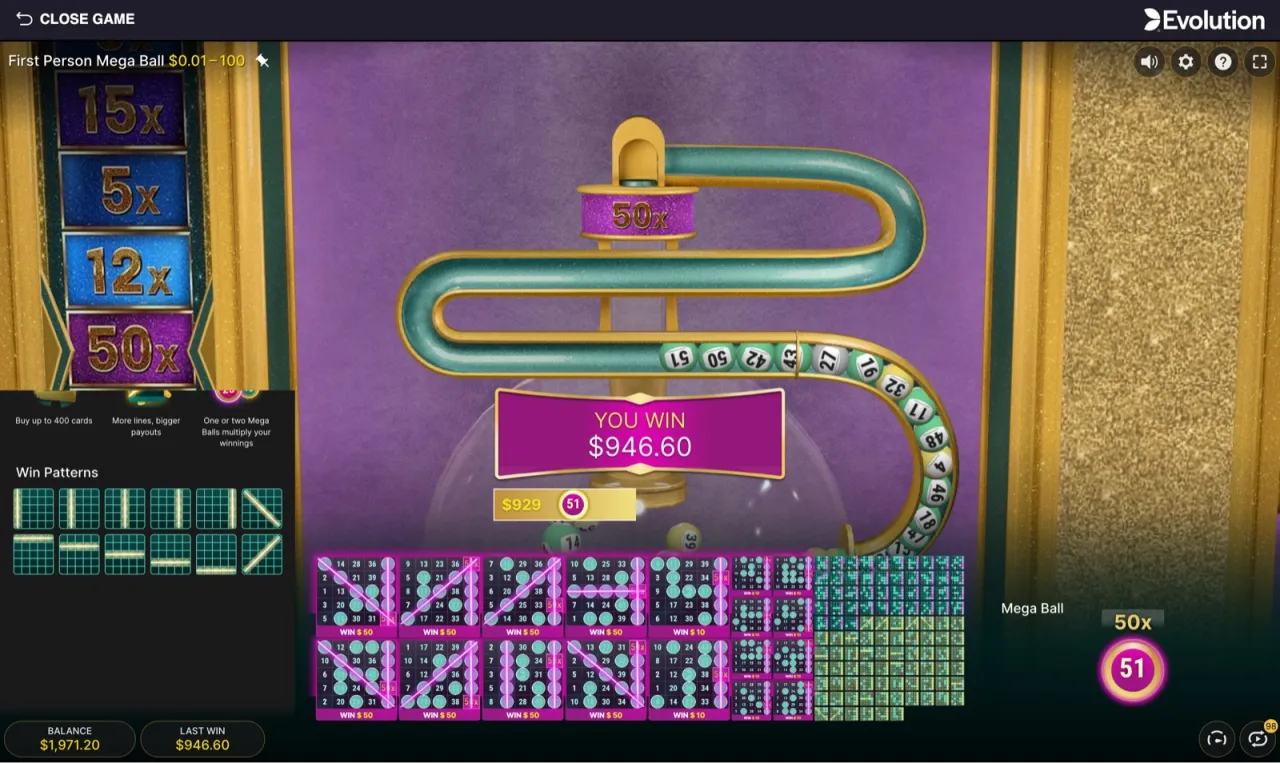
Mega Ball #51 dropped with a 50x multiplier and connected to 124 of my 400 cards. The screen took a second to do the math. Then YOU WIN $946.60 appeared in the centre with the prize ladder lit up to its 50x rung, and the balance jumped to $1,971.20 — within thirty dollars of doubling the starting bank. That single round basically settled the session before I'd really started playing. Everything that came after was either a smaller paid round or a flat one that gave a sliver of the $946.60 back.
Wins between the spike
The rest of the sitting wasn't all dead air. Several rounds paid back meaningfully when the multiplier hit a number that mattered. Round 18 caught Mega Ball #19 at 20x for $273.60. Eleven rounds on, Mega Ball #21 landed at 50x and paid $268. Late in the sitting, round 33 took Mega Ball #37 at 12x for $189 across 109 winning cards. Lower down the ladder, the 20x rung produced $132 on Mega Ball #33 and $95.60 on #31.
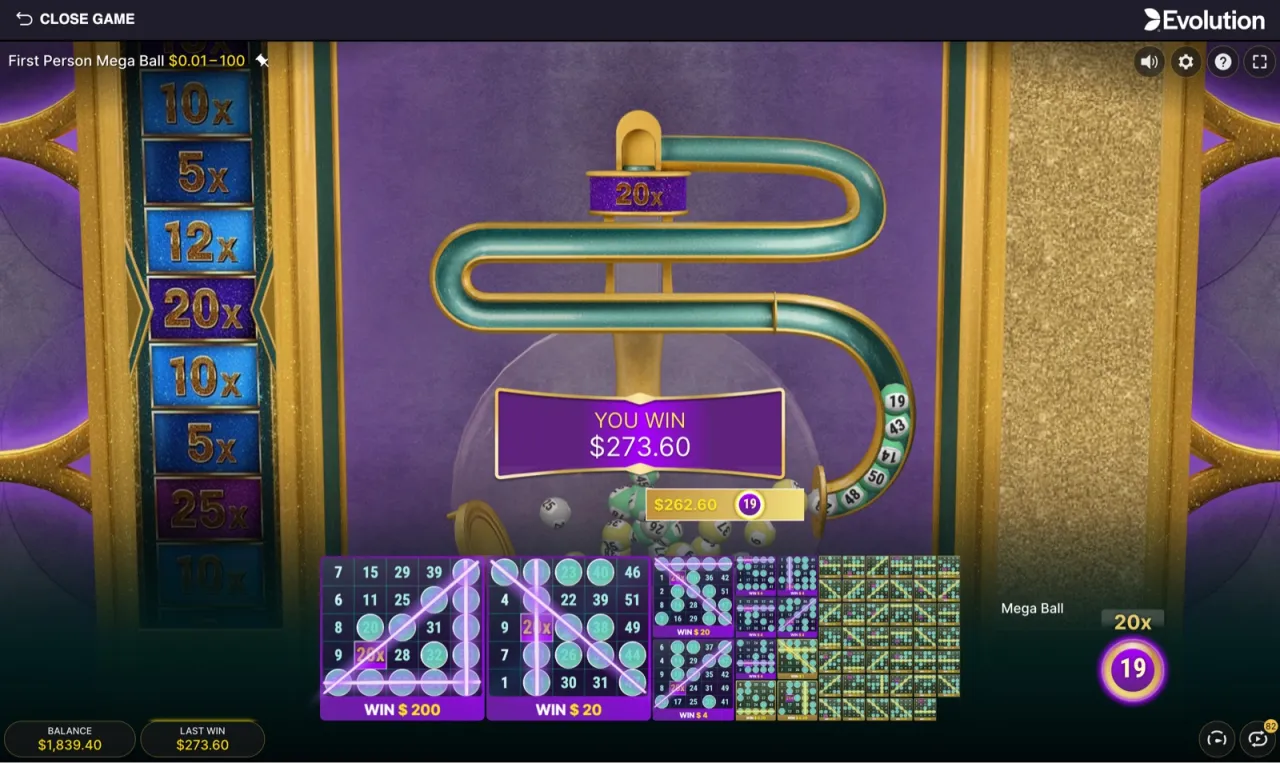
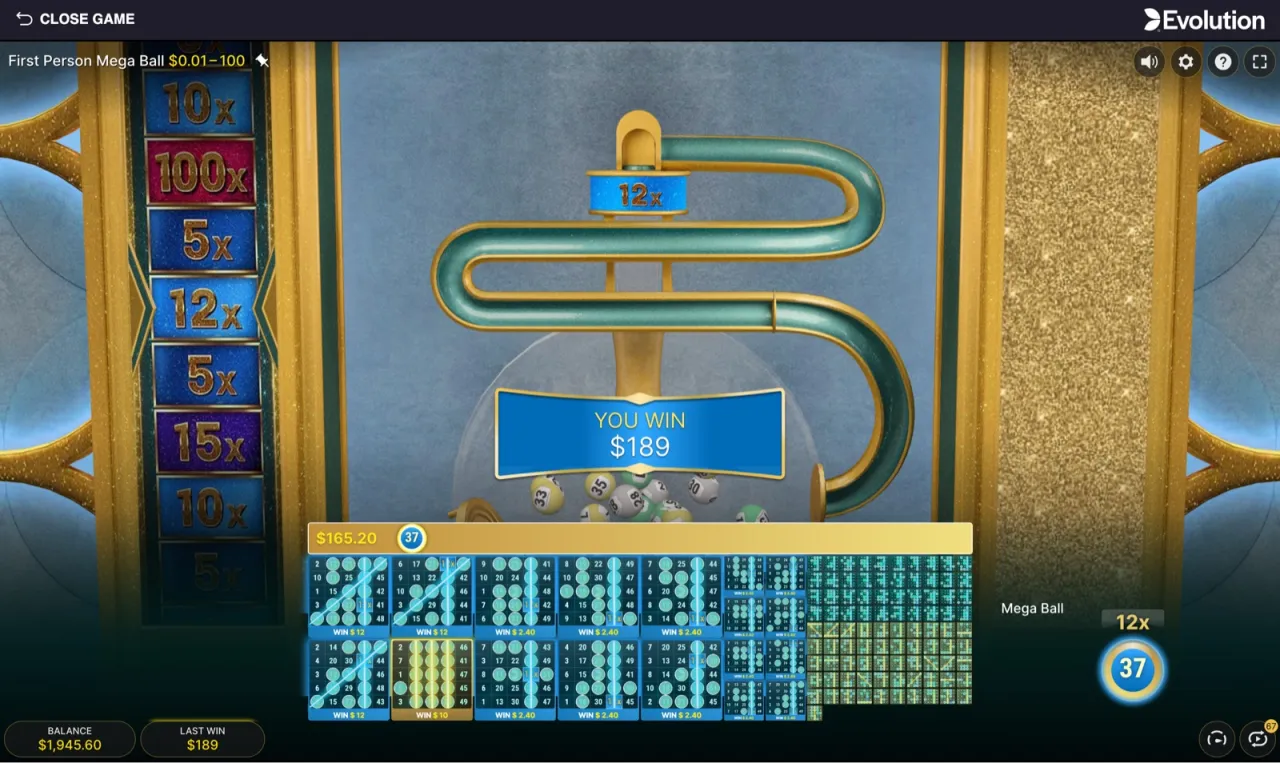
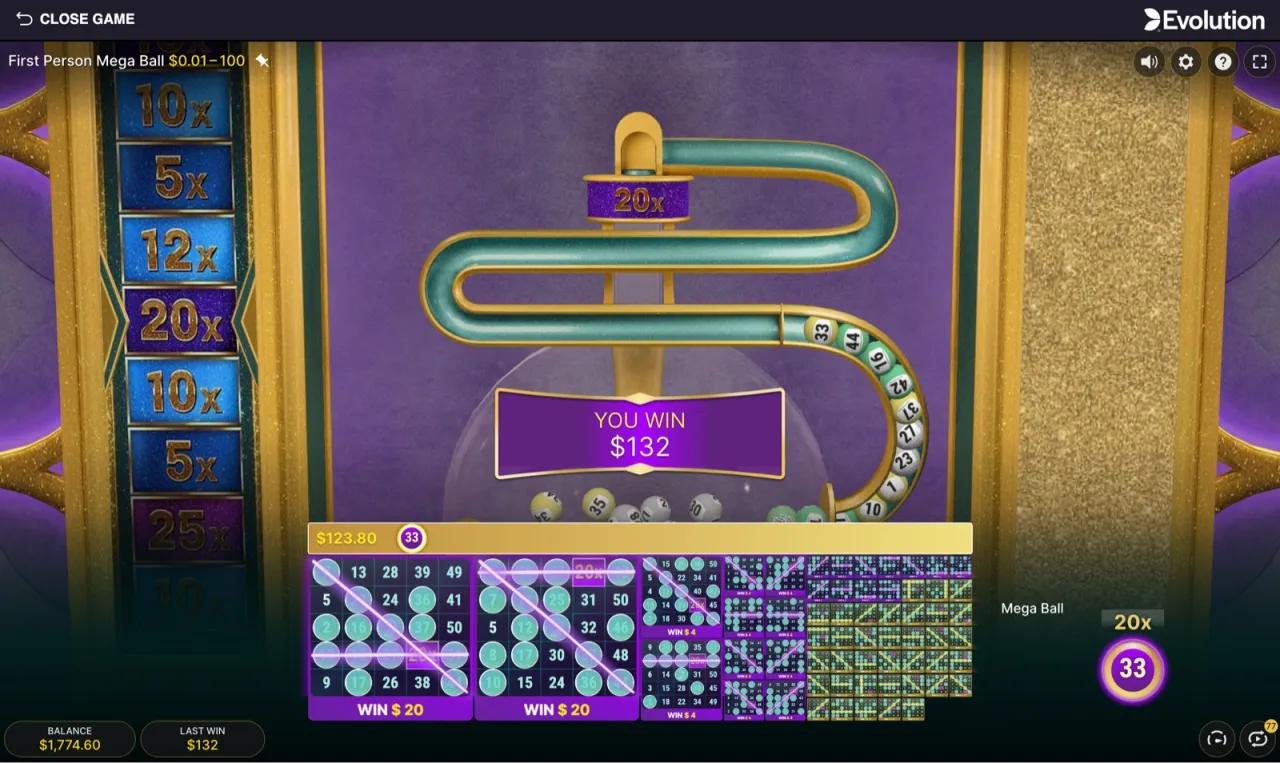
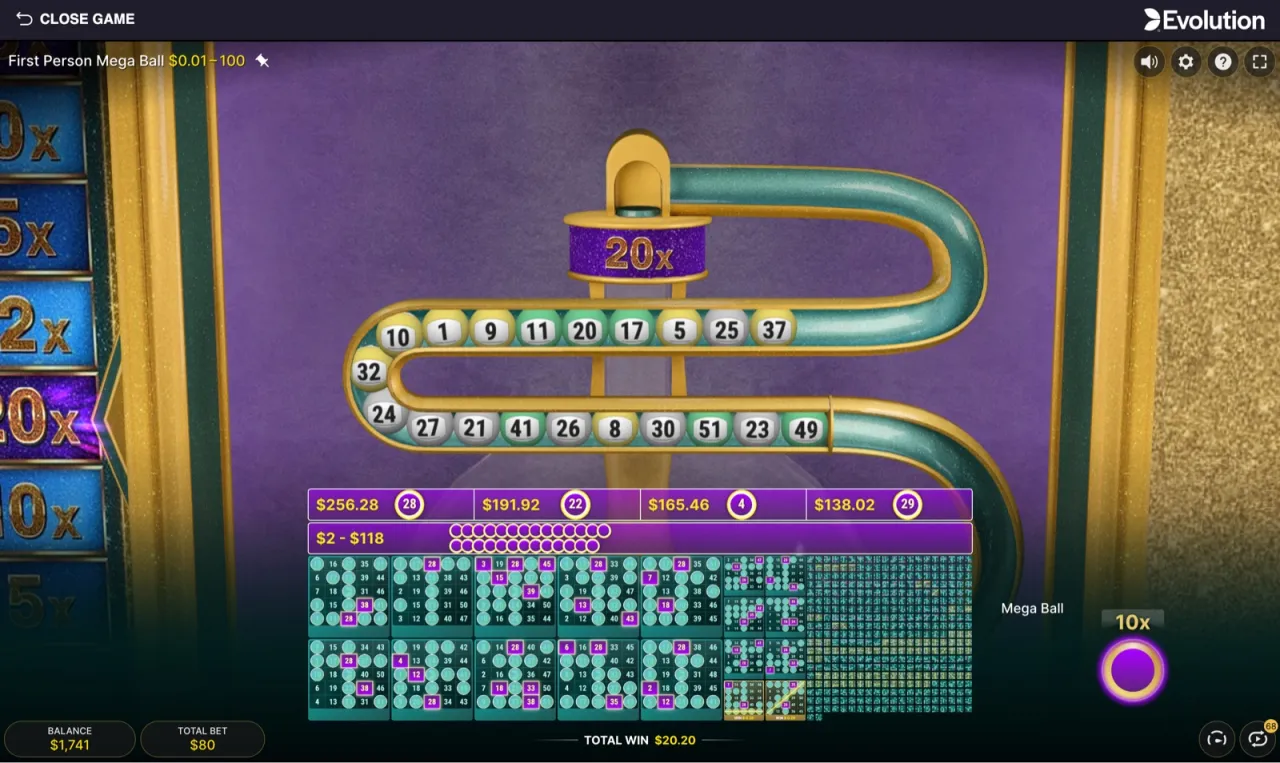
The smaller paid rounds, the ones returning $30 to $90, felt more like getting some of the stake back than winning. A Mega Ball at 5x or 10x usually means the multiplier completed only a few winning patterns across the matrix, and the result barely covers the cost of the round itself. At $80 a round, a $37.20 return on Mega Ball #39 at 5x is technically a paid round, but in practice you're down $42.80.
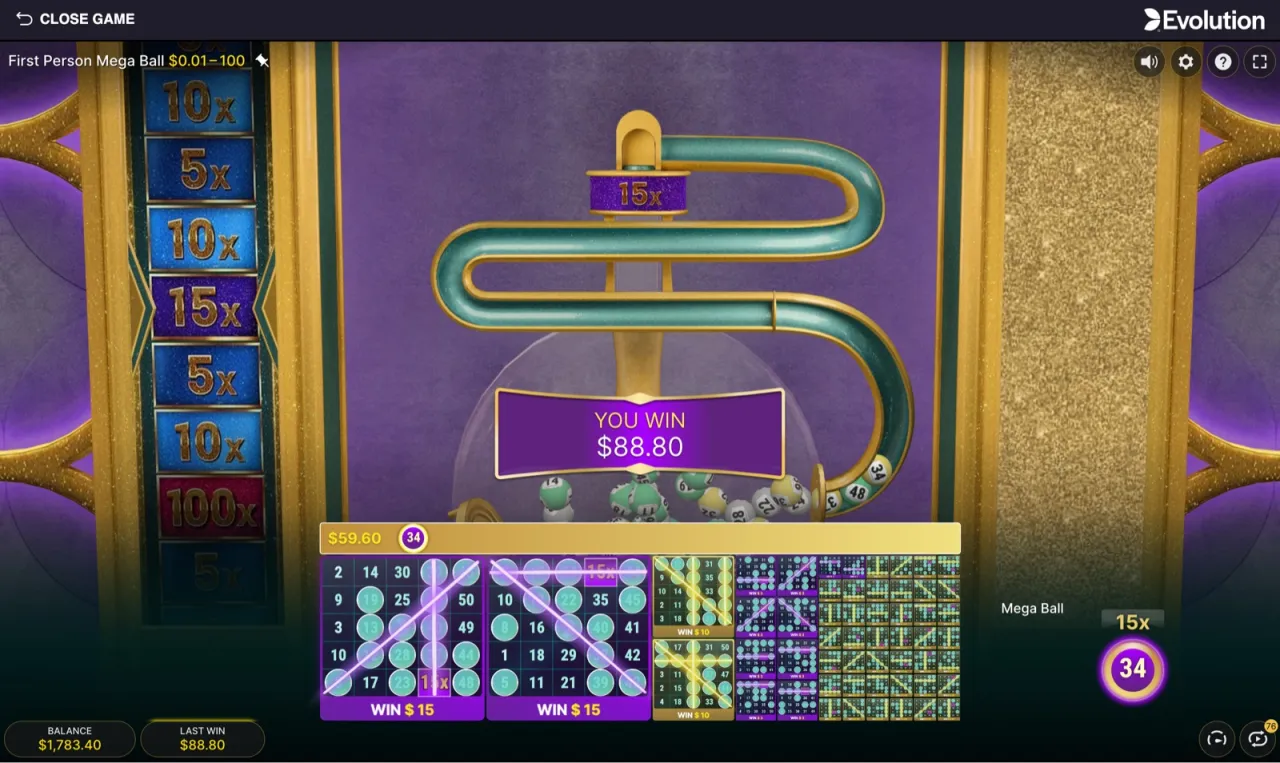
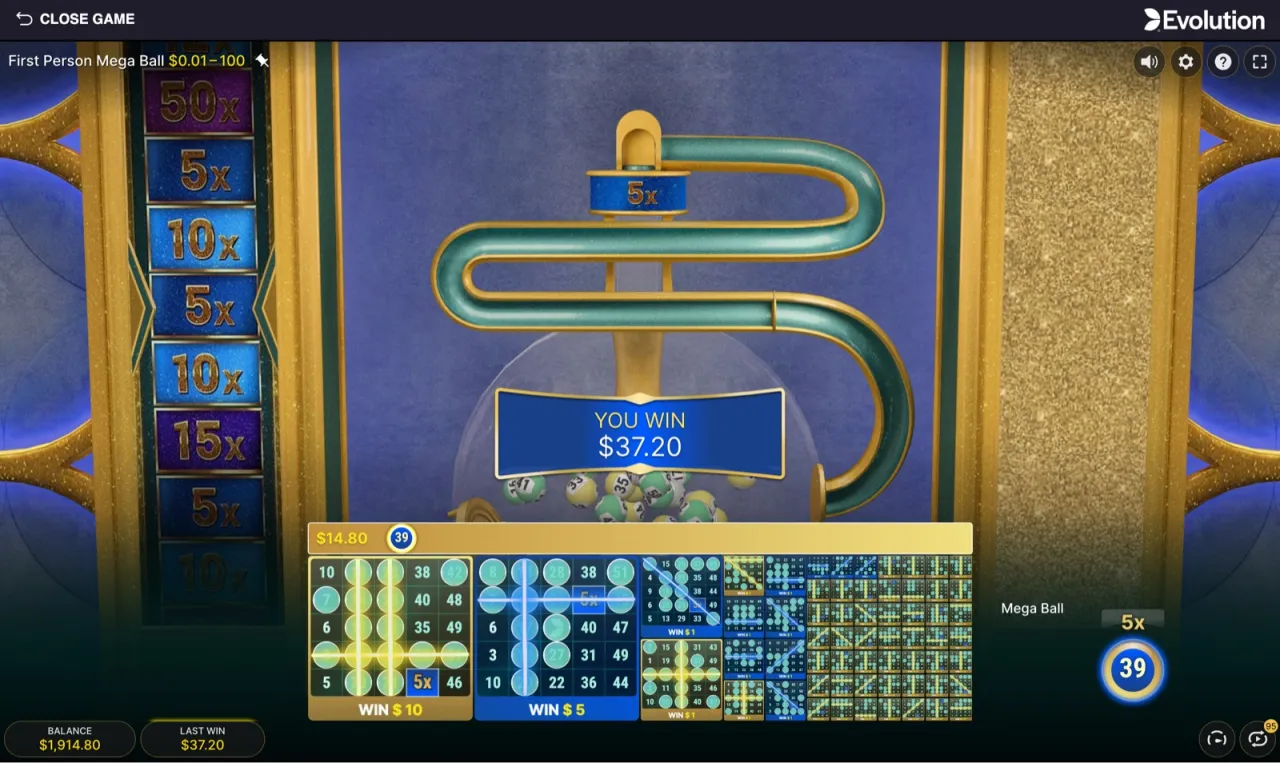
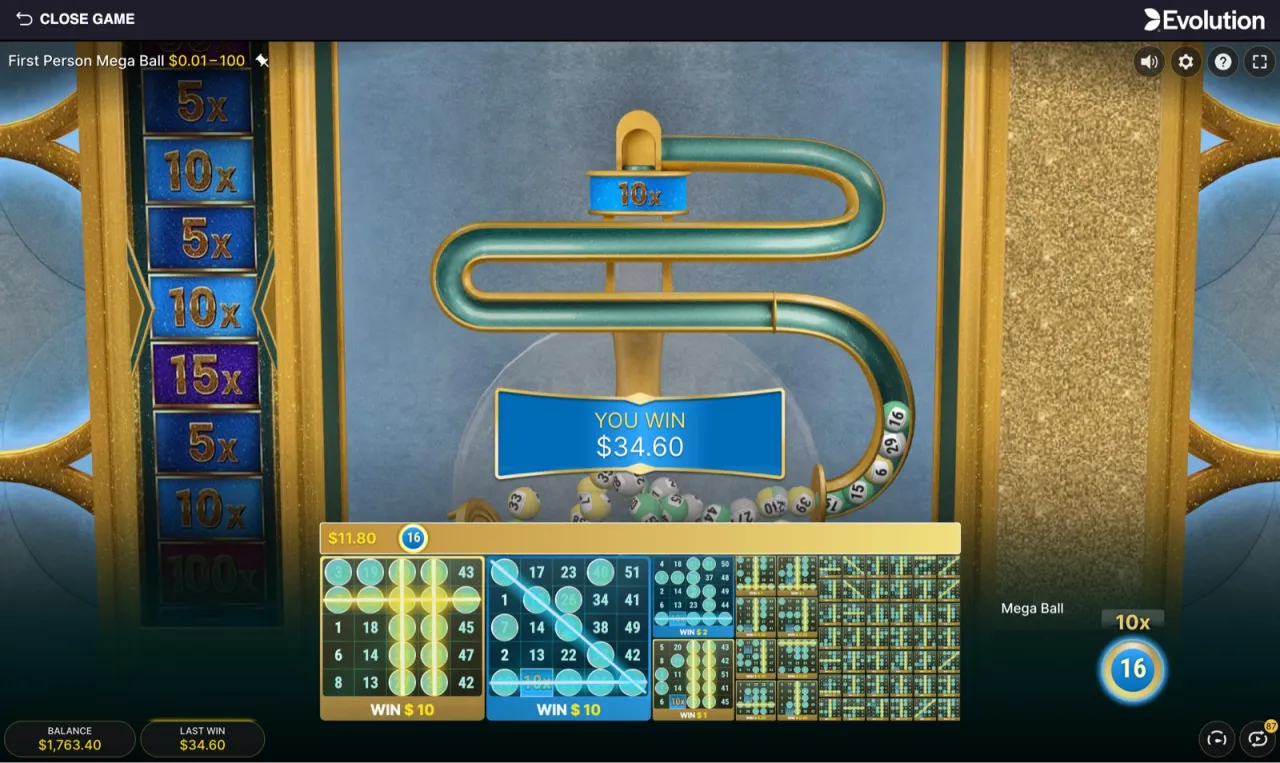
Then there were the dry rounds, the ones where the Mega Ball landed on a number that completed nothing, or the multiplier was 5x against a small base. Those were a fixed $80 loss each. Across thirty-four rounds, my count of "felt like a loss" outcomes was about half the sitting. The published return is 95.05%. On a format like this it gets paid out in chunky lumps; a single sitting will almost always look like outliers around an unseen average.
The one round with two Mega Balls
Round 11 was the only round in the sitting where two Mega Balls dropped instead of one. Number 37 came in at 12x, then number 48 right after it at 25x. Between them they completed patterns worth $157 on the round.
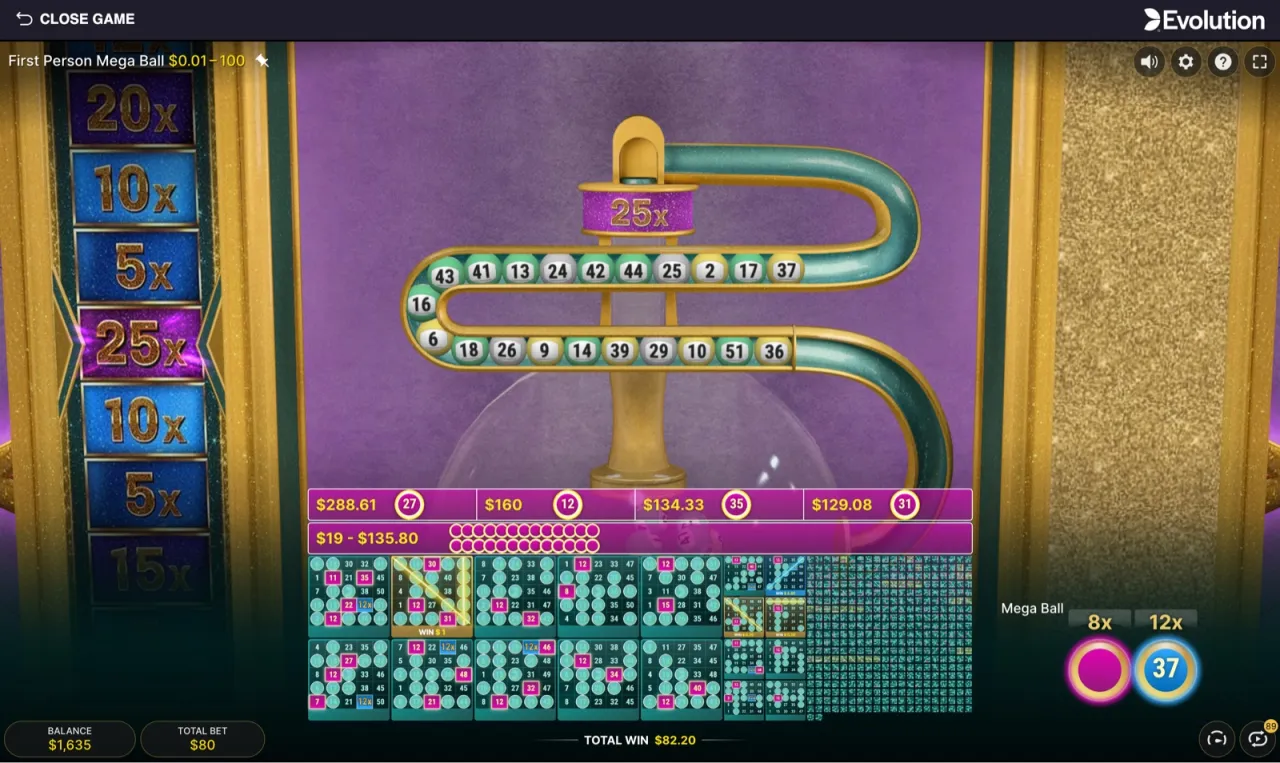
I don't have a published figure for how often two Mega Balls land instead of one. Going on the sitting alone, it was one round in thirty-four. The game's strapline calls it "one or two Mega Balls" without naming odds, and that's fine; you don't need the percentage to enjoy the round when it lands. What I'll say is that the screen makes a visual production out of the second ball appearing, so you know you've drawn the rare variant the moment it happens.
Why I bought the full 400 every round
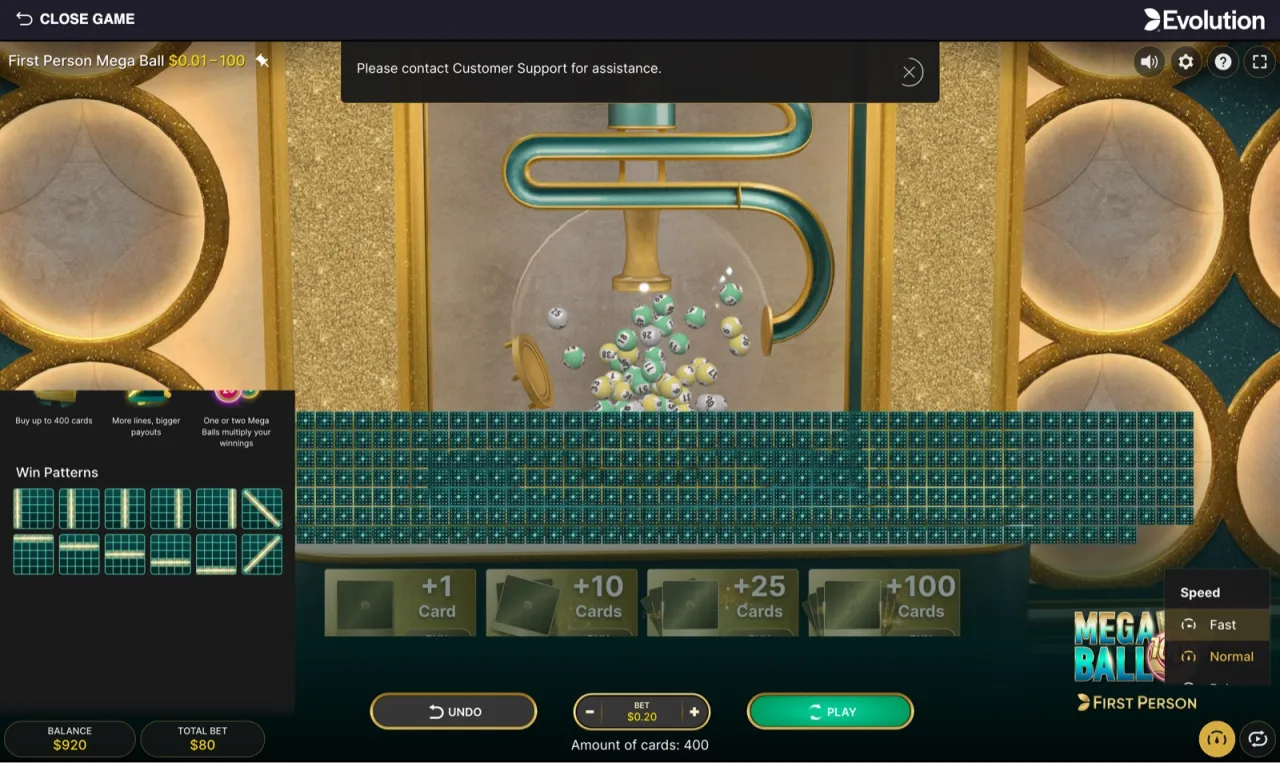
The first time you see the buy panel, 400 cards looks insane. The card matrix takes up the right side of the screen, and the total bet jumps to $80 the moment you tap the +100 button four times. By that point you've committed before you've really thought about it. I went with it because Mega Ball is one of those formats where buying more cards meaningfully changes what you're playing. A single card at $0.20 reduces the game to a fairly slow lottery draw. Four hundred cards at the same value turns it into a wide-net play where almost every draw clips something, and the Mega Ball multiplier has somewhere to land.
If I'd bought a hundred cards per round instead of four hundred, the stake would have been a quarter of mine, around $20 per round. The wins would have shrunk in absolute terms (round 2's $946.60 would have been $236.65). But the session would have lasted longer at the same starting bank. The number of cards is the main risk lever. After that, the card value and the speed setting do the rest.
RTP 95.05%, multipliers from 5x to 50x
Evolution publishes Mega Ball's long-run return at around 95.05% and the multiplier cap at 100x. Across my sitting the multipliers actually drawn ran from 5x at the bottom of the ladder up to 50x at the peak (round 2 and round 29 both caught 50x). The 100x rung never landed. That tracks with what you'd expect: the higher rungs are rarer by design, and one short session isn't going to surface all of them. A different thirty-four rounds in another sitting might never catch a 50x at all, or might catch two 100x and finish well above my +$908.40.
The 95.05% figure is the right way to think about Mega Ball over the long haul. Over a single ten-minute sitting it's almost meaningless; you're either in the round 2 outlier camp or you're not. What I'd take from the session is the shape of the game more than the result. You buy cards and watch them light up as balls land. Once or twice in a session the Mega Ball lands somewhere expensive and the round means something. The rest of the time it doesn't, and that's the math. If you want the same engine in a different shell, the studio's other RNG titles sit on the Evolution page.