First Person Dream Catcher Slot – Free Demo
Provider:
Evolution
Evolution's First Person Dream Catcher puts a 54-segment money wheel on screen and asks you to bet on one of six numbers; the 40, sitting on a single segment, is the long shot the whole game is built around. I chased it for 31 straight $10 spins and watched the balance slide from $1,000 to about…
Play First Person Dream Catcher demo
Six numbers, fifty-four segments
First Person Dream Catcher is the software solo of Evolution's live Dream Catcher money-wheel game show. Same wheel layout and the same multiplier segments, only without the studio host. Each spot on the wheel pays its own face value, scaling from a 1:1 return on the 1 up to a 40:1 return on the 40. On the surface the math couldn't be simpler.

The wheel has 54 spots in total. Half of those (23 segments) carry the 1. The 2 takes 15 more. The 40, the rare jackpot number, sits on a single spot. The remaining 15 spaces split between the wheel's middle numbers and a pair of multiplier wedges (a 2x and a 7x). The 1 is going to hit constantly; the 40, by design, almost never. The 77-spin session I worked through confirmed that prediction. The 40 stayed cold from start to finish.
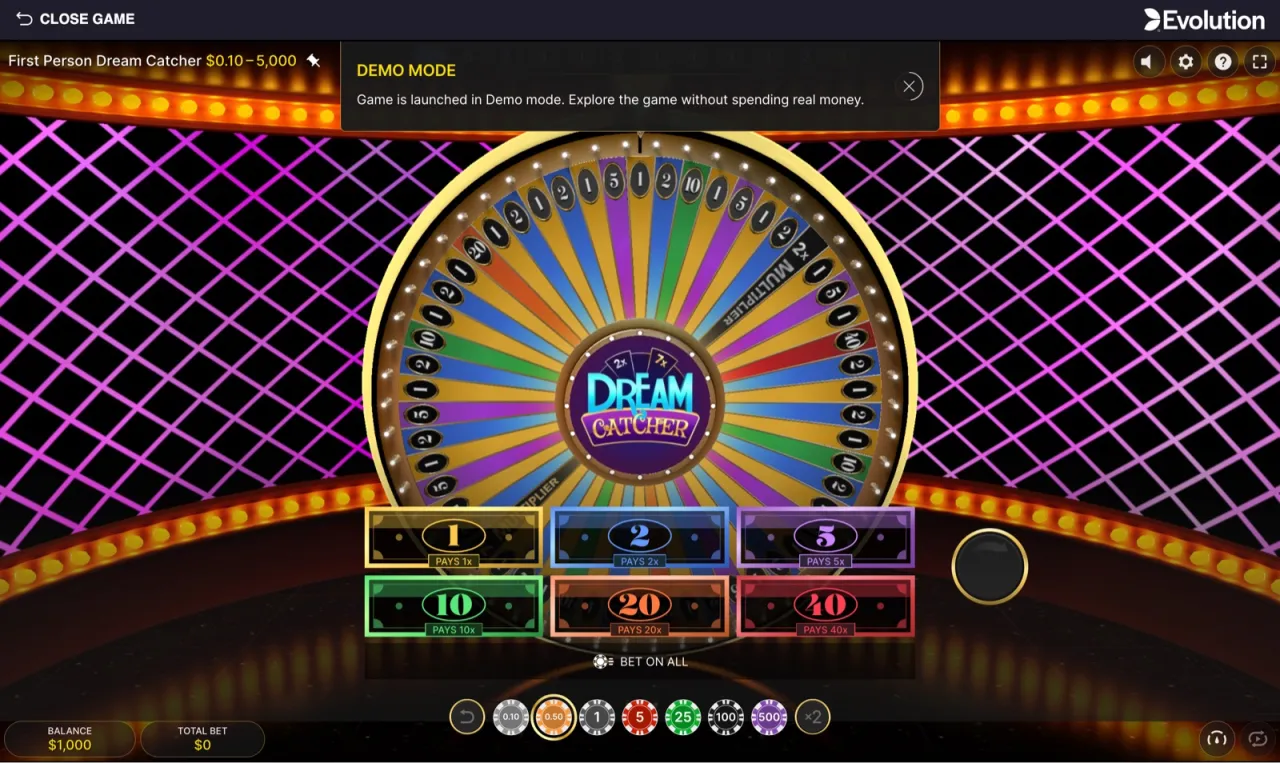
The Minty Take: 77 spins on First Person Dream Catcher at varied stakes from a $1,000 balance. The 40 (one of 54 segments) didn't land; three $1,100 hits on the 10 carried the upside, with the balance peaking at $2,140. A 7x multiplier later lit the same 10 spot at 70x for a teased $7,000, and the re-spin missed. Closed at $165, down $835. The wheel's published return tracks the number you back, sliding from 96.58% on the 1 down to 90.57% on the 40.
31 straight $10 bets on the 40
I opened the sitting with 31 consecutive $10 bets on the 40 alone. The 40 sits on a single segment of 54, so the per-spin chance of it landing is a hair under two percent. The wheel kept stopping on the low numbers, mostly 1s and 2s. The 10 came up a few times, close to the 40 on the layout but a different segment, so no payout. The 40 itself didn't show. By spin 31 the balance had bled from $1,000 to about $690.
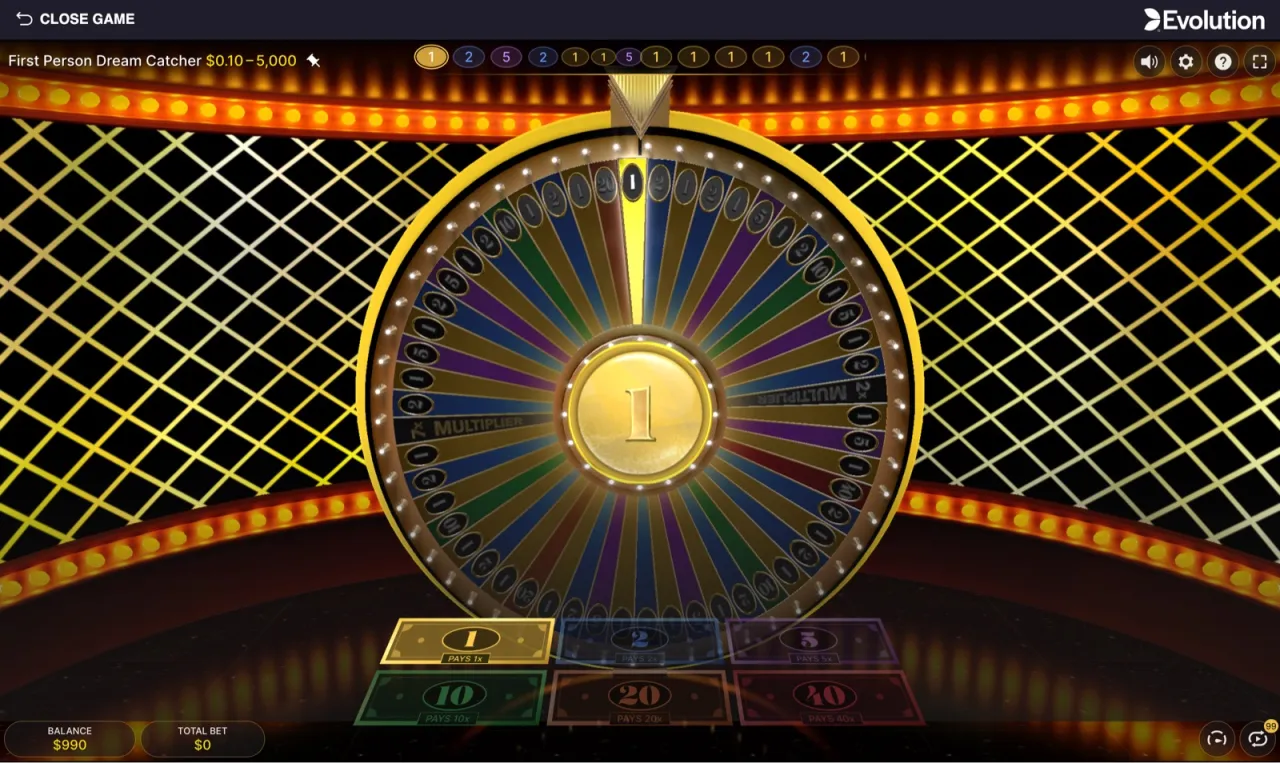
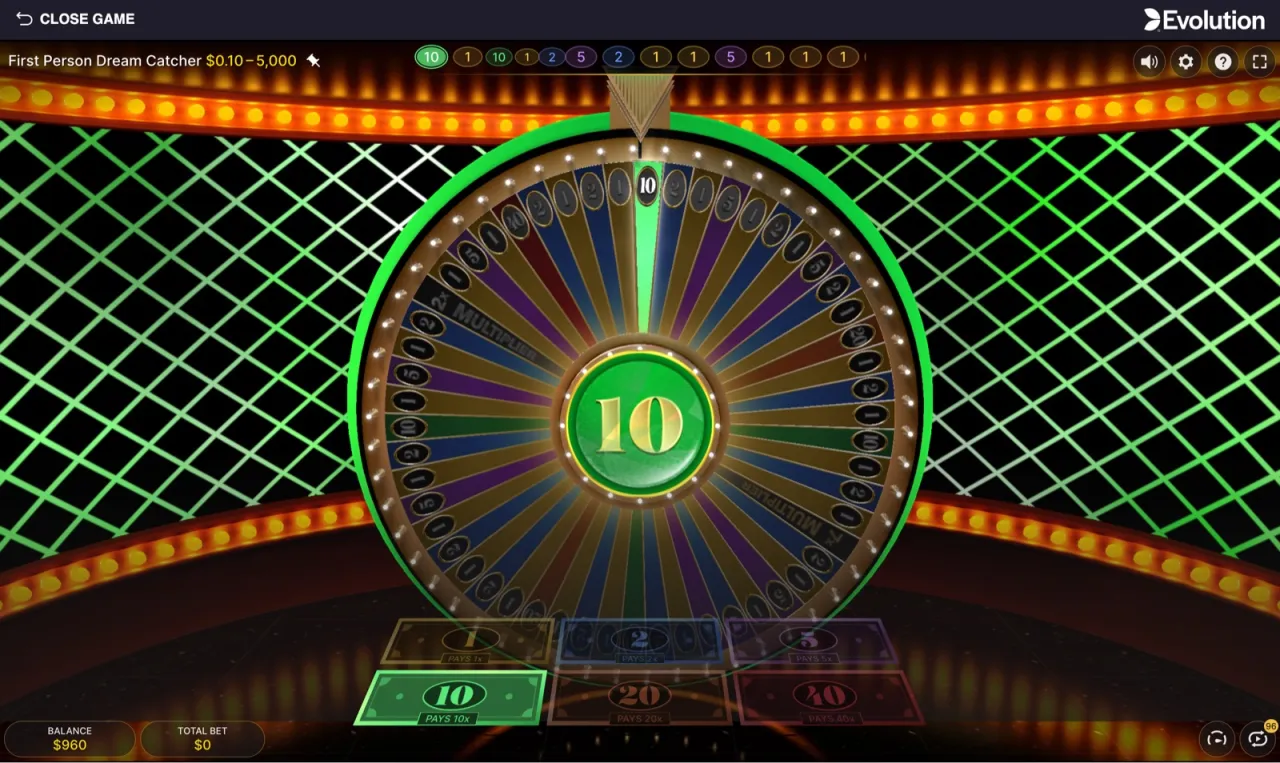
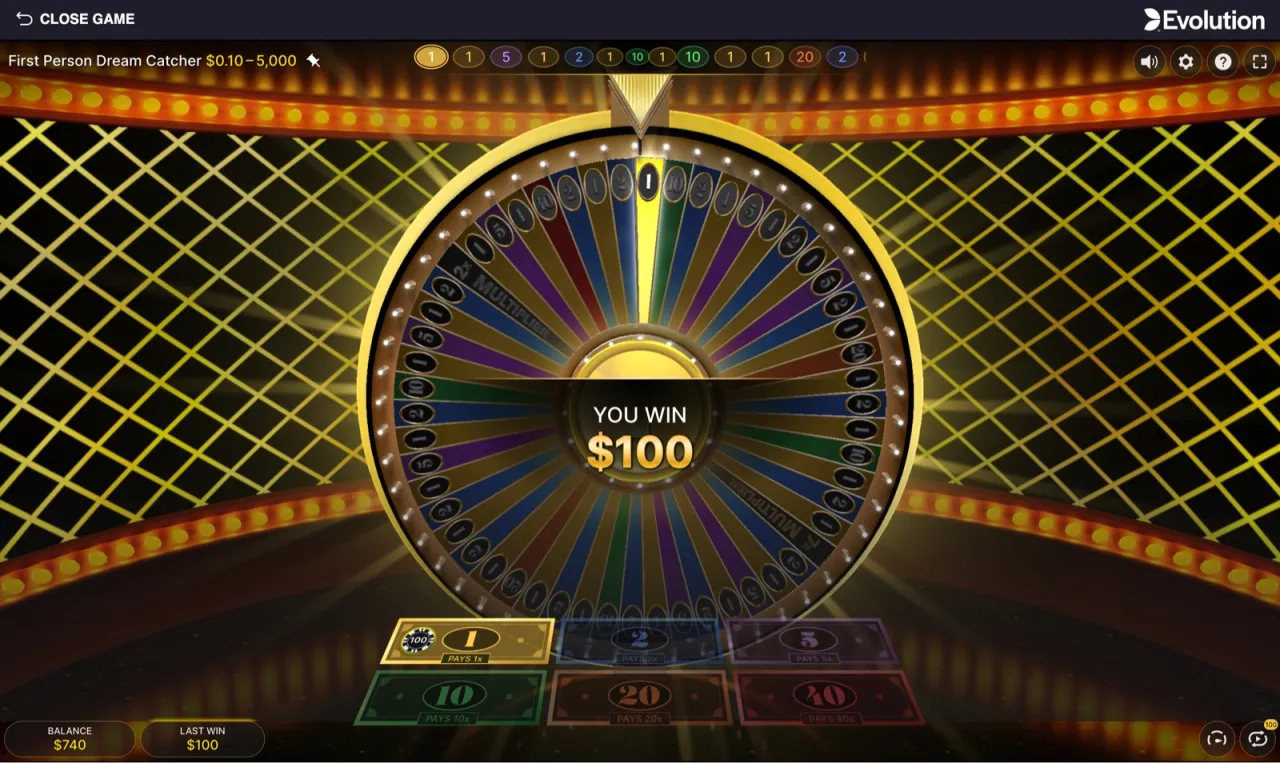
The 40:1 payout is the wheel's biggest face-value win, and that's the draw. The segment count is the part you have to plan around. Stacking $10 on a one-in-54 event spin after spin is what the layout punishes. After spin 31 I stepped off the 40; the next bet on the 1 paid $100, the first paying spin of the sitting.
Switching to the 10 at $100 a spin
I worked the 1 at $50 a stake for a few more spins; another three $100 wins came in as the strategy settled, and the balance steadied around $740. Then I bumped to $100 a spin on the 10.
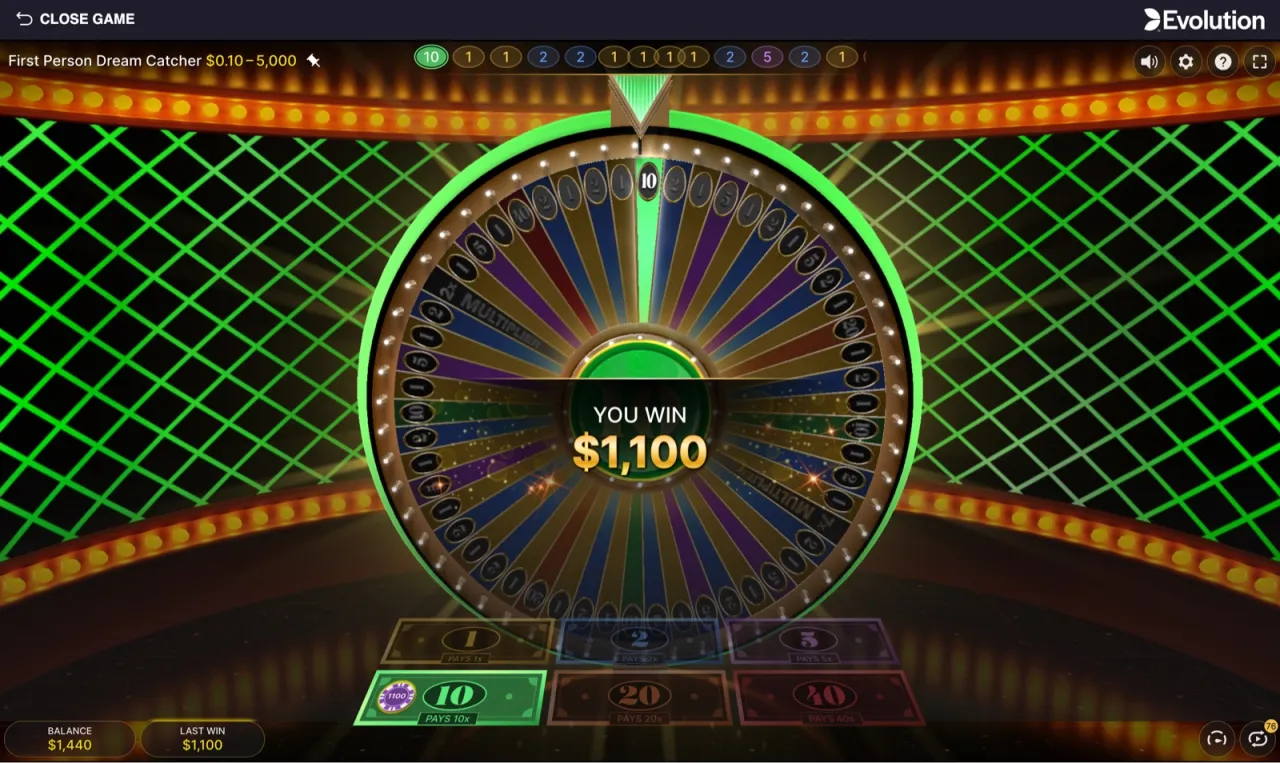
After the switch the 10 came in three times, each one paying $1,100. The balance peaked at $2,140 just after the second hit. That high water didn't hold; long dry stretches between hits ground the balance back down, and by spin 76 it had dipped to $15.
The 7x multiplier that lit the 10 spot at 70x
The wheel carries one 2x segment and one 7x. When it lands on either, all bets stay in place and the wheel spins again. The multiplier applies to the win on whatever number lands on the deciding spin. If a second multiplier lands before a number does, the multipliers stack: a 7x followed by a 7x reads as 49x on the next number to hit.
The session's tease came on round 45. I had $100 sitting on the 10 when the wheel stopped on the 7x. Every bet spot then relit at the boosted figure. The 10 now showed 70x — a potential $7,000 if the deciding spin came up 10. The deciding spin came up 1 instead. The 70x slipped away.
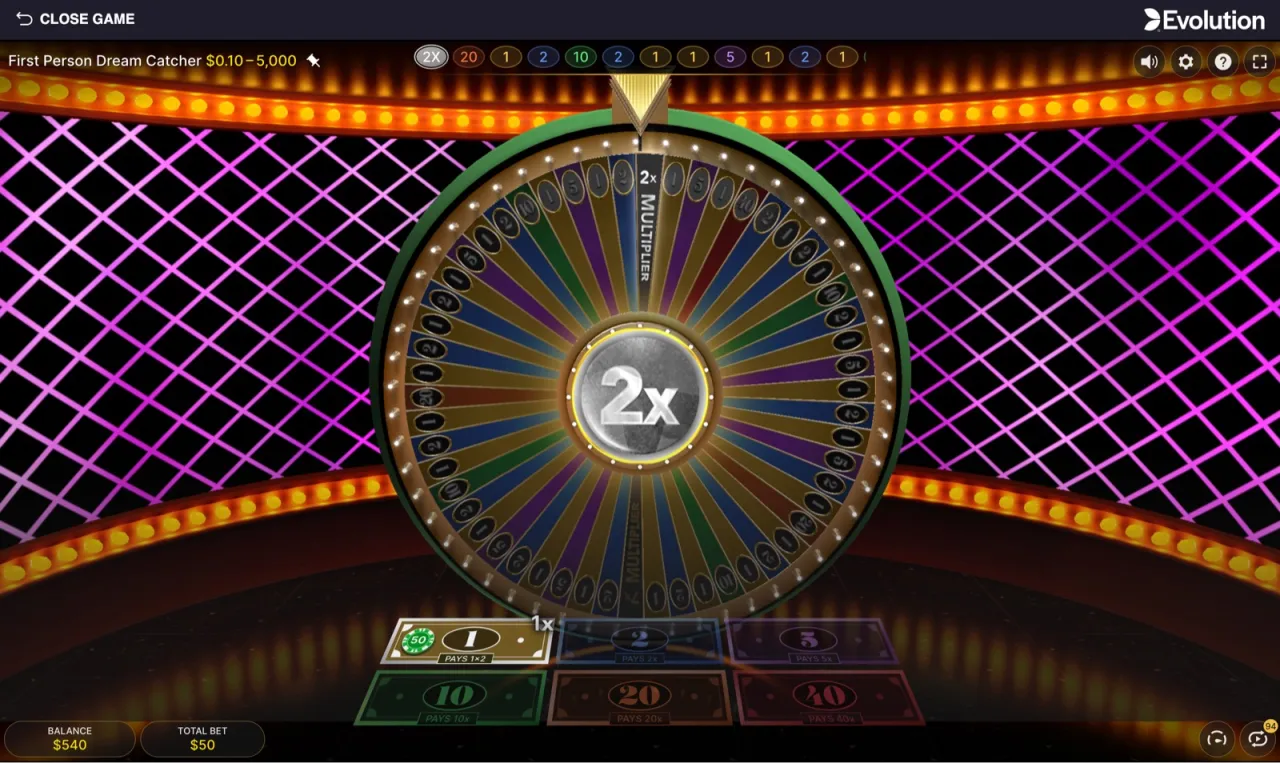
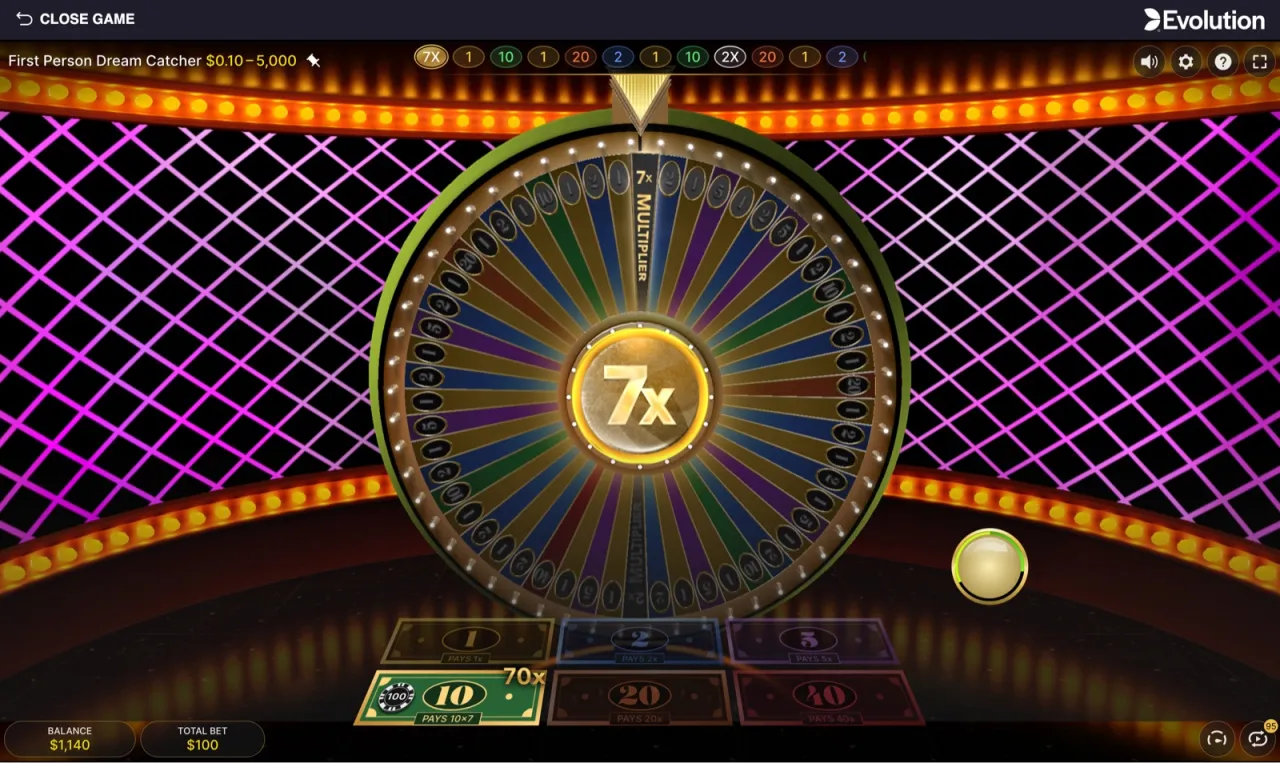
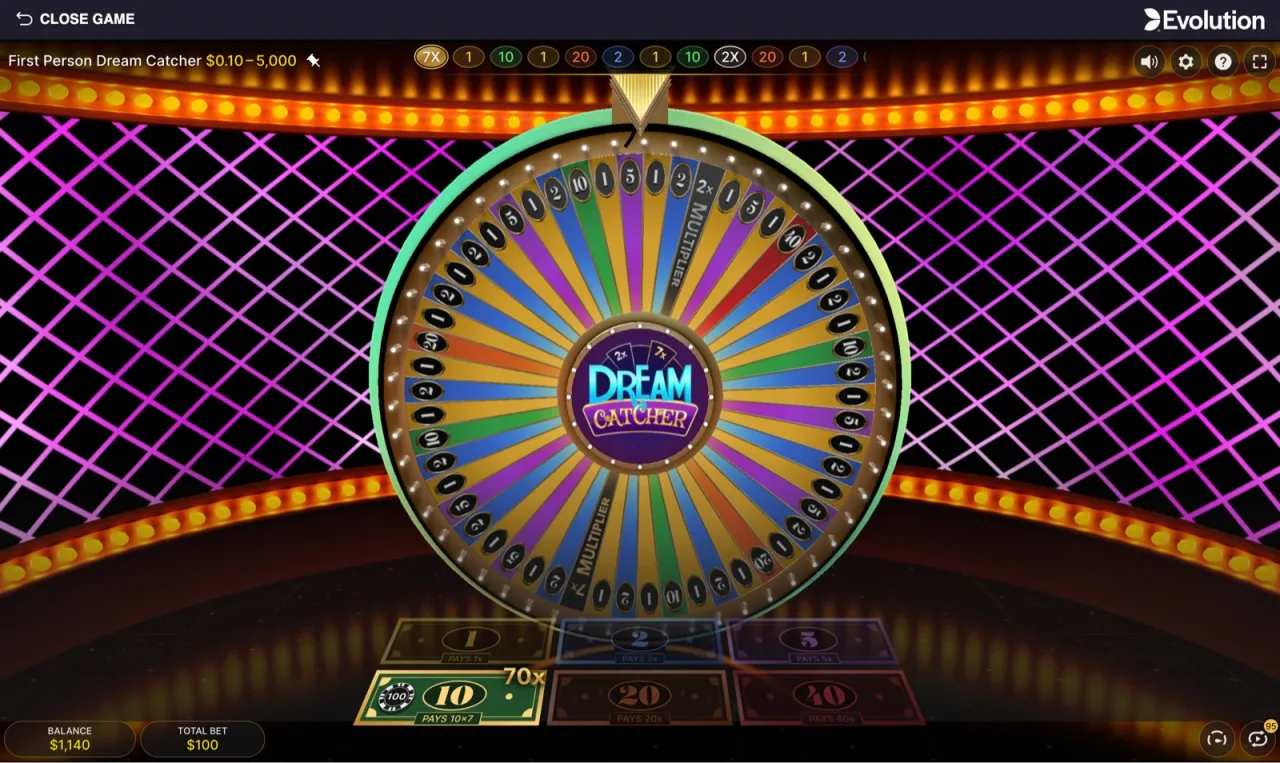
The 2x and 7x landed three times across the sitting, and the deciding re-spin missed the bet number every time. None of the multipliers paid out. That's the realistic Dream Catcher mechanic: the multiplier is the headline upside, and the most common way it resolves is by not paying.
Why the RTP depends on which number you back
Most slots quote a single RTP figure. The wheel's math gives a different return for each number. Backing the 1 returns about 96.58% over the long run, the 40 returns about 90.57%, and the 2 through 20 stack between those at roughly 95% to 96%. It runs counter to instinct: the biggest face-value payout has the worst return. The 40 looks like the jackpot bet, but the segment distribution punishes it. That's not a flaw in the design; that's how money wheels balance their math.
The wheel's segment counts are spelled out in the in-game stats panel. Most slots hide that math; this one displays it. If you want to know what return you're actually playing against, the answer is the number you've picked off the betting layout.
The Go Live button and the close
One feature worth a mention: the Go Live button at the corner of the screen jumps you from the RNG version straight into the live Dream Catcher table mid-session. Same six numbers and the same multiplier layout, only with a real wheel and a host in place of software. Useful if you're treating this RNG version as practice for the live table.
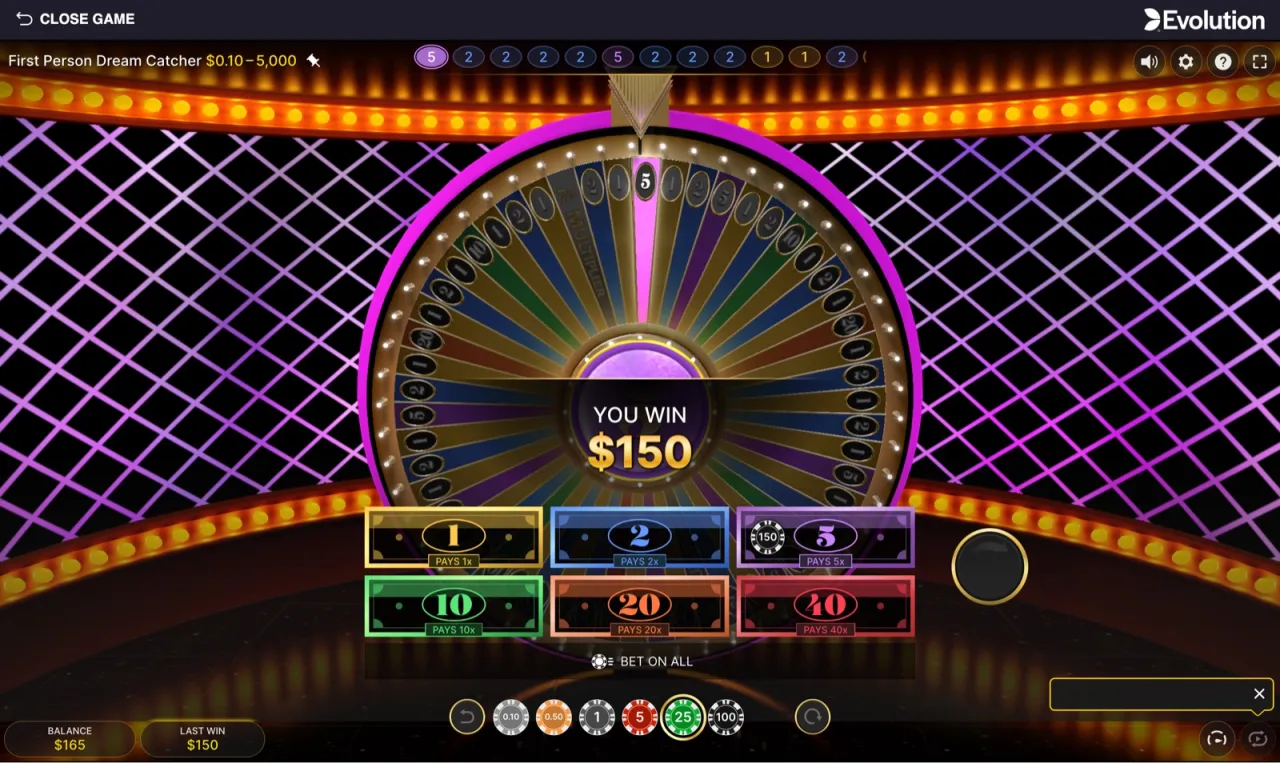
The final spin of my run was a spread bet across 1, 2, 5 and 10. The wheel landed on 5 for a $150 return. The sitting ended at $165, $835 below where it started. The 40 doesn't land often, and the multipliers don't pay if the re-spin misses. That's the wheel doing what its segment distribution promises.