
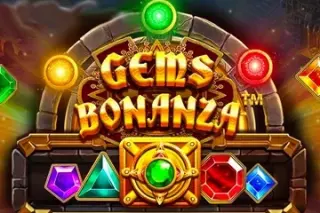
Gems Bonanza Slot – Free Demo
Added: Jan 10, 2026
Updated: Apr 7, 2026
Provider:
Pragmatic Play
Pragmatic Play's Gems Bonanza runs on an 8×8 cluster grid where five colored markers — hidden beneath the symbols — can detonate board-reshaping modifiers mid-tumble. The Gold Fever bonus ditches scatter counts in favor of a collection meter that resets the moment your chain dies. Stake range: 0.20…
Play Gems Bonanza demo
How Gems Bonanza Actually Plays
Strip away the gemstone gloss and what you have is a momentum-based math model on a 64-position grid. Wins require five or more matching symbols touching horizontally or vertically — no paylines, no scatter thresholds. Once a cluster pays, symbols clear and new ones drop, creating a tumble that can chain repeatedly inside a single spin. The difference between this and a standard cluster slot is the five colored markers embedded in the grid: when a winning cluster lands on one, the corresponding board modifier triggers mid-chain before the next drop resolves. The grid you start a spin with may look nothing like the grid that closes it out.
The Pragmatic Play math is unambiguously high-volatility. The 96.55% RTP (top configuration) does not distribute evenly — the bulk of a typical session will be low-output cluster hits that sustain your balance without growing it. The swings that define a session arrive when two or more modifiers stack inside a single chain, or when Gold Fever's multiplier ladder finds traction. Long dry runs are not a bug in this game. They are load-bearing.
Minty's Expert Conclusion: Gems Bonanza is a well-constructed high-variance grid slot with genuine mechanical depth — and it will drain a shallow bankroll before it shows you anything interesting. The five-modifier base game creates real mid-session tension, but the Chain Killer — that cold, disconnected grid that collapses the Gold Fever meter one symbol short of a level-up — operates with depressing consistency. The 10,000× ceiling is real. The road to it is a grind with no shortcuts. Size your stake accordingly or this one will eat you alive in portrait mode.
Gems Bonanza Visual Design and Grid Legibility
The art direction is temple-treasure: molten-gold trim, ancient glyphs, a backdrop that implies you are excavating something that did not want to be found. None of this is the point. The real design priority is grid readability at 64 symbols. Color-coded gems, clear cluster highlights, and clean symbol removal animations make it possible to track five modifier positions, an active tumble chain, and the Gold Fever meter simultaneously without losing the thread. That is harder to achieve than it sounds at this board size, and Pragmatic mostly gets it right.
Audio is functional rather than decorative — short, distinct cues for marker activations, rising intensity during longer chains, nothing that competes with the visual information you need to process. The overall package holds up on mobile, where the grid's scale could easily become unmanageable. It does not.
Battle of the Bonanzas: Gems vs. Sweet
They share a name and a developer. The resemblance ends there.
| Feature | Gems Bonanza | Sweet Bonanza |
|---|---|---|
| Pay System | Clusters (5+ touching) | Scatter Pays (8+ anywhere) |
| Bonus Trigger | Level-Up Meter (Gold Fever) | Free Spins with Bomb Multipliers |
| Max Win | 10,000× | 21,100× |
| Base Game Activity | High — 5 active modifiers | Low — bonus-dependent |
| Best For | Momentum grinders, base-game action fans | Bonus hunters, multiplier ceiling chasers |
| Link | Current Page | Check Review |
The 8×8 Grid: Wins, Tumbles, and What a Spin Actually Costs You
The 8×8 grid holds 64 symbol positions. A win requires five or more matching symbols in a connected horizontal or vertical shape. Clusters clear, replacements drop, and if the new layout generates another qualifying group, the tumble continues — all within a single spin deduction. A spin can resolve in one dead drop or in a seven-step chain. You are not betting on a snapshot; you are betting on a sequence.
That changes the risk calculus. The first cluster in a chain might pay almost nothing. The modifier it triggers might restructure the board so dramatically that the third or fourth tumble becomes a substantial hit. Chasing the late-chain payoff is the entire point of playing this format — and also the reason a session can feel perpetually almost good without ever delivering.
Betting Range and Speed Controls
Stakes run from 0.20 to 100 per spin, with quick spin and autoplay available. Default to a moderate pace if you are unfamiliar with the format — fast mode removes your ability to track marker triggers and meter progress in real time, and gives you no mathematical benefit in exchange. Burning through spins faster only accelerates bankroll consumption during the dry stretches, which are frequent.
Five Modifiers, One Board: How the Colored Markers Work
The five colored marker positions are the defining feature of Gems Bonanza. Each marker sits beneath a symbol on the grid. When a winning cluster covers a marker, its modifier activates immediately — before the next tumble drop. Multiple markers can trigger within a single chain, which is the source of the game's highest base-game variance.
Nuclear (Blue) clears every symbol off the board and forces a complete fresh drop. High risk, high reward depending on where in the chain it fires. Squares (Yellow) places random 2×2 blocks of identical symbols onto the grid, bridging gaps between near-clusters. Colossal (Red) lands an oversized symbol — 3×3, 4×4, or 5×5 — that forces cluster formation through sheer footprint.
Wild Gem (Pink) converts every instance of a selected symbol type into wilds, closing near-miss connections across the board. Lucky Wilds (Green) drops 5–15 wild symbols at random positions, lifting mid-value gem groups past the five-symbol threshold. The net effect: the grid at the end of a chained sequence can be structurally unrecognizable compared to the grid at the start of the same spin.
Color Marker Reference Table
| Color | Modifier | Effect |
|---|---|---|
| ● Blue | Nuclear | Clears the entire board — full symbol replacement on next drop. |
| ● Pink | Wild Gem | Converts all instances of one symbol type into Wilds. |
| ● Yellow | Squares | Places random 2×2 identical symbol blocks on the grid. |
| ● Green | Lucky Wilds | Scatters 5–15 Wilds at random positions across the board. |
| ● Red | Colossal | Drops a 3×3, 4×4, or 5×5 oversized symbol onto the grid. |
Minty Tip: Red (Colossal) and Green (Lucky Wilds) are the modifiers most likely to push your meter toward Gold Fever territory. Blue (Nuclear) is the wildcard — grid-clearing mid-chain can either rescue a dying sequence or incinerate a good one.
Gold Fever: The Level-Up Bonus That Earns Nothing Until It Does
Gold Fever does not trigger from scatters. It runs off a collection meter that fills as symbols are removed during a tumble chain. The meter threshold must be reached within a single continuous sequence — if the chain dies before you fill it, the meter resets to zero. Fill it in time and the bonus activates, shifting the game into a structured level-up round.
Inside Gold Fever, you start at Level 1 with a base multiplier and attempt to refill the meter again to advance. Each level increases the multiplier, and all five modifiers activate sequentially per level — the grid gets progressively more loaded in your favor as you climb. The round terminates the instant you fail to advance. Top-tier payout potential lives at the upper levels, where the multiplier reaches 10× and the board has been modified to its maximum connected state.
A bonus run that stalls at Level 1 or 2 is likely a net loss against the cost of the base-game grind to get there. A run that reaches Level 4 or 5 is where 10,000× enters the conversation. Most sessions produce something in between, which is probably not what you were hoping to read.
Bonus Buy Access
In markets where it is permitted, the Gold Fever feature can be purchased directly for 100× the current stake, bypassing base-game play entirely and dropping you into Level 1 immediately. This concentrates variance rather than eliminating it — the bonus can still stall at Level 1 after you have paid a 100× premium to be there. Fix a buy limit before the session, not after the second disappointing result.
Gems Bonanza RTP, Volatility, and Payout Cap
The published RTP is 96.55% at standard configuration. Some operators deploy lower versions in the 94%–95% range — check the paytable info at your specific casino before committing. Volatility is genuinely high, not marketing-high. The return is distributed across a high volume of small cluster wins and a much lower volume of modifier-stacked sequences. The gap between those two categories is where the session variance lives.
The hard payout cap is 10,000× the bet. It requires Gold Fever to reach the upper levels while large clusters form under active sequential modifiers. The ceiling is reachable in the mathematical sense. The conditions that produce it are outside player control and statistically rare. Plan your stake around the grind, not the ceiling.
Progressive Jackpots: There Are None
Gems Bonanza has no progressive jackpot and no fixed prize tiers. All payouts are generated through cluster math, tumble chains, modifier activations, and the Gold Fever multiplier ladder. The biggest wins come from gameplay sequences, not jackpot draws — which means the upside is internally generated and capped at 10,000×, full stop.
Gems Bonanza on Mobile
An 8×8 grid on a phone screen is a real design challenge. Pragmatic's solution — large symbols, high-contrast cluster highlights, and a clean control strip that keeps stake and meter status visible without crowding the board — holds up in portrait mode. Short sessions on mobile are workable. The format is readable. It is not the most relaxed mobile experience in the Pragmatic catalogue, but it functions as intended.
Playing Gems Bonanza Without Burning Out Your Bankroll
Stake sizing is the only variable you control. High-volatility cluster grids produce long low-output stretches before delivering swings. A stake that keeps you in the game for 200–300 spins is worth more than a higher stake that forces an early exit before the variance distribution has room to play out. Choose a number you can sustain through a cold run without recalibrating mid-session.
Speed is a bankroll expense, not an advantage. Quick spin and autoplay accelerate losses during dry runs without increasing modifier frequency or improving your read on the Gold Fever meter. Slower play gives you time to make stake decisions based on information, not frustration.
Bonus Buy discipline matters. At 100× per purchase, a session with multiple consecutive buys can escalate spend faster than almost any other single action in this game. Set a buy count limit before the session opens. Base spins as the primary vehicle, with one or two buys as a deliberate feature probe — that is the approach most players find sustainable.
If the tumble-and-modifier format resonates but Gold Fever's all-or-nothing meter structure frustrates you, Sugar Rush runs on a 7×7 grid with sticky board multipliers that accumulate across spins rather than resetting — similar DNA, meaningfully different pressure.
Other Pragmatic Play Grids Worth Benchmarking
- Sugar Rush — 7×7 grid with multipliers that accumulate on the board across spins. Slower build, different risk profile.
- Sweet Bonanza — scatter pays, free spins with bomb multipliers, and a 21,100× ceiling if you can stand the bonus-dependency.
- Gates of Olympus — scatter-pay logic with Zeus multiplier orbs and a volatility profile that makes Gems Bonanza look gentle.
Gems Bonanza FAQ
-
Q: Does Gems Bonanza's return rate hold steady across all casinos, or should players check each site individually?
A: The top configuration pays back 96.55% over the long run, but operators are permitted to deploy reduced versions — commonly in the 94%–95% range. Pull up the in-game paytable or info panel at your specific casino to confirm which configuration is actually running before you commit a session bankroll. -
Q: Why does Gold Fever sometimes end almost immediately after triggering?
A: The bonus runs entirely on chain momentum. If the tumble sequence fails to clear enough symbols to refill the collection meter, the round ends on the spot — no grace spins, no second attempt. A disconnected grid can kill it at Level 1. A board that keeps connecting can carry the run all the way to the 10× multiplier at Level 5. There is no middle ground structurally. -
Q: Can you access Gold Fever without grinding through the base game?
A: In supported markets, the Bonus Buy is priced at 100× your active stake and delivers you directly into Level 1. It eliminates the base-game wait, not the bonus variance — a post-buy run can still stall at Level 1. Fix a purchase limit before you open the session. -
Q: What is the hard cap on winnings from a single spin in Gems Bonanza?
A: Pragmatic Play enforces a maximum return of 10,000× the bet per spin outcome. Approaching that ceiling requires a Gold Fever run that sustains through the upper levels while large clusters form under active sequential modifiers — rare conditions that are outside player control. -
Q: Are all five colored markers equally useful, or do certain ones do the heavy lifting?
A: Situationally unequal. Red (Colossal) and Green (Lucky Wilds) generate the most immediate cluster impact and chain continuation potential. Blue (Nuclear) is the high-risk swing modifier — a full board wipe mid-chain saves or destroys a sequence depending entirely on timing. Pink (Wild Gem) and Yellow (Squares) are steady connectivity builders: consistent, rarely spectacular.