

Gates of Olympus Slot – Free Demo
Provider:
Pragmatic Play
Gates of Olympus came out from Pragmatic Play in February 2021. It's a 6x5 pay-anywhere slot. The mechanics pair cascading tumbles with random multiplier orbs that sum together inside a single paid spin, and the published volatility sits at the top of Pragmatic's scale. Pragmatic ships the title on…
Play Gates of Olympus demo
How the Pay-Anywhere Engine Works
Pragmatic calls the engine "Pay Anywhere." There are no paylines on the 6x5 grid. A win registers whenever eight or more matching symbols land anywhere on the board, the winners clear, and fresh symbols drop in to fill the gaps. The chain can keep running for several rounds if the math cooperates.
Separately from the tumble logic, Zeus throws between one and six multiplier orbs onto the screen during paid spins. Each orb is worth somewhere from 2x to 500x. The orbs aren't tied to specific positions on the grid. They sum into a single total, and that total is applied once to whatever the cascade sequence produced on that spin. Nothing carries over to the next paid spin in the base game.
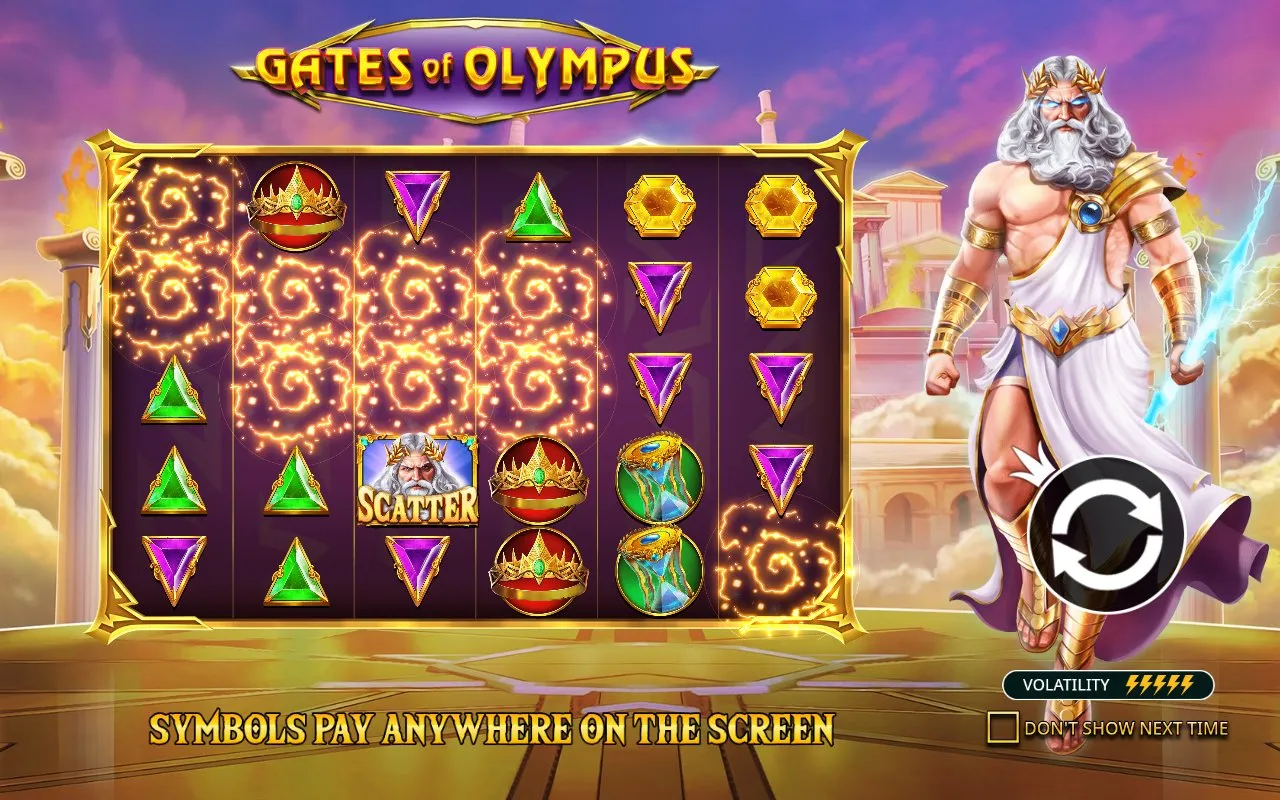
Default demo bet is CAD $2.00. Operators can expose a range from CAD $0.20 up to CAD $100. Spin is the big orange disc in the middle of the control bar. The Bonus Buy button sits on the left panel, and I treat any direct-purchase bonus with the same caution I'd give a credit-card cash advance.
Reading the Paytable
The paytable is steep at the top and shallow at the bottom. That shape changes how the variance feels across a session, so it's worth understanding before the first spin.
Red crown gem sits at the top: 100x the per-symbol bet contribution for a cluster of twelve or more. Three further high-tier symbols come next (blue ornament, purple helmet, purple ornament), then three mid-tier geometric gems (red pentagon, purple triangle, yellow hexagon), and two low-tier pieces (green triangle, blue diamond) at the floor. Zeus himself is a scatter only. Six anywhere pays 100x. Four or more triggers the free spins round.
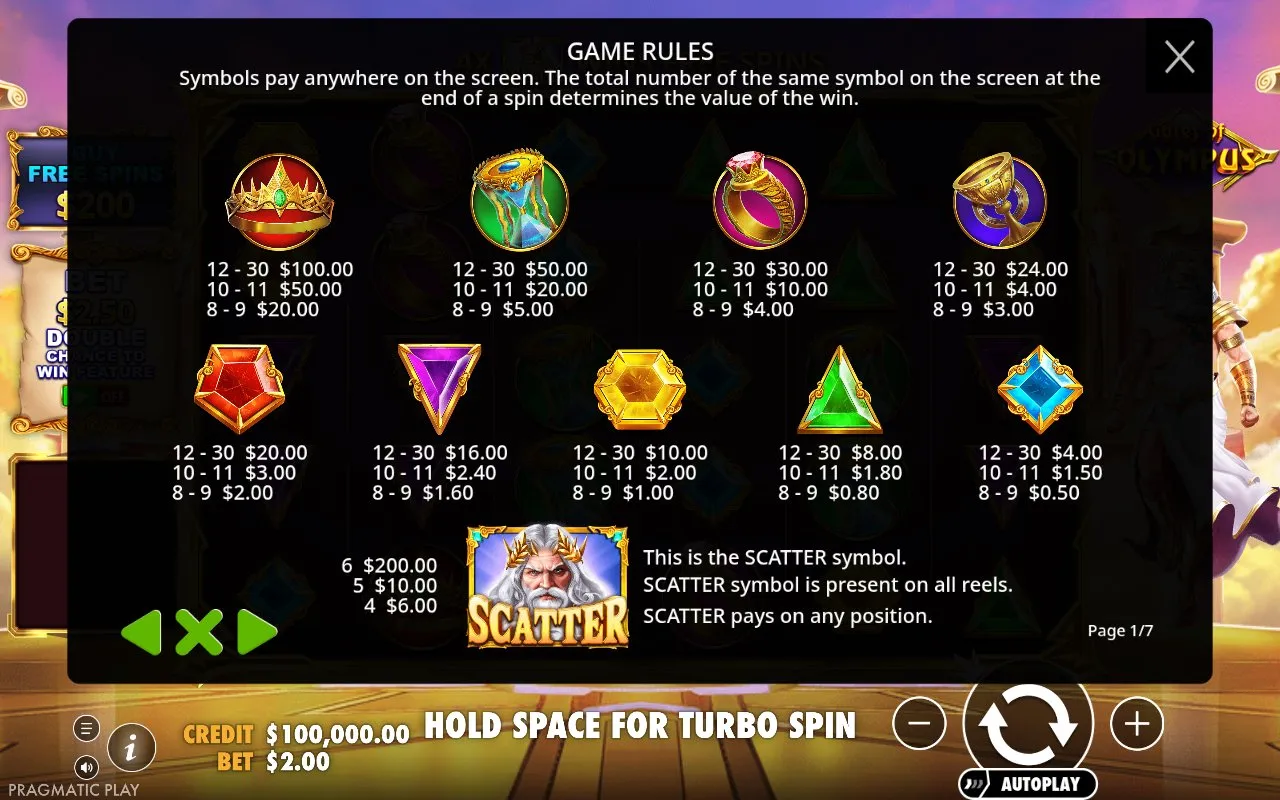
Low-tier clusters of eight or nine pay a small fraction of stake. The floor is around 0.4x. For a paid spin to recover its own cost, you need either a high-tier cluster or a multiplier orb landing on the same tumble. That's why Pragmatic labels the game high variance, and every Pay-Anywhere title they've shipped since runs on the same skeleton.
What Sixty-Two Demo Spins Showed Me
I ran 62 spins at the default CAD $2.00 stake. One hundred twenty-four dollars wagered. The closing balance was CAD $14.14 below opening, which works out to roughly 88.6% return across the sample. That number tells you almost nothing about the long-run RTP. Sixty-two spins on a high-variance title is statistical noise.
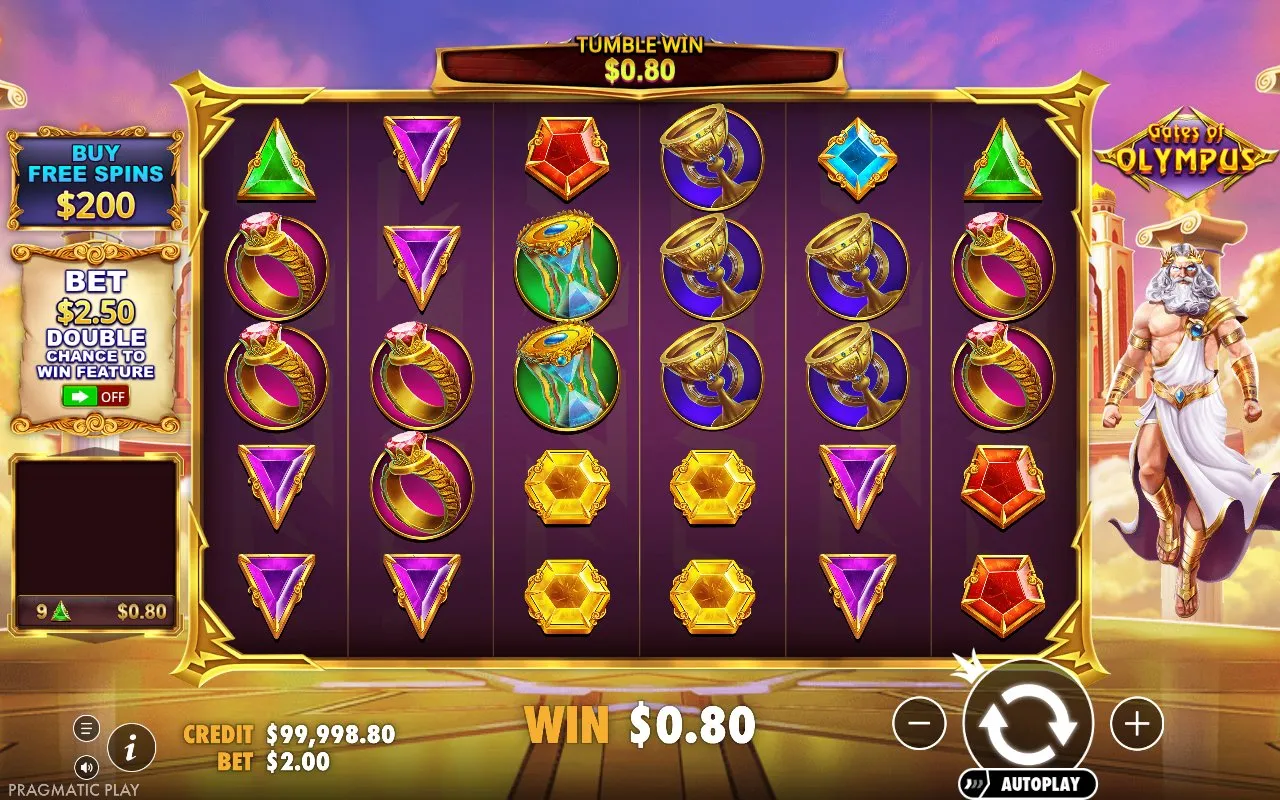
What it shows is the feel of the thing. Two tumble-plus-multiplier events landed inside the run. One came in around the eighth spin, the other somewhere in the back half. Neither was a session-maker. Five to ten times stake on the recovery, enough to cushion the dead spins around them, not enough to put the balance back above water.
Zero organic four-scatter triggers. With the Ante Bet off, free spins land roughly once per 200 to 300 paid spins on the published frequency, so sixty-two spins finding nothing is well inside expectation. You'd need a sample five or six times that size before drawing anything from the absence.
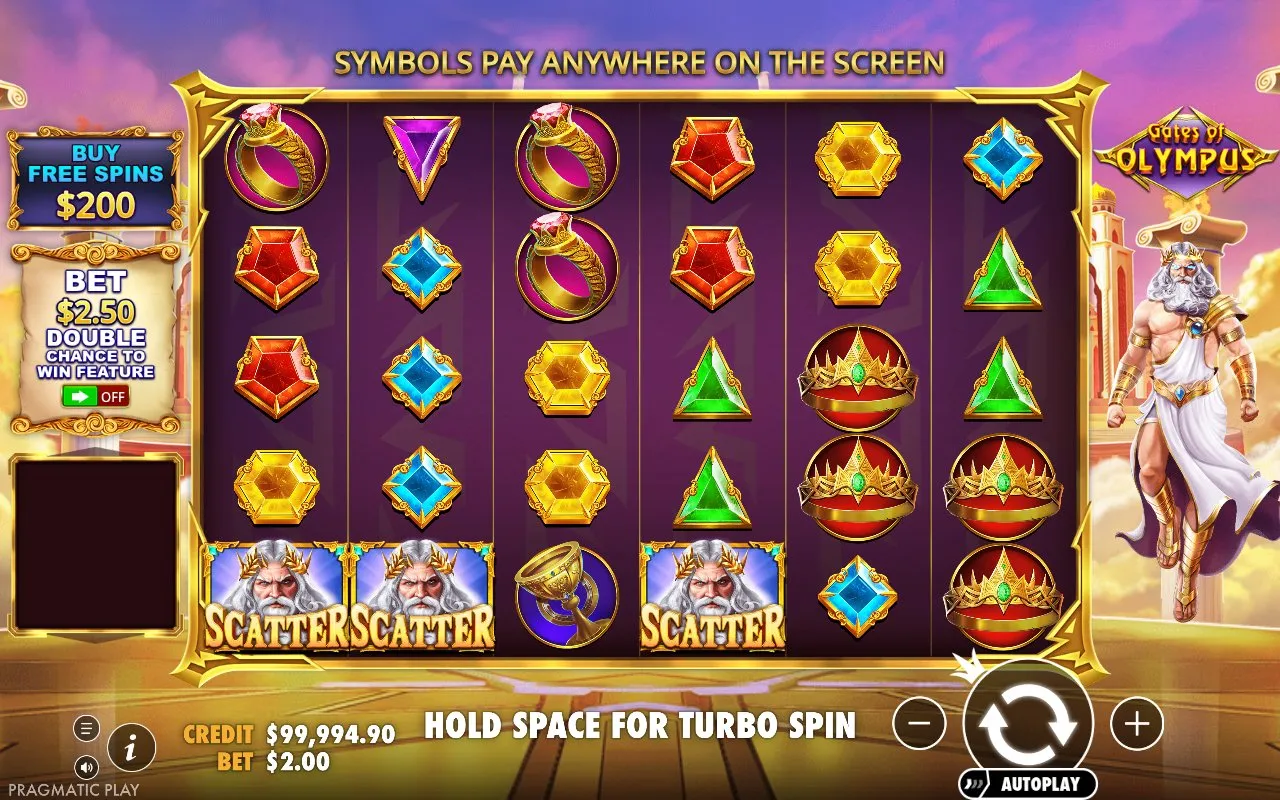
Dry-spell behaviour dominates the base game's texture. If your session bankroll can't soak up 150 to 200 times your base bet without hitting a stop-loss, you'll be out before the multiplier engine has a fair shot at doing its job.
Inside the Free Spins Round
Four Zeus scatters trigger fifteen free spins. The base mechanics carry into the round, with one change that matters. Every multiplier orb that lands on a winning spin is banked into a running total, and the total does not reset between spins. In a productive round, by the back half that figure is sitting anywhere from 20x to 100x. At that point even a low-tier cluster pays a multiple of the trigger stake.
Three more scatters during the round add five spins. The whole thing terminates the moment cumulative wins hit 5,000x stake. That's a hard cap. Anything won past the ceiling is truncated by the engine, which is worth knowing if you ever find yourself in the situation.
Ante Bet and Bonus Buy
Two shortcuts exist. The Ante Bet adds 25% to every paid spin and roughly doubles the four-scatter rate. The math works out close to neutral over a long sample. You pay more per spin, you reach the bonus more often, the expected return stays inside rounding distance of the base game.
The Bonus Buy is a flat purchase of the fifteen-spin round at 100x stake. Pragmatic's published expected return on it sits a hair above 1.0, but the variance is brutal. A non-trivial share of purchased rounds come back under 20x stake. Ontario-regulated operators have to display the buy's certified RTP separately from the base game, and a handful of AGCO licensees disable the buy entirely. Gates of Olympus 1000 raises the max-win ceiling to 15,000x stake but runs on the same engine underneath. Forge of Olympus counts symbols the same way on a 6x5 grid, but its free spins step the orbs through four multiplier levels instead of banking one running total.
Ontario or Offshore: The RTP Question
Pragmatic ships the title to operators on an RTP ladder: 96.50%, 95.51%, and 94.50%, with a 94.00% configuration available in some jurisdictions. Each variant is certified separately by GLI, iTech Labs, or eCOGRA depending on the licensee.
In Ontario, AGCO and iGaming Ontario require licensees to disclose the active configuration in the in-game help file. iGO publishes aggregated population-level returns on top of that. Several AGCO-licensed brands run the 96.50% default. The offshore copy, including the demo embedded on most affiliate sites, will often sit at 95.51% or lower without flagging it on the game tile.
Open the help file before you commit a session. A hundred basis points of RTP compounded over a sustained bankroll is real money.
Gates of Olympus FAQ
- Q: How do I confirm the active RTP on the version I'm about to play?
A: Open the in-game help or rules menu and read the certified return-to-player figure listed there. The number on the casino's marketing page isn't always the number deployed in the live build. On AGCO-licensed sites the disclosed value is binding. - Q: How do the additive multipliers actually resolve?
A: Every orb that lands on the same paid spin sums into a single combined total. That total is applied once to the aggregate win from every cascade in the sequence. Nothing carries to subsequent base spins. - Q: Is the Bonus Buy worth using to reach the free spins?
A: Pragmatic publishes an expected return modestly above 1.0 on the 100x stake purchase. The variance is heavy. A meaningful share of buys come back under half their cost. It's a high-variance staking decision with substantial downside, not a value play. - Q: Does the running free-spins multiplier reset on a dead spin?
A: No. Once an orb is banked, it persists for the rest of the round and applies to any subsequent winning spin. It clears only when the round ends. - Q: What's the max win and how realistically is it reached?
A: The cap is 5,000x stake. To get there you need a free-spins round with the running multiplier climbing north of 100x, then landing on a high-tier cluster. Published hit-frequency data puts the event well below one in 100,000 paid spins. Most players will never see it.