
Mahjong 88 Slot – Free Demo
Provider:
Play'n GO
Winning symbols in Mahjong 88 pay and also charge two meters beside the grid — one fires a random frog effect at 33 symbols, the other multiplies every win by five at 88. The seasonal wilds arrive the other way round, on spins that did not win at all.
Play Mahjong 88 demo
Everything Mahjong 88 does happens in the base game
Mahjong 88 is an 8x8 grid slot with cluster pays. A cluster counts when matching tiles sit horizontally or vertically next to each other, and four is the smallest group that pays. It is playable on all devices, pays in clusters, has no free spins game and revolves around the random Season Wilds. Concealed Tiles, the Fortune Frog, the Super Charge and the Season Bonus all sit in the base game alongside them.
Four adjacent tiles, then the grid refills
Examining the grid, I find mahjong tiles arranged eight by eight. Cluster sizes are stepped, with separate rungs at 4, 5, 6, 7, 8, 9, 10+ and 12+ symbols. Wins are formed by clusters of four or more adjacent tiles, and winning symbols are cleared. Each clear is a cascade, and the refilled grid is checked again for clusters. New symbols fill the spaces, and the Concealed Tiles rotate to be revealed as an adjacent symbol. That makes a concealed tile a way of completing a cluster it happens to be sitting beside.
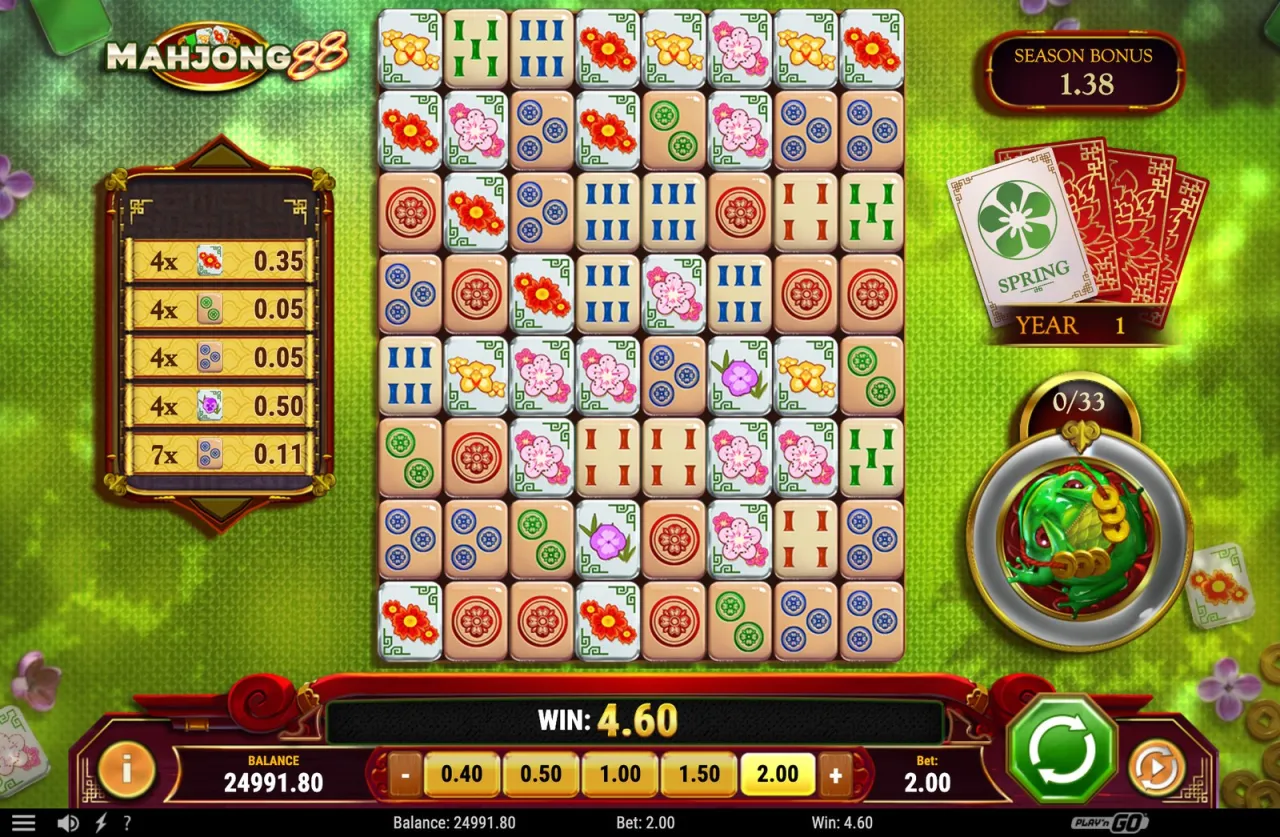
As anticipated, the wild symbol substitutes for all other symbols, and one wild belongs to each season. Which of the four turns up is decided by the season the game is currently running. Spring places up to 12, Autumn up to 11, Summer up to 5 while destroying adjacent symbols, and Winter up to 4, with the wilds remaining in place while they keep winning. Autumn's version turns symbols wild or destroys them from the edges inward, and on the captured frame the season card reads Spring with Year 1 beside it. The game is capped. So the max win is restricted to 5000x.
The frog counts to 33, the Super Charge to 88
This slot arrives with a feature named the Fortune Frog, which charges on winning symbols. The captured frame has the meter sitting at 0/33, so the panel shows the count as it fills. It triggers after wins on 33 symbols. Because the meter counts symbols rather than spins, a single cascading round can move it a long way. At that point one of Croak, Spawn, Tongue or Hop is selected at random. Croak pays one symbol set as a scatter, Spawn turns one symbol set into another, Tongue picks two edges and transforms everything between them, and Hop picks one symbol, transforming it and destroying the symbols next to it.
The same charging powers the Super Charge. Its target is 88 symbols against the frog's 33, so it is the slower of the two to fill. That triggers at 88 symbols and multiplies all wins by 5, and running beneath both is the Season Bonus, shifting from Spring to Summer to Autumn to Winter. The change of season is random rather than scheduled. The pot grows by 10% of symbol win amounts and is granted when the season shifts. On the captured frame the pot reads 1.38 credits.
Our Minty Verdict: Mahjong 88 keeps its two charging meters, its four seasonal wilds and the Season Bonus pot in the base game, and the pot only pays when the season turns. Across 320 spins at a 2.00 stake I got 261.20 back from 640.00 wagered, with 38 of the 77 paying spins landing below the stake.
320 spins at a 2.00 stake
The core of the game is the Season Wilds. They trigger on non-winning spins, and the round continues from there. The captured frame shows a 4.60 win being paid at a bet of 2.00, with the balance at 24,991.80 credits.
Mahjong 88 is not the most powerful game out there. My balance opened at 25,000.00 and closed at 24,621.20. The payouts are relatively modest, and across 320 spins at a 2.00 stake I received 261.20 back from 640.00 wagered, a 40.8% return. The high point arrived early, at 25,037.80 on spin 42. There were only 77 paying spins and 38 of those under the stake. The best of them was 19x on spin 24, and a dry run of 19 spins concluded on spin 218. Spin 42 paid 34.00 and spin 33 paid 18.80, the two next largest of the run.