Reactoonz 2 Slot – Free Demo
Added: Mar 30, 2026
Provider:
Play'n GO
Reactoonz 2 is Play'n GO's sequel to one of the most mechanically distinct cluster slots ever built — a 7x7 grid wired with cascading wins, dual progression meters, and a wild escalation system that can turn a single paid spin into a chain reaction of Electric Wilds, Energoon drops, and Gargantoon…
Play Reactoonz 2 demo
How Reactoonz 2 Actually Works
Play'n GO didn't rebuild Reactoonz — they bolted a second engine onto it. Reactoonz 2 runs on the same 7x7 Cluster Pays grid as its predecessor, but now drives two stacked progression meters simultaneously: the Fluctometer, which charges off a randomly selected alien symbol appearing in winning clusters, and the Quantumeter, which escalates when Electric Wilds clear non-wild symbols. The two meters feed each other in sequence, and when they align with a long cascade chain, the result stops being a slot spin and starts being a controlled demolition.
This is not a game you read correctly in the first five minutes. The feature ladder — Electric Wilds upgrading into Energoons, Energoons giving way to Gargantoons, Gargantoons splitting into cascading wild blocks, the Quantumeter's overcharge state applying an x2 multiplier to the whole sequence — takes time to internalize. That complexity is precisely the point. Reactoonz 2 rewards mechanical literacy, and the demo exists for a reason.
Visual Design: Style That Serves the Grid
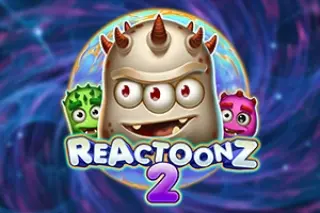
The alien aesthetic carries over from the original: expressive one-eyed creatures, electric color palette, effects that escalate audibly and visually as cascades compound. It looks playful without being juvenile, and crucially, it stays readable. When the board is mid-chain — Gargantoon splitting, wilds cascading, meters ticking — you can still track what's happening without pausing the session. That's a design problem many cluster slots fail. Reactoonz 2 doesn't.
The information hierarchy is clean: charged wilds look different from uncharged wilds, meter states are visually distinct, and the arrival of larger block symbols is hard to miss. Clarity in a complex game is a genuine achievement. It's doing real work here.
Reactoonz 2 Grid Structure and Base Game
Wins require a minimum cluster of five matching symbols connected horizontally or vertically — no paylines, no adjacency bias. Winning symbols disappear, the board collapses, and new symbols fall. That cascade engine is the foundation everything else is built on.
What distinguishes the base game is the fluctuating alien: a randomly selected symbol type assigned each spin. When that symbol appears in a winning cluster, it charges the Fluctometer. Charged Fluctometer positions convert uncharged wilds into Electric Wilds. Electric Wilds, in turn, feed the Quantumeter when they help clear non-wild winning symbols. In plain terms: ordinary spins aren't just hit-or-miss. Every cluster win involving the fluctuating symbol is doing infrastructure work, and even modest returns have a function beyond their face value.
There are no fixed paylines to track, no locked symbols, no coin-collection grid. Progress is purely kinetic — driven by symbol removal, board shape, and cascading drops. It rewards players who think in terms of grid state rather than scatter count.
The Dual-Meter System: Where Sessions Are Won or Lost
Fluctometer and Electric Wilds
The Fluctometer's charged positions trigger wild upgrades: uncharged wilds on the grid become Electric Wilds, which do significantly more than substitute. They remove additional symbols on the board, reshape the grid, and generate the Quantumeter charge needed to unlock the upper feature tiers. Without Electric Wilds firing consistently, the Quantumeter barely moves. The Fluctometer is the ignition system for everything above it — not a secondary consideration.
Quantumeter: Energoons, Gargantoons, and Overcharge
The Quantumeter builds when Electric Wilds clear non-wild winning symbols. As it climbs through its segments, it releases increasingly disruptive rewards:
- Lower tiers spawn Energoon Wilds — single wild symbols placed onto the grid.
- Higher tiers introduce the Gargantoon — an oversized block wild occupying multiple grid positions simultaneously.
- After cascades, the Gargantoon splits into smaller wild blocks, extending the sequence and keeping substitution power active across more positions.
- The Overcharge state at the Quantumeter's peak applies an x2 multiplier to all wins within the remaining cascade chain.
There is no separate free spins screen. The entire feature ladder runs inside the same paid spin, compounding through the cascade engine. One exceptional drop — where the grid keeps refreshing, Electric Wilds stay relevant, and the Quantumeter crests into Gargantoon and Overcharge territory — is where the max win range lives.
Wild Pair Explosion
When Electric Wilds land in qualifying adjacent positions, a Wild Pair Explosion triggers, clearing additional non-wild symbols from the board. This creates fresh drop space mid-cascade and can re-ignite a chain that was losing momentum. It's not a guaranteed sequence extender, but in high-activity spins it frequently becomes the mechanism that keeps the Quantumeter climbing between cascade rounds.
Reactoonz 2 RTP, Volatility, and Max Win
The main published RTP is 96.20%. Operator-adjusted lower configurations exist at 94.20%, 91.20%, 87.20%, and 84.20% — always check which tier your casino actually runs before committing a session budget. Volatility is high. The return profile is back-loaded: base-game clusters deliver modest, frequent hits; the real math weight sits inside feature-escalated sequences where Electric Wilds, Gargantoon placement, and the Overcharge multiplier compound inside one extended cascade chain.
The maximum win is 5,083× bet. No progressive jackpot, no bonus wheel — the ceiling is reached through the grid's own cascading logic. That figure requires an alignment of cascades, meter progression, and Overcharge that isn't engineered to happen regularly. Sessions are streaky by design: long stretches of unremarkable cluster activity punctuated by occasional violent bursts when the meter system fires in the right sequence. Budget accordingly.
Mobile Performance and Demo Play
The 7x7 grid scales cleanly to mobile. Symbols are bold, meter states remain legible at smaller sizes, and cascade effects stay visually clear without becoming unreadable clutter. The game's complexity doesn't degrade on a phone screen — that's a higher bar than it sounds for a slot running this many simultaneous layers.
The demo is not optional courtesy — it's the correct starting point. The first session in Reactoonz 2 without context will look like colorful noise. The fluctuating alien selection, the two-meter interaction, the difference between an Energoon and a Gargantoon sequence — these need a few free-play rounds to internalize. Players who skip straight to cash play are paying a tuition fee that doesn't have to exist.
Minty's Expert Conclusion: Two meters, seven columns, and one relentlessly patient grid that will drain your bankroll with cheerful alien expressions and busy-nothing cascades until the stars align. The recurring stretch where Electric Wilds spawn just often enough to tease the Quantumeter without ever cresting into Gargantoon territory is what keeps most sessions firmly in the "mathematically humbling" category. The ceiling is real, the escalation is genuinely satisfying when it fires, and the dual-meter design is the most coherent Play'n GO has shipped. But coherent math is still violent math. Approach with a bankroll designed for swings, not smooth returns.
Reactoonz 2 FAQ
-
Q: Can operators change the RTP, and by how much?
A: The default configuration returns 96.20% over the long run. Operators can dial this down to 94.20%, 91.20%, 87.20%, or 84.20%. Check the active RTP in your casino's game info panel before committing a session budget — the gap between 96.20% and 84.20% is not trivial. -
Q: Does Reactoonz 2 have a free spins round or a jackpot?
A: Neither exists in this game. Every escalating feature — Electric Wilds, Energoons, Gargantoons, and the x2 Overcharge multiplier — triggers and resolves entirely within a single paid spin via the cascade and dual-meter engine. The entire session is base game; the features are the game. -
Q: What does it actually take to hit the 5,083× max win?
A: The top payout requires an extended cascade chain where both meters activate in sequence, Gargantoon wilds remain on the grid through multiple collapse rounds, and the Quantumeter's Overcharge state multiplies the closing win sequence. All of that within a single paid spin. It's a legitimate ceiling, not a theoretical rounding exercise — but it's also not something the math is built to deliver frequently. -
Q: What is the practical difference between the Fluctometer and the Quantumeter?
A: They are sequential, not parallel. The Fluctometer charges whenever the randomly designated fluctuating alien lands in a winning cluster, converting dormant wilds into Electric Wilds. The Quantumeter then feeds off those Electric Wilds as they eliminate non-wild symbols — unlocking Energoons, Gargantoons, and finally the x2 Overcharge multiplier. The Fluctometer generates the raw material; the Quantumeter converts it into escalating destruction. One doesn't function meaningfully without the other. -
Q: Is Reactoonz 2 worth playing over the original Reactoonz?
A: Depends on your tolerance for complexity. The original is a cleaner, more immediately readable experience. Reactoonz 2 adds the dual-meter interaction and Wild Pair Explosion, which raise the ceiling but also lengthen the learning curve and push variance higher. If you found the first game too shallow after extended play, the sequel justifies the switch. If you're a casual session player, the added layers may produce more confusion than reward.